

There are about 154,925 barber shops operating in the United States right now, and the count keeps climbing — up 2.2% in a single year. That is a lot of clippers, a lot of chairs, and a lot of owners quietly wondering why a shop that stays busy from open to close somehow still feels tight at the end of the month.
Here is the uncomfortable answer for most of them: the leak is not the rent, the towels, or the guy who no-shows every other Thursday. It is the barber shop POS system sitting on the front counter. The one that came free with a processing contract nobody read. The one that takes a card, prints a receipt, and does absolutely nothing else — while quietly skimming a percentage off every single haircut you sell.
A good barber shop POS system should feel like an extra employee. A bad one feels like a cash register with a monthly bill. If you have never sat down and audited yours, this is your sign.

The Hidden Costs Hiding in Your Barber Shop POS System
Most owners can tell you their rent to the dollar and their processing rate not at all. That is not carelessness — it is by design. Payment statements are written to be skimmed, not read.
The rate you were quoted is not the rate you pay
You were probably sold on a headline number. Two-something percent. Sounds fine. Then the statement arrives with a stack of line items: non-qualified surcharges, batch fees, PCI compliance fees, monthly minimums, statement fees, and an “annual technology fee” that appears once a year like a bad penny.
Run the real math. Take your total fees for the month, divide by your total card volume, and you have your effective rate. Owners who do this for the first time are usually somewhere between 3.2% and 4.1% — not the 2.6% they think they are paying. On a shop doing $30,000 a month in card sales, that gap is roughly $400 a month walking out the door. That is a chair’s worth of profit, gone, every month, forever.
If that number surprises you, our breakdown of credit card processing fees walks through every line item you are likely staring at.
“Free” hardware is the most expensive hardware
The free terminal is never free. It is financed by a longer contract, a higher rate, or an equipment lease with an early-termination clause that would make a gym membership blush. Some of those leases run 48 months and are non-cancellable even if you close the shop.
Before you sign anything, ask two questions: Do I own this hardware outright? And what does it cost me to walk away? If the answer to either one makes the rep shift in his seat, you have learned something.
The cost that never shows up on a statement
The biggest expense of a bad barber shop POS system is not on any invoice. It is the fifteen minutes at close spent reconciling tips by hand. It is the walk-in you turned away because nobody could see the schedule. It is the regular who moved to the shop down the street because they book online now and you still take appointments on a wall calendar.
None of that appears on a statement. All of it appears in your revenue.
What a Barber Shop POS System Actually Needs to Do
Barbershops are not retail stores, and they are not restaurants. The workflow is genuinely its own thing: appointments, walk-ins, individual barbers with individual books, tips split a dozen different ways, retail product on the back wall, and a checkout that has to happen in under thirty seconds because the next guy is already in the chair.
Here is what a barber shop POS system actually has to handle.
Booking that lives in the same place as payment
If your calendar and your card reader are two different systems that do not talk, you are doing double entry every single day. A modern setup keeps the appointment, the client, the service, and the payment in one record. When a client books online, the slot closes. When they check out, the ticket is already built.
Online booking is not a nice-to-have anymore. Clients expect to book a fade at 11 p.m. from their couch without calling anyone. Shops that make that easy fill more chairs.
Tips and payouts that do not require a calculator
Tips are the single most common reason barbershop owners hate their POS. Card tips have to be tracked per barber, per shift, and paid out correctly — whether your barbers are W-2 employees on commission, booth renters, or some hybrid you invented three years ago and have been maintaining by memory ever since.
A proper system tracks tips at the item level, reports them by employee, and produces a payout sheet you can actually hand to someone. Our employee management tools handle clock-in, shift tracking, and permissions so a barber can run their own tickets without seeing your whole business.
Client history at the chair
“The usual” is a business model. A POS that stores the last cut, the guard number, the product they bought, and the note that says do not use the citrus stuff, he hates it turns a good haircut into a relationship. That is the entire game in a shop where the average client visits eight to twelve times a year.
Retail that does not get forgotten
Pomade, beard oil, and clipper guards carry margins that services can only dream of. But they only sell if they are in the system, tracked in inventory, and one tap away at checkout. Shops that treat retail as an afterthought leave real money on the shelf — literally.
Chair Rent, Commission, and the Payout Headache
This is the part nobody warns you about when you open a shop.
If every barber in your building is an independent booth renter with their own Square account, you are not running a barbershop — you are running a co-working space with sinks. The client’s card goes to whoever cut their hair, your retail sales get muddy, and you have no visibility into what your own business actually did last week.
If everyone runs through the house, you own the client relationship and the data, but now you are responsible for splitting revenue correctly, every day, without arguments.

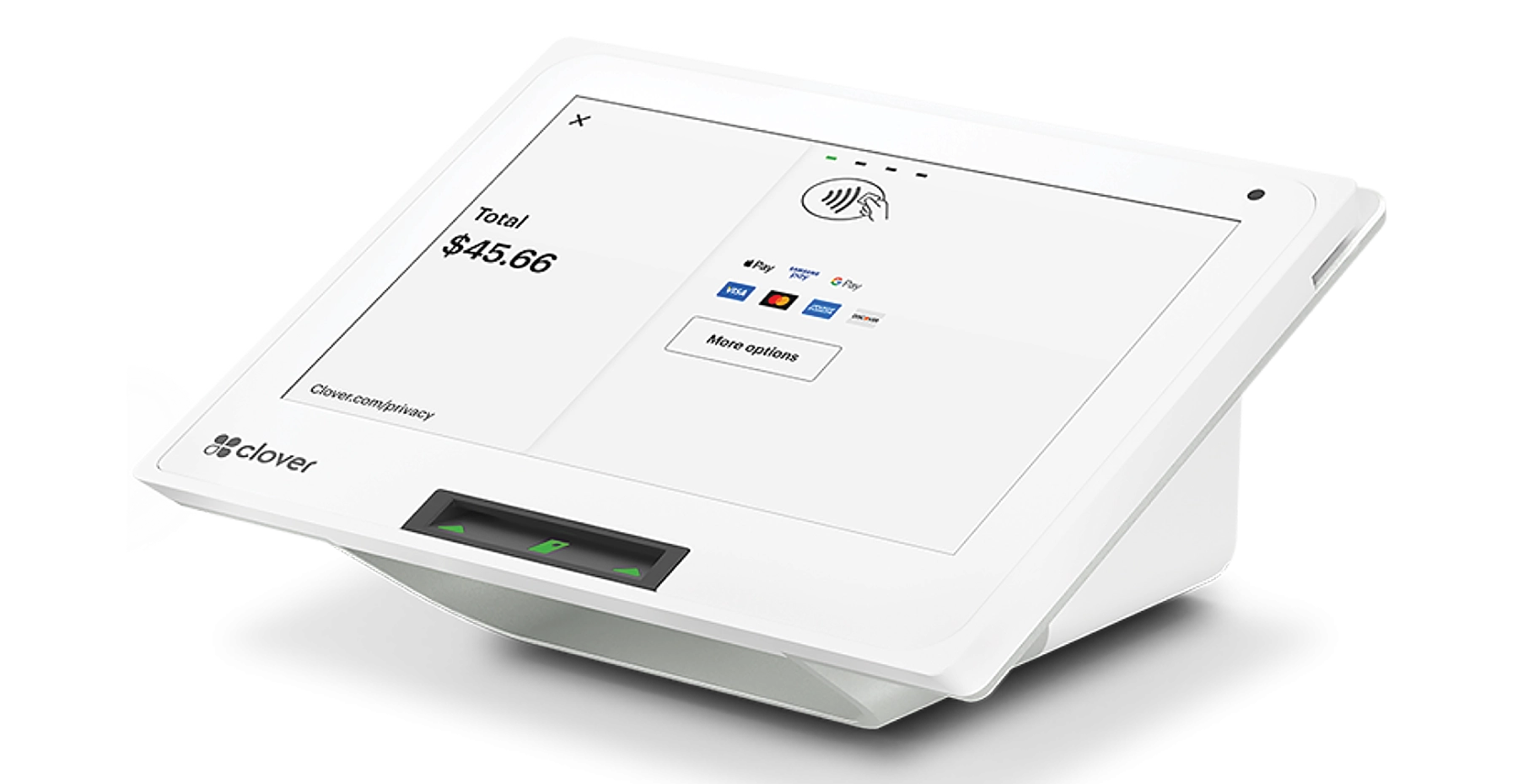
The right answer depends on your model, but the right barber shop POS system is the same either way: one system, multiple operators, clean per-barber reporting. Devices like the Clover Mini at the front desk paired with a handheld Clover Flex for chair-side checkout let each barber ring their own client without anyone crowding the counter. Every ticket is tagged to the barber who did the work, so the end-of-week split is a report, not a negotiation.
If you are not sure which hardware fits your floor plan, our full lineup of POS devices for small businesses lays out the options side by side.
Ready to stop overpaying on every haircut?
VMS sets up barbershops with honest processing, real Clover hardware, and per-barber reporting — usually live in a few days.
Or call our team: 888-902-6227
Cutting Card Fees Without Cutting Corners
Now the fun part — the one that actually moves your margin.
The barbershop industry runs on a 10–15% net profit margin. When your effective processing rate is 3.5%, card fees are eating roughly a quarter to a third of your entire profit. Not your revenue. Your profit. Fix that one number and you have given yourself a raise without raising a single price.
Get honest pricing. Interchange-plus pricing shows you the actual cost of the card plus a fixed markup, instead of burying everything in tiers. It is less convenient for the processor and much better for you.
Take the cost out of the equation. Zero Fee Processing lets you offset the cost of card acceptance so the fee stops coming out of your margin. Clients who pay cash get the lower price; clients who tap a card cover the convenience they chose. It is transparent, it is legal in most states when implemented correctly, and it is the fastest way for a small shop to reclaim thousands of dollars a year.
Just make sure whoever sets it up handles the signage and disclosure requirements properly — that part is not optional, and a sloppy rollout is how shops end up with confused clients at the register.
Stop paying for things you do not use. Gateway fees for a gateway you never turned on. PCI “non-compliance” fees because nobody ever filled out the questionnaire. A second terminal in the back that has not taken a payment since 2023. Audit the list.
A quick word on cash
Cash is not dead in barbershops — it is one of the last strongholds. But it is shrinking every year, and younger clients increasingly show up with nothing but a phone. A shop that can only take cash or only take cards is turning away business at the door. Take everything: tap, dip, swipe, digital wallet, and cash. Then make sure your barber shop POS system reconciles all of it in one place at close.
How to Switch Without Losing a Single Day of Business
The number one reason owners stay in a bad contract is fear of the transition. Fair. You cannot close for a week to learn new software. In practice, a well-run switch takes about a day of setup and a slow Tuesday to get comfortable. Here is the order of operations.
1. Pull your last three statements. Not one — three. You need to see the fees that only hit quarterly or annually. This is also what any honest provider will ask for before quoting you, because without it they are guessing.
2. Find your exit. Check for an early termination fee and, separately, for an equipment lease. They are two different contracts and people constantly assume canceling one cancels the other. It does not.
3. Get your data out. Client list, service menu, pricing, and appointment history. Any system worth using will import it. Any system that will not let you export it is telling you something about how it plans to keep you.
4. Run parallel for a few days. Keep the old terminal plugged in and live while the new one takes real transactions. Belt and suspenders. Nobody has ever regretted this.
5. Train on a slow shift. Not Saturday morning. Pick your quietest window, run every barber through a full ticket — service, retail add-on, tip, split — and let them make mistakes when there is no line.
6. Tell your regulars. A sign at the desk and a text blast that says “we’ve upgraded, booking online now lives here” turns a back-office change into a marketing moment.
If you have questions about how any of this works in practice, our merchant services FAQs cover most of what comes up, and our team has walked hundreds of shops through it.
While you are at it: two upgrades worth the ten minutes
Loyalty. A simple “tenth cut is on us” program tracked automatically at checkout does more for retention than any discount you can run. Our loyalty programs plug straight into the terminal, so nobody has to punch a paper card that lives in a wallet and dies in a washing machine.
Working capital. Adding a chair, redoing the storefront, or buying out a partner is a lot easier when funding is tied to your card volume instead of a bank’s mood. Working capital built around your actual daily deposits is worth understanding before you need it, not after.
And if you also run a salon side of the house, the same logic applies — our salon and spa payment solutions are built on the same platform, so one shop with two service lines does not need two systems.
Your Chair Time Is Worth More Than This
You did not open a barbershop to reconcile tip sheets at 8 p.m. or to decode a statement written by someone whose job is to make sure you do not decode it.
The right barber shop POS system pays for itself twice — once in the fees you stop overpaying, and once in the hours you get back. The wrong one takes a small bite out of every haircut you will ever sell, and it never stops.
VMS has been setting up small businesses with honest processing and real POS hardware since 1998. No mystery fees, no four-year equipment leases, no rep who disappears after the install. We will look at your last three statements, tell you exactly what you are actually paying, and show you what the same volume costs on our side — even if the answer is “stay where you are.”
Bring us your statements. We will bring the math.
Have questions about your barber shop POS system?
Fill out the form below and a VMS payment specialist will contact you shortly.