

Here’s a scenario that plays out far too often when people underestimate Clover POS pricing: a small business owner sees a sleek Clover POS system at a trade show, gets a competitive quote on the hardware, signs up — and then spends the next three months confused by charges they never expected. Monthly software subscriptions. Per-transaction fees stacked on top of a flat rate. App marketplace add-ons that quietly renew every month. It adds up fast.
Understanding Clover POS pricing before you commit is one of the smartest financial moves you can make for your business. This guide walks through all five Clover hardware options, the software plans behind each one, the processing fees that determine your real monthly cost, and the hidden charges most sales conversations conveniently skip over.
What Is Clover POS and Why Is Pricing Complicated?
Clover is one of the most widely used point-of-sale systems in the United States, trusted by restaurants, retail shops, salons, food trucks, service businesses, and more. Built on Android hardware manufactured by Fiserv, Clover combines sleek touchscreen terminals with a cloud-based software platform and a built-in app marketplace that extends what your system can do.
It’s a genuinely excellent product — flexible, reliable, and feature-rich. But Clover POS pricing has a layered structure that trips up buyers who only look at the hardware sticker price:
- Hardware cost — one-time purchase (or financed over time)
- Software subscription — monthly fee that varies by business type and features needed
- Payment processing fees — per-transaction rates that depend on your processor, not Clover itself
Get all three working in your favor, and Clover is outstanding value. Focus only on hardware and ignore the other two layers? That’s how people end up frustrated by their first invoice.
Clover POS Pricing: The 5 Hardware Options Explained
Clover builds five primary hardware devices, each designed for different business types and use cases. Choosing the right one upfront saves you money twice: once on the initial purchase, and again by not outgrowing your setup within a year.
1. Clover Go — The Mobile Card Reader
Typical hardware cost: ~$49
Best for: Mobile businesses, market vendors, popup shops, field service providers
Clover Go is the entry point — a compact Bluetooth card reader that pairs with your smartphone. It accepts chip cards, magnetic stripe, and contactless tap-to-pay (Apple Pay, Google Pay, Samsung Pay). The companion app runs on iOS and Android.
If you take payments on the go — at a farmers market, a client’s home, or a food truck window — Clover Go handles it without tying you to a counter. It’s affordable and portable, but it’s a starting point rather than a long-term solution for businesses that grow beyond occasional or supplemental payments.
2. Clover Flex — The Handheld Terminal
Typical hardware cost: ~$599
Best for: Full-service restaurants, tableside payments, line-busting, delivery operations
The Clover Flex is a handheld powerhouse with a built-in thermal receipt printer, barcode scanner, camera, and long battery life. It accepts every payment type including NFC, EMV chip, and magnetic stripe. You can use it as a standalone terminal or as part of a multi-device Clover ecosystem.
Restaurants love the Flex for tableside checkout. Waitstaff bring the terminal directly to the customer, which speeds up table turns and makes tip prompts more natural. Retailers use multiple Flex units to bust checkout lines during peak hours without installing additional fixed terminals.
3. Clover Mini — The Compact Countertop System
Typical hardware cost: ~$799
Best for: Small retail shops, salons, service businesses, quick-service spots with limited counter space
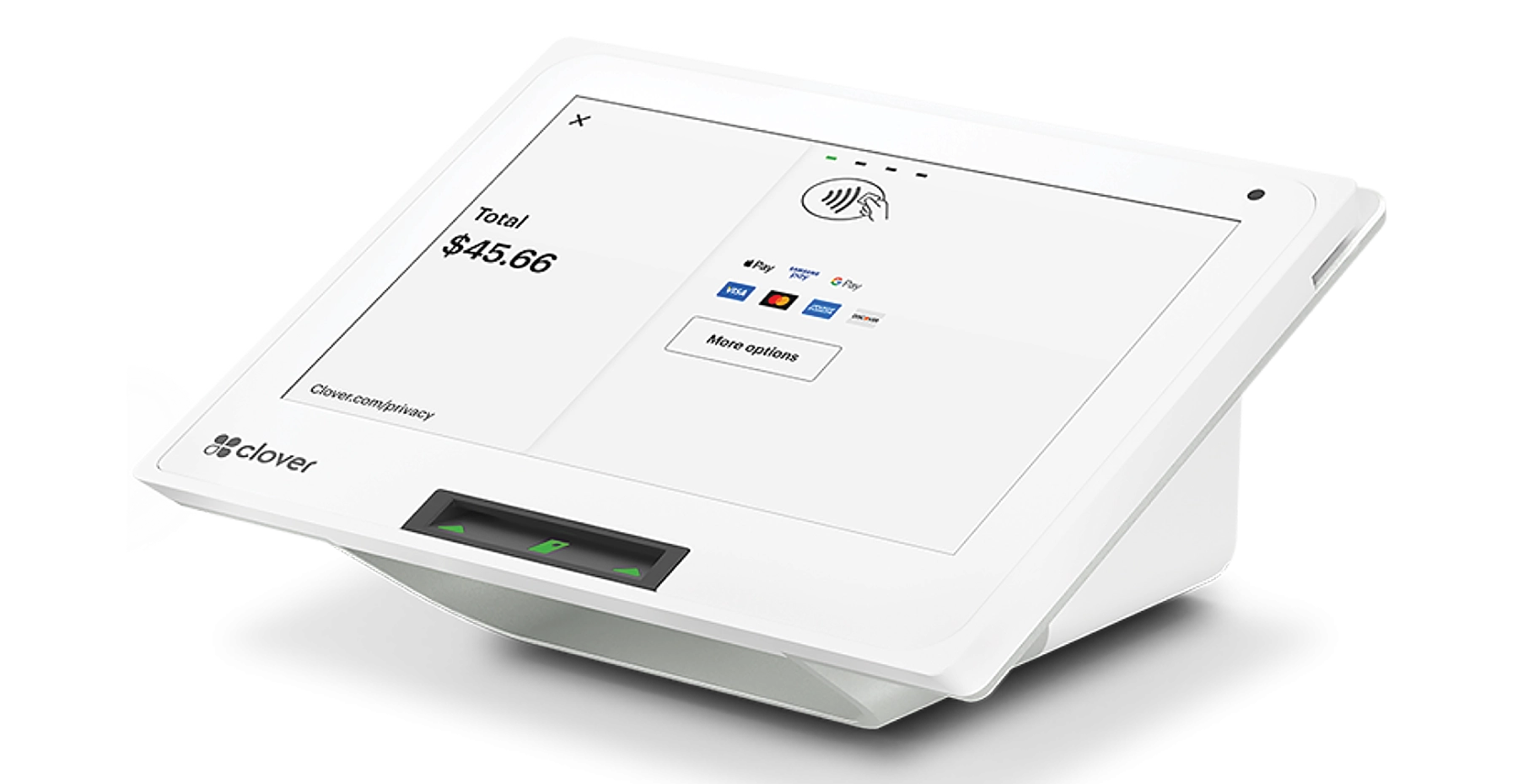
The Clover Mini is a small but complete countertop POS system. It has a 7-inch touchscreen, built-in receipt printer, and full access to the Clover software platform — inventory management, customer loyalty, employee clock-in/out, and reporting — all in a footprint that won’t swallow your counter.
It’s the most popular first step for businesses moving up from a basic card reader. If counter space is limited but you need real POS functionality, the Mini hits the sweet spot.
4. Clover Station Solo — The Full POS Workstation
Typical hardware cost: ~$1,349–$1,499
Best for: Established retail stores, quick-service restaurants, service counters with moderate to high volume
The Clover Station Solo is where Clover becomes a real commercial POS. It features a 14-inch HD touchscreen, a high-speed built-in receipt printer, and deep software integration for inventory, employee management, reporting, and customer engagement. You can connect a cash drawer, barcode scanner, kitchen display, and more.
This is the workhorse for most small-to-medium businesses. A busy retail shop, a growing pizza restaurant, a multi-chair salon — the Station Solo has the processing power and screen real estate to handle serious volume and give you the business intelligence you actually need.
5. Clover Station Duo — With Customer-Facing Display
Typical hardware cost: ~$1,649–$1,799
Best for: Any business where tipping, customer confidence, or checkout transparency matters
The Clover Station Duo adds a second 7-inch customer-facing display to the Station setup. While you manage the order on your screen, the customer sees their itemized total, confirms the amount, selects a tip, and signs — all on their own screen. For restaurants and any business with tipped employees, the Duo pays for itself. Research consistently shows that visible tip prompts increase both the frequency and average amount of tips.
Clover POS Software Plans: The Monthly Fees That Really Add Up
Every Clover device requires an active software subscription to function fully. This is where many buyers get surprised, because Clover restructured its plans in 2024 — the old “Register,” “Counter Service,” and “Table Service” plans are gone. Today you pick a business type first, then a Starter / Standard / Advanced tier within it. The fees run on top of your hardware cost every single month.
- Payments Plan (~$0/month): The bare-bones option. Works only with Clover Go and gives you payment acceptance with basic reporting — no real POS features, no inventory, no employee management. Processing runs 2.6% + 10¢ in-person. Fine if you literally just need to take cards, but most businesses outgrow it within weeks.
- Retail Plans ($14.95–$104.90/month): Three tiers for stores and shops. Starter (~$14.95) covers basic POS and sales tracking. Standard (~$84.95) adds full inventory with variants, customer database, loyalty, and employee permissions. Advanced (~$104.90) layers in advanced reporting, purchase orders, and supplier management — typically bundled with a Station Duo and a Flex handheld. In-person rates drop to 2.5% + 10¢ on Standard and Advanced.
- Quick-Service Dining ($59.95–$89.95/month): Built for cafes, food trucks, coffee shops, and counter-service restaurants. Standard (~$59.95) handles fast-paced order entry, modifiers, and kitchen ticket printing. Advanced (~$89.95) adds stock tracking, order notes, and tighter back-of-house controls. In-person processing runs 2.3% + 10¢ — the best rate Clover offers.
- Full-Service Dining ($89.95+/month): The sit-down restaurant plan. Adds table maps, coursing, split checks, tableside payments, and the service-flow tools full-service dining needs. Standard starts around $89.95/month, with Advanced bundles running $135–$165/month when paired with hardware. Same 2.3% + 10¢ in-person rate.
- Personal Services (~$14.95–$69.95/month): For salons, spas, barbershops, and appointment-based businesses. Adds booking, client history, and staff scheduling on top of standard POS features.
- Professional Services & Home & Field Services (~$14.95–$69.95/month): Newer verticals for consultants, contractors, and mobile service businesses. Heavy emphasis on invoicing, estimates, and mobile payment acceptance via Clover Flex or Go.
One important note: Software fees are per device. If you’re running three Clover Flex units in your restaurant, you’re paying the software subscription fee three times. Build this into your monthly budget before you expand your device count.
Processing Rates: Where Clover POS Pricing Really Lives
Hardware is a one-time cost. Software is a predictable monthly line item. But processing fees are the ongoing expense that compounds with every transaction — and where working with the right payment processor makes a measurable difference to your bottom line.
If you buy Clover hardware directly through Fiserv (Clover’s parent company), you’ll typically be locked into their in-house processing rates:
- Card-present transactions: 2.3% + $0.10 per transaction
- Card-not-present/keyed-in transactions: 3.5% + $0.10 per transaction
Here’s what that means in practice. A retail shop processing $40,000/month in card sales at 2.3% + $0.10 — with roughly 600 transactions — is paying $980 in processing fees every month. Over a year, that’s nearly $12,000 just in processing costs.
Working with an authorized Clover reseller like Velocity Merchant Services changes this equation. VMS can set up your Clover system with interchange-plus Clover POS pricing, which is more transparent and frequently more cost-effective for businesses with moderate to high volume. The Small Business Administration notes that understanding and negotiating your payment processing structure is one of the most important financial decisions a small business can make.
For businesses that want to go further, VMS also offers Zero Fee Processing — a compliant surcharge program that routes card processing costs to card-paying customers rather than the merchant, effectively eliminating processing fees from your expense sheet entirely.
Hidden Clover POS Costs You Need to Know About
The App Marketplace
One of Clover’s genuine strengths is its app marketplace — hundreds of third-party apps for loyalty programs, advanced analytics, online ordering integrations, gift card platforms, scheduling tools, and more. Most of them cost extra, typically $5–$30/month per app. It’s easy to install four or five apps during setup and find yourself paying $80–$120/month in app subscriptions on top of your base software plan. Review your app subscriptions quarterly and remove anything you’re not actively using.
Hardware Warranties
Standard Clover hardware comes with a one-year manufacturer warranty. Extended coverage and replacement programs are available for an additional fee. For high-volume operations where a downed terminal means real lost revenue, this coverage isn’t optional — it’s risk management.
Multi-Location Pricing
Each business location requires its own hardware, software subscription, and processing agreement. There are no automatic multi-location volume discounts in standard Clover POS pricing. If you operate multiple locations, working with an authorized reseller who can negotiate package terms across sites is worth the conversation.
How VMS Gets You the Best Clover POS Pricing
Velocity Merchant Services has been helping small businesses navigate payment processing since 1998 — and as an authorized Clover reseller, VMS bundles hardware, software, and payment processing into a single relationship instead of leaving you to manage three separate vendors.
- One point of contact for hardware questions, software support, and processing issues
- Competitive interchange-plus processing rates built around your actual sales volume
- Zero Fee Processing — a fully compliant solution that eliminates credit card processing fees for your business
- Real human support — VMS is based in Downers Grove, IL, and answers the phone
The right Clover POS pricing isn’t just about what you pay upfront. It’s about your total cost over 24–36 months — hardware, software, processing, and any add-ons — and whether those costs are structured for your specific volume and business type.
Ready to see what Clover POS pricing actually looks like for your business? Contact VMS today — we’ll walk through every cost with you honestly, with no pressure and no hidden fees.
Frequently Asked Questions About Clover POS Pricing
Does Clover charge a monthly fee in addition to hardware?
Yes — every Clover device requires an active software subscription. Plans start at approximately $14.95/month for basic payments and go up to $89.95/month for full-service restaurant features.
Can I use Clover with my own payment processor?
Clover hardware purchased directly through Fiserv is typically locked to Fiserv’s processing. Hardware purchased through an authorized reseller like VMS can be paired with VMS merchant processing, which often delivers meaningfully better rates.
Is Clover worth it for a small business?
For most businesses processing over $5,000/month, Clover’s inventory, reporting, and employee management tools offer strong value beyond basic card readers. The key is getting competitive processing rates — which is where the reseller relationship matters most.
What’s the most affordable way to get started with Clover?
Start with the Clover Go or Clover Mini, choose the software plan that matches your actual needs rather than the most feature-rich option, and work with an authorized reseller to negotiate processing rates before you sign anything.