Devices
Explore Our Point-of-Sale Devices Built For Small Businesses
Running a small business today means more than just ringing up sales. Customers expect fast checkout, flexible payment options, and smooth loyalty experiences every time. That’s where POS devices for small businesses come in.

Receive a $500 statement credit with your new device*
Receive credit
Clover Devices
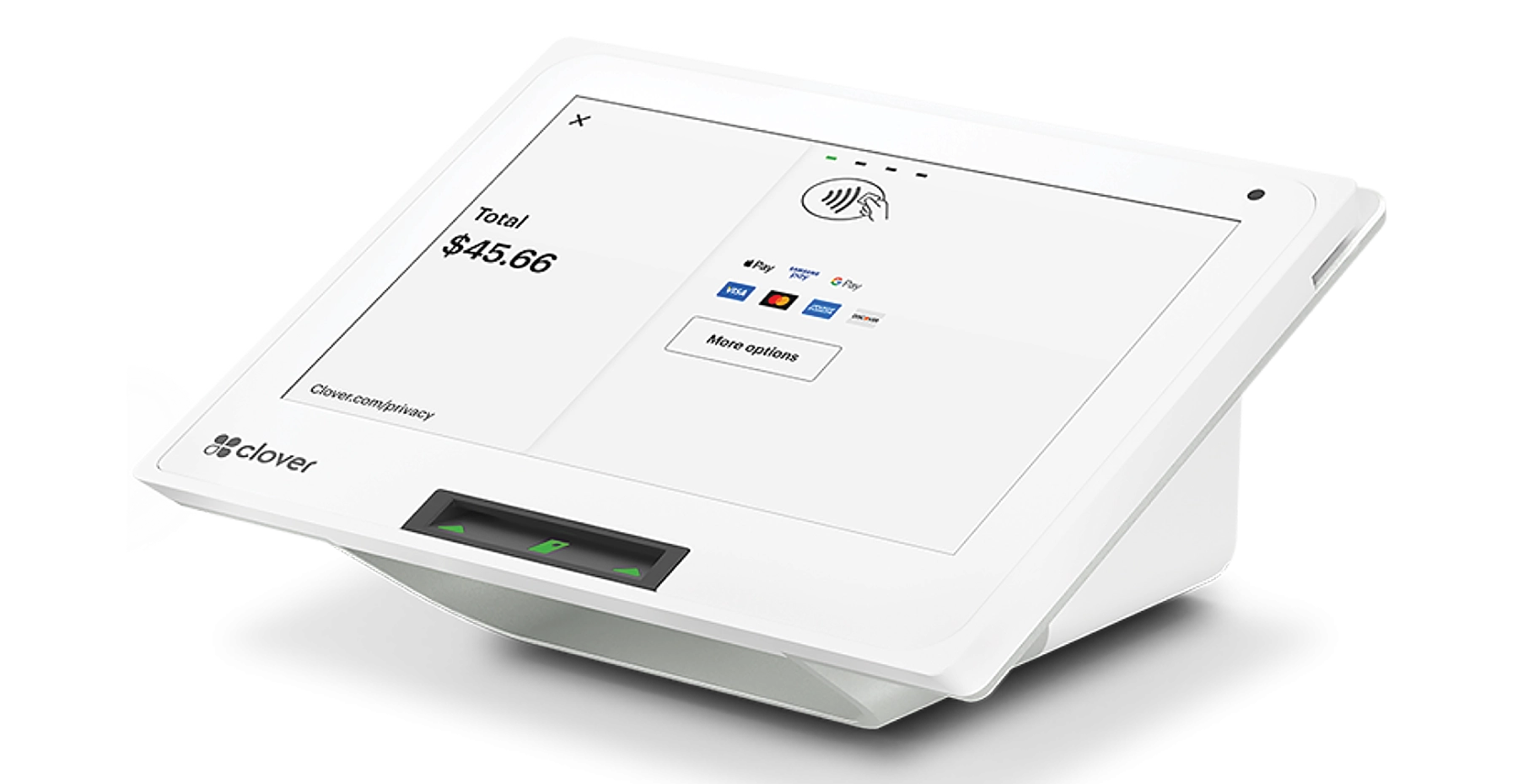
Here at VMS, we recommend Clover because it’s flexible enough to fit nearly any business model. Here’s a look at the main devices:


VMS Devices
VMS offers point-of-sale devices built to help small businesses accept payments faster, manage daily operations easier, and create a smoother checkout experience.


How to Choose a POS Machine for Your Small Business
A POS machine is the device that takes the payment, but the one you pick also decides how you track inventory, run reports, manage staff hours, and get paid. Buying on price alone is the most common and most expensive mistake, because the hardware is usually the smallest line in the total cost.
Four questions settle most decisions:
1. Where does the sale actually happen?
If customers come to a counter, a countertop point of sale machine with a customer-facing display is the right shape. If you take payments at the table, in a truck, at a market stall, or at a job site, you need a handheld that runs on Wi-Fi or LTE. If you do both, a countertop station paired with a handheld covers you without paying for two full systems.
2. How many items do you carry?
A shop with a dozen products can run on almost anything. Once you pass roughly a hundred SKUs, or carry sizes and colors, you want a POS system with real inventory management built in, so stock counts adjust as you sell instead of being reconciled by hand every week.
3. Do you need to accept EBT or SNAP?
Not every POS machine processes EBT, and it is not something you can bolt on later without the right setup. Grocery stores, convenience stores, and gas stations should confirm EBT capability before choosing hardware, along with USDA FNS authorization for the store itself.
4. What does the monthly cost look like at your volume?
Every POS device carries a software plan on top of the hardware, and processing rates sit on top of that. A terminal that looks cheap can cost more over three years than a more capable system on better rates. Ask for the total: hardware, monthly software, and the effective processing rate at your actual monthly volume.
Countertop, Handheld, or Self-Service?
- Countertop stations suit fixed checkout lanes in retail and full-service restaurants. Largest screens, built-in printers, and the best fit for busy lines and multiple staff.
- Handheld and mobile POS machines suit food trucks, markets, delivery, salons, home services, and line-busting during rushes. Lighter, battery powered, and connect over Wi-Fi or LTE.
- Self-service kiosks suit quick-service restaurants and high-volume counters where ordering is the bottleneck. They cut wait times and ease pressure when staffing is short.
- Compact terminals suit small counters where space is tight but you still want full POS capability rather than a bare card reader.
POS Machine FAQs
What is a POS machine?
A POS (point-of-sale) machine is the device that processes a customer payment and records the sale. Modern POS machines do more than take cards: they track inventory, manage employees, produce sales reports, and run apps that extend the system for your industry.
How much does a POS system cost for a small business?
Cost has three parts: the hardware, a monthly software plan per device, and payment processing rates. Hardware ranges from entry-level mobile readers to full countertop stations. Compare the combined monthly total at your real processing volume rather than the sticker price of the device.
What is the difference between a POS machine and a credit card terminal?
A credit card terminal only takes payments. A POS machine takes payments and runs your business: inventory, reporting, staff management, and customer tools. If you only ever need to accept a card, a terminal is enough. If you need to know what sold and what is left, you want a POS system.
Can a POS machine work without internet?
Most need a connection for full functionality, including processing and syncing. Many devices offer offline modes that store transactions and sync when the connection returns, and LTE-capable models keep working when Wi-Fi drops.
Which POS machine is best for a small business?
There is no single best device, only the right match for how you sell. Counter-based retail favors a countertop station; mobile and outdoor businesses favor a handheld; quick-service favors a kiosk paired with a station. Volume, SKU count, and whether you need EBT narrow it quickly.