

Choosing your point-of-sale system is one of those decisions that feels small until you are standing at the counter during a rush, wishing the hardware in your hands worked a little differently. If you have narrowed your shortlist down to two Clover devices, the Clover Flex vs Clover Mini question is a good one to wrestle with, because these two are the workhorses of the Clover lineup and the ones most small businesses actually end up using every day.
The good news is that neither one is a bad choice. They run the same Clover software, accept the same payment types, and sync to the same dashboard. The real question is not which device is “better” in the abstract, but which one matches how your business takes money. Get that match right and the device disappears into your workflow. Get it wrong and you will spend a year working around a piece of hardware that was built for a different kind of shop.
Let us break down the Clover Flex vs Clover Mini decision the way we would if you called our team in Downers Grove and asked us straight up: which one should I get?
Clover Flex vs Clover Mini: The Quick Verdict
Here is the short version before we get into the details. The Clover Flex is a handheld, all-in-one device you carry to the customer. The Clover Mini is a compact countertop terminal the customer comes to. If your business moves around a lot inside your shop — at the table, on the floor, in a truck, or out on a job site — the Flex is usually the answer. If most of your sales happen at a fixed counter with a line of customers, the Mini is usually the answer.
That single distinction — mobile versus fixed — settles the Clover Flex vs Clover Mini debate for most owners in about ten seconds. But a POS is a multi-year commitment, so it is worth understanding what each device actually gives you before you sign anything. The device is only half the picture anyway; the payment processing behind it matters just as much, and that is where a good merchant services partner earns their keep.

Meet the Clover Flex: The Go-Anywhere Handheld
The Clover Flex is a palm-sized POS that packs a touchscreen, a built-in receipt printer, a barcode scanner, and a camera into a single device you can hold in one hand. It runs on WiFi and cellular data, so it keeps taking payments whether you are at the front counter or three blocks away at a pop-up. The battery is built to last a full shift on a charge, which is the whole point of a device you are meant to carry.
What makes the Flex genuinely useful is that it removes the walk. Instead of asking a customer to come to a register, you bring the checkout to them. A server can fire an order and run a card tableside without ever leaving the guest. A boutique owner can close a sale in the fitting-room area. A contractor can collect a deposit on the customer’s porch and hand them a printed or texted receipt on the spot. Fewer trips to the counter means fewer abandoned sales and shorter lines during a rush.
The Flex accepts everything you would expect — swipe, chip, and contactless tap, including phone and watch wallets. Contactless is not a nice-to-have anymore; tap-to-pay has become the default way a huge share of customers reach for their card, and a handheld that takes taps anywhere in your space keeps those fast transactions fast. If you want a deeper look at the hardware itself, our Clover Flex overview walks through the specs and setup.
The trade-off is screen size and stability. A handheld is smaller than a countertop unit, and it is not designed to anchor a busy fixed register with a cash drawer and a customer-facing display. If ninety percent of your day is ringing people up at one spot, a device built to be carried is solving a problem you may not have.
Meet the Clover Mini: The Countertop Workhorse
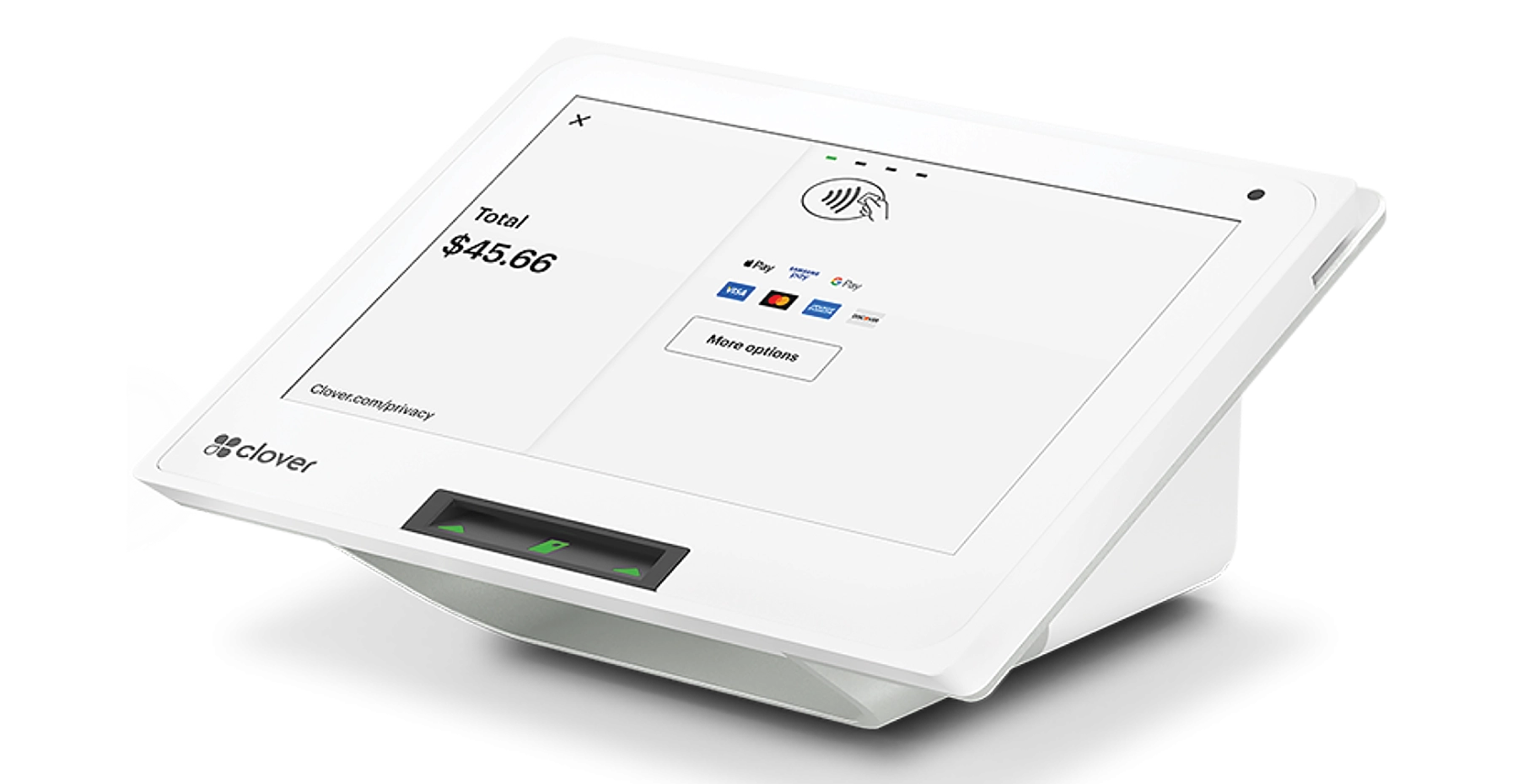
The Clover Mini is exactly what it sounds like — a small but full-strength countertop POS. It has a larger touchscreen than the Flex, a built-in receipt printer, and the muscle to run as the central register for a retail shop, a cafe, or a quick-service counter. You can pair it with a cash drawer, a weight scale, a barcode scanner, and a kitchen printer, so it grows into a complete front-of-house station rather than just a card reader.
Because it sits in one place and plugs into power and internet, the Mini never worries about battery life, and it handles a steady line of customers all day without breaking a sweat. The bigger screen makes it easier for staff to navigate a large menu or a deep inventory, and the customer-facing angle makes tipping, signatures, and contactless taps feel natural at the point of sale. For a fixed counter, that stability and screen real estate is a real advantage.
Like the Flex, the Mini takes swipe, chip, and tap payments and runs the full Clover app ecosystem, so you can add inventory, employee management, and loyalty tools as you grow. If you are curious how it stacks up spec-by-spec, the Clover Mini device page has the full rundown.
The catch is mobility, or the lack of it. The Mini is not meant to leave the counter. If your sales happen at the table, on the sales floor, at the curb, or anywhere other than one fixed spot, a countertop-only device will have you and your customers doing a lot of walking.
Head-to-Head: How the Two Devices Compare
Sometimes it helps to see the Clover Flex vs Clover Mini comparison side by side. Here is how the two line up on the features owners ask about most.
| Feature | Clover Flex | Clover Mini |
|---|---|---|
| Form factor | Handheld, portable | Compact countertop |
| Best for | Tableside, mobile, on-the-go | Fixed counter, steady lines |
| Connectivity | WiFi + cellular data | WiFi + Ethernet |
| Built-in printer | Yes | Yes |
| Battery | Full-shift battery | Plugged in, always on |
| Cash drawer | Not the primary role | Pairs easily |
| Screen size | Smaller, handheld | Larger, counter-friendly |
| Payments accepted | Swipe, chip, tap | Swipe, chip, tap |
Notice what is identical across the two columns. Both run the same Clover software, both take every modern payment type, both print receipts, and both connect to the same reporting dashboard. You are not choosing between a strong device and a weak one. You are choosing between “carry it” and “anchor it.” That is genuinely the heart of the Clover Flex vs Clover Mini choice.
Pricing follows the same logic. Hardware cost and monthly plan depend on your industry, your volume, and the software package you need, which is why we quote it per business rather than off a sticker. You can see how the plans are structured in our guide to Clover POS pricing, and it is worth asking about Zero Fee Processing while you are at it, since offsetting your processing fees can change the math on either device in a hurry.
Which Clover Device Fits Your Business?
Specs are useful, but the honest way to settle the Clover Flex vs Clover Mini question is to picture your actual day. Here is how it usually shakes out by business type.

Choose the Clover Flex if you run a:
- Full-service restaurant or bar where servers close checks at the table. Tableside payment speeds up turns and protects card data, which is why so many full-service restaurants reach for a handheld.
- Food truck, market stall, or pop-up that needs to take payments anywhere with a cellular signal.
- Salon, spa, or service business where you check out clients away from a front desk.
- Contractor or mobile pro collecting deposits and final payments in the field, then texting a receipt before you leave the driveway.
Choose the Clover Mini if you run a:
- Retail shop or boutique with a fixed checkout counter and a cash drawer. A stable countertop station keeps a retail line moving.
- Cafe or quick-service counter where customers order and pay at one spot. Pair it with the tools your quick-service restaurant already relies on.
- Professional office taking scheduled payments at a reception desk.
- Any counter-first business that values a bigger screen and a plug-in device that never runs low on battery.
Still on the fence? Plenty of businesses run both — a Mini anchoring the counter and a Flex or two for line-busting during peak hours or for tableside service. Clover devices sync to the same account, so a mixed fleet reports as one business. If you want a playful nudge, our POS matchmaking quiz pairs your business personality with the right device.
Not sure which Clover is right for you?
VMS matches you to the perfect Clover device, sets it up for how your business actually works, and backs it with fair pricing — often within the week.
Or call our team: 888-902-6227
Do Not Overlook the Processing Behind the Device
Here is the part that gets lost in every Clover Flex vs Clover Mini shootout: the device is the easy decision. The processing rate, the funding speed, the support you get when something goes sideways on a Saturday — those are the things that actually cost or save you money over the life of the account. A gorgeous device on a bad processing contract is still a bad deal.
That is worth taking seriously because payment costs add up fast. According to the National Retail Federation, card swipe fees are one of the largest operating expenses many merchants face, running into the tens of billions across U.S. retail each year, and those fees land squarely on small businesses. The right device paired with the wrong pricing model quietly skims your margin on every sale. The right device paired with transparent pricing and Zero Fee Processing can hand a meaningful chunk of that back.
It also changes how you should think about the upfront hardware question. Owners often obsess over whether the Flex or the Mini costs a little more out of the gate, when the number that really moves over three years is the effective rate you pay on every transaction. A device is a one-time line item; processing is a monthly one, forever. That is exactly backward from how most Clover Flex vs Clover Mini comparisons online frame the decision, and it is why we always start with your volume and your average ticket before we ever talk hardware.
This is also where buying your Clover from a real merchant services partner beats buying a box off a shelf. When you get your Flex or Mini through VMS, you get a team that configures the device for your industry, sets up your menu or inventory, and answers the phone when you need help, plus options like working capital if you want to grow. You are not just buying hardware; you are buying a payments partner who has your back. For more on the full family of devices, our POS devices overview is a good next stop, and our blog is full of tips on getting the most out of your Clover.
The Bottom Line on Clover Flex vs Clover Mini
Strip away the spec sheets and the Clover Flex vs Clover Mini decision comes down to one honest question: do you bring the checkout to the customer, or does the customer come to the checkout? If you move, choose the Flex. If you are anchored to a counter, choose the Mini. If you do both, run both — they play nicely together.
Whatever you pick, the device is only as good as the processing and the people behind it. That is where VMS has been helping small businesses since 1998 — matching owners to the right Clover device, setting it up for the way they actually work, and backing it with fair pricing and real human support. Ready to find your perfect match? Let us help you choose the Clover that fits your business and set it up right the first time.
Have questions about choosing your Clover POS?
Fill out the form below and a VMS payment specialist will contact you shortly.