

Your next great customer might be sitting 5,000 miles away, credit card in hand, ready to buy from you right now. The only question is whether your checkout will actually let them. For a lot of small businesses, the answer is a quiet, expensive “no” — a declined card, a currency they can’t pay in, or a fraud filter that treats every foreign order like a threat. International payment processing is what turns that faraway shopper into a paying customer, and getting it right is one of the fastest ways to grow without spending a dime more on marketing.
Here’s the good news: you don’t need a warehouse in London or a finance team in Singapore to sell across borders. You need the right processing setup, a clear-eyed view of the fees, and a few smart guardrails against fraud. This guide walks you through all three so you can open your doors to the world with confidence instead of crossing your fingers at checkout.
What International Payment Processing Really Means
Let’s clear up a common misconception. International payment processing doesn’t mean you have to open foreign bank accounts or become an importer-exporter. In plain terms, it’s your ability to accept a card that was issued in another country and get paid in your own — smoothly, securely, and without the transaction bouncing.
When a customer in Toronto or Tokyo taps their Visa at your online store, that card rides the same global networks (Visa, Mastercard, American Express, Discover) that your local cards use. The difference is that the issuing bank sits in another country, sometimes in another currency. Your processor’s job is to authorize that charge, handle any currency conversion, apply the correct cross-border fees, and settle the funds into your U.S. account.
Most modern small businesses already brush up against this more than they realize:
- An online shop ships a handmade product to a customer in Australia.
- A consultant invoices a client in Germany for a project.
- A hotel or tour operator takes a deposit from a traveler before they ever land.
- A software or subscription business signs up users from a dozen countries a month.
If any of that sounds like your business — or where you want it to go — then international payment processing isn’t a “someday” feature. It’s a growth lever you can pull now. The U.S. Small Business Administration has long pointed out that the overwhelming majority of the world’s purchasing power sits outside the United States, and its own export guidance for small businesses exists precisely because so many owners leave that demand on the table.
The Hidden Costs Nobody Warns You About
Accepting a card from overseas is not free, and pretending otherwise is how margins quietly evaporate. The good news is that international payment processing costs are predictable once you know what to look for — and predictable costs are ones you can price around.
Here are the extra line items that typically ride along on a cross-border sale:
- International service assessment (ISA). When a foreign-issued card is used at a U.S. merchant, Visa applies an international service assessment of roughly 1% of the transaction. Mastercard and other networks charge their own comparable cross-border fees. It’s small per sale, but it adds up across volume.
- Currency conversion. If you let a customer pay in their home currency, someone has to convert it. That conversion carries a spread, and where it lands on your statement depends entirely on how your processor structures it.
- Higher fraud and chargeback exposure. International orders statistically carry more fraud risk, and more fraud means more chargebacks — each one costing you the sale plus a dispute fee.
None of this should scare you off. A 1% cross-border assessment on a sale you otherwise never would have made is a rounding error compared to the revenue. The mistake isn’t accepting international payments — it’s accepting them blind. If you already feel like domestic fees are a mystery, our breakdown of credit card processing fees is the perfect primer before you layer cross-border costs on top.
Picture it in real numbers. Say you run a specialty coffee-roasting business and a customer in Vancouver orders a $120 gift box. The cross-border assessment might add roughly $1.20, plus your normal processing rate — call it a few dollars total in extra fees. Now compare that to the alternative: your checkout rejects the foreign card, the customer shrugs, and $120 walks out the door forever. Framed that way, the cost of international payment processing looks less like an expense and more like the cheapest sales rep you’ll ever hire.
This is also where your pricing strategy matters. Some owners absorb the extra cost, others build it into their prices, and many use compliant Zero Fee Processing to offset card costs across the board. There’s no single right answer — but there is a wrong one, which is not knowing your numbers at all.

Is Your Business Ready to Sell Globally?
Before you flip the switch, it’s worth a quick gut check. You don’t need every box ticked on day one — but knowing where you stand helps you set up your international payment processing the right way from the start:
- Can you fulfill across borders? Shipping, delivery timelines, and returns look different overseas. Make sure the back half of the sale is as ready as the checkout.
- Have you set clear terms? Spell out currencies, shipping costs, duties, and return policies up front. Clarity here prevents disputes later.
- Is your fraud stack switched on? AVS, CVV, and 3-D Secure should be active before your first international order, not after your first chargeback.
- Do you know your true cost per sale? Fold the cross-border assessment and conversion spread into your pricing so every global sale is a profitable one.
- Who’s your safety net? A responsive processing partner who answers the phone matters even more when a customer is in a different time zone.
Run through that list and you’ll spot exactly where a little prep pays off. Most owners discover they’re closer to ready than they thought — the pieces are already in place, they just haven’t turned them toward the rest of the world yet.
Ready to sell to customers anywhere in the world?
VMS sets up secure international payment processing, dials in your fraud rules, and explains every fee in plain English — often in days, not weeks.
Or call our team: 888-902-6227
How to Accept International Payments Without the Headaches
Now for the part you actually came for: making it work. Setting up international payment processing is far less complicated than most owners fear, and the tools you likely already use can do most of the heavy lifting.
Sell online with a gateway built for the world
If you sell on a website, your payment gateway is the front door for global customers. A capable gateway accepts foreign-issued cards, supports major wallets, and encrypts every transaction end to end. If you haven’t nailed this down yet, start with our guide to choosing a payment gateway for small business — it’s the foundation everything else sits on.
For invoices and phone or email orders from overseas clients, a virtual terminal lets you key in a card from anywhere in the world using nothing but a browser. It’s the unsung hero of B2B and service businesses that land international clients one relationship at a time.
Take cards in person, wherever “in person” happens
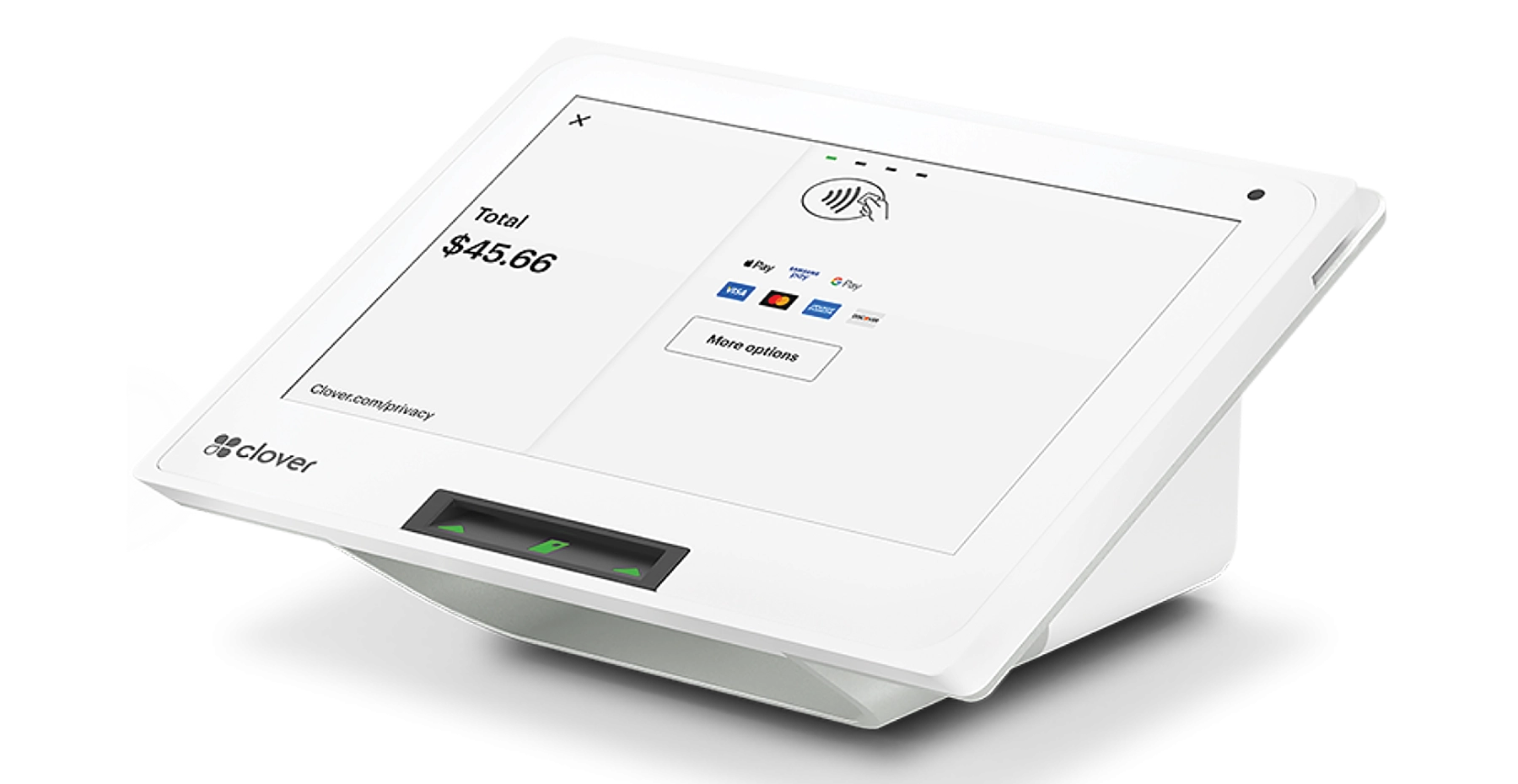
Plenty of international payments happen face to face — think tourists at your shop, a trade-show booth, or a pop-up abroad. A modern countertop or handheld device makes this effortless. A Clover Flex, for example, accepts chip, swipe, and contactless taps from cards issued anywhere, so a visitor from overseas pays exactly the way a local does. Browse the full lineup of POS devices for small businesses to match the hardware to how you actually sell.
Meet customers where they shop
If a chunk of your international demand comes through delivery, pickup, or a digital menu, your online ordering setup should accept global cards right alongside local ones. Every channel where money changes hands is a channel that should welcome an overseas customer, not turn them away.
The theme across all of this: you don’t bolt on a separate “international system.” You choose processing tools that treat a card from Madrid the same as a card from Miami — and let your processor sort out the cross-border details in the background.
Guarding Against Cross-Border Fraud and Chargebacks
Let’s talk about the fear that keeps owners from selling globally in the first place: fraud. It’s a legitimate concern — card-not-present and international orders do carry elevated risk — but the answer is not to slam the door. The answer is to be smart at the checkout.
A few proven guardrails go a long way:
- Turn on address verification (AVS) and CVV checks. Requiring the security code and matching billing details filters out a huge share of stolen-card attempts before they ever clear.
- Use 3-D Secure. This adds an extra identity step (think Visa Secure or Mastercard Identity Check) for online orders and, crucially, shifts liability for many fraudulent chargebacks away from you.
- Set velocity and geography rules. Flag or hold orders that don’t fit normal patterns — ten sign-ups from one card in an hour, or a shipping address that doesn’t match the card’s country.
- Keep spotless records. Clear order confirmations, delivery tracking, and customer communications are your best evidence if a dispute lands.
Fraud prevention and chargeback prevention are two sides of the same coin, and both are absolutely winnable. Our field guide on how to prevent chargebacks goes deep on the tactics that protect your revenue without adding friction for honest buyers. Done right, your international payment processing can actually be safer than a cash-only shop that has no digital trail at all.

Turning Global Reach Into Real Growth
Here’s the mindset shift that separates businesses that dabble in cross-border sales from the ones that scale on them: international payment processing isn’t a cost center to tolerate. It’s a growth engine to feed.
Think about what accepting global cards actually unlocks:
- A bigger addressable market. Every country you can charge is a country you can sell to. That’s more revenue from the same products, the same website, and the same effort.
- Higher-value customers. International B2B clients and destination shoppers often place larger orders. Losing even one to a declined card is a painful, invisible cost.
- A more resilient business. When your customer base spans borders, a slow season in one market can be offset by a strong one somewhere else.
Of course, growth needs fuel. Expanding into new markets — new inventory, new shipping, new marketing — takes cash, and that’s exactly why so many owners pair their global ambitions with flexible working capital to fund the next leg of the journey. The sale is only the beginning; what you do with the momentum is where the real growth lives.
And you don’t have to figure any of it out alone. The right partner sets up your accounts, dials in your fraud rules, explains every fee in plain English, and stays in your corner as you expand. If you’re weighing your options, the merchant services FAQs answer the questions most owners ask before they take the leap.
Your Storefront Is Already Global — Make Sure Your Checkout Is Too
The internet erased the map years ago. Your website is visible in every country on earth the moment you hit publish, which means the only thing standing between you and a worldwide customer base is whether your checkout can take their money. International payment processing is how you say “yes” to that customer in Toronto, that client in Berlin, and that traveler who just found your shop online — instead of watching them click away.
You don’t need to be a giant to sell like one. With the right processing setup, sensible fraud guardrails, and a clear picture of your fees, a small business in Downers Grove can serve customers in Dublin just as easily as ones down the street. VMS has been helping small businesses accept payments the smart way since 1998, and we’d love to help you open your doors to the world. Reach out below and let’s build a checkout with no borders.
Have questions about international payment processing?
Fill out the form below and a VMS payment specialist will contact you shortly.