

If you’re still chasing late payments with phone calls and paper invoices, you’re leaving real money on the table — and burning hours you don’t have. Online invoicing for small business isn’t just about sending cleaner-looking bills. It’s about building a payment system that works in the background while you focus on running your operation.
According to the Federal Reserve’s Small Business Credit Survey, cash flow difficulties remain one of the top financial challenges small businesses face, with slow-paying customers consistently ranking among the leading causes. That’s not a minor inconvenience — it’s revenue you’ve already earned sitting in someone else’s account.
The good news: modern payment processing tools have made online invoicing faster, simpler, and far more professional than the old attach-a-PDF-and-hope method. And if you’re working with a merchant services partner like VMS, you likely already have the tools to fix this — you just need to know how to use them.
Here are five proven ways to put online invoicing to work for your small business and start getting paid on time, every time.
Why Online Invoicing Is a Game-Changer for Small Business Cash Flow
Traditional invoicing — printed PDF, emailed attachment, net-30 terms, and a lot of hoping — was designed for a slower era. Today’s customers expect frictionless payment experiences, and your business needs cash in the bank faster than a month from now.
Online invoicing changes the equation in several key ways:
- Speed. An invoice sent electronically, with a one-click “Pay Now” button embedded, can be paid in minutes. A paper invoice stuffed in a folder can sit for weeks.
- Professionalism. A clean, branded invoice with a clear total and an easy payment method signals that you run a legitimate, organized business. Customers are psychologically more likely to pay promptly when the experience feels polished.
- Fewer disputes. Digital invoices include line-item details, service descriptions, timestamps, and clear payment terms. That eliminates the “I don’t remember what this is for” delay that kills cash flow on vague invoices.
- Real-time tracking. You can see at a glance which invoices are paid, open, or overdue — without maintaining a separate spreadsheet or making awkward follow-up calls.
- Payment flexibility. Customers can pay with credit cards, debit cards, or ACH bank transfers. The more ways they can pay, the faster they actually do.
For service-based businesses — contractors, auto shops, consultants, healthcare providers, salons — online invoicing bridges the gap between delivering a service and collecting payment for it. Whether you’re sending a plumbing invoice by email or texting a payment link to a customer at their door, the goal is the same: remove friction and get paid faster.
5 Proven Ways to Use Online Invoicing for Small Business
1. Send Payment Links by Email and Text
The simplest and most immediate version of online invoicing doesn’t require a dedicated invoicing platform. It just requires a payment link — a shareable URL that takes the customer directly to a secure checkout page where they can pay with a card or bank account in under a minute.
VMS’s virtual terminal for small business lets you generate payment links on the fly, right from your browser or mobile device. After completing a job, you fire off the link by text or email. Your customer clicks it, pays in 60 seconds, and you see funds hit your account within one to two business days.
This approach works especially well for:
- Service businesses billing clients after a site visit
- Remote or out-of-state clients who can’t hand over a card in person
- Recurring customers on a retainer or subscription arrangement
- Any situation where in-person card swipe isn’t practical
The key insight here is simple: you’re meeting your customer where they already are. Most people are far more likely to tap a link on their phone than locate a checkbook, write a check, and mail it. A payment link closes that gap entirely.
2. Accept Credit Cards and ACH Directly on Your Invoice
A great online invoice has exactly one job: remove every possible reason not to pay it right now. That means embedding a payment button that accepts multiple methods — and it means the payment experience must be smooth enough that customers don’t abandon midway through.
Credit cards are typically the fastest route to payment. Most customers have a card in hand or saved on their phone and can complete payment in under 30 seconds. ACH bank transfers take one to two business days to settle but carry lower processing fees, making them ideal for larger invoices or customers who prefer bank-to-bank transfers. If you’ve already explored ACH payment processing for your small business, adding ACH as an invoice payment option is a natural extension of the same system.
Some business owners worry about credit card processing fees eating into their margins, especially on larger invoices. It’s a legitimate concern — a 2.5% to 3% fee on a $2,000 invoice is $50 to $60 off the top. That’s why many VMS clients have switched to Zero Fee Processing, a compliant surcharging program that passes the processing fee to the customer as a small service charge. You receive the full invoice amount, every time, with zero deduction.
3. Set Up Automatic Payment Reminders
The single biggest driver of late invoices isn’t unwillingness to pay — it’s forgetfulness. Your customer got the invoice, fully intended to pay it, got distracted by their own business, and now it’s three weeks past due. This is routine for service businesses, and it’s 100% fixable without a single awkward phone call.
Automated payment reminders send a follow-up message (by email, text, or both) at intervals you control. A common sequence: three days before the due date, on the due date itself, and three days after the due date. Each reminder includes the original invoice details and the payment link. The customer clicks, pays, done.
Business owners who implement automated reminders consistently report a significant drop in average days-to-payment. You’re not hounding anyone — you’re just making it easy for a busy person to do what they already planned to do.
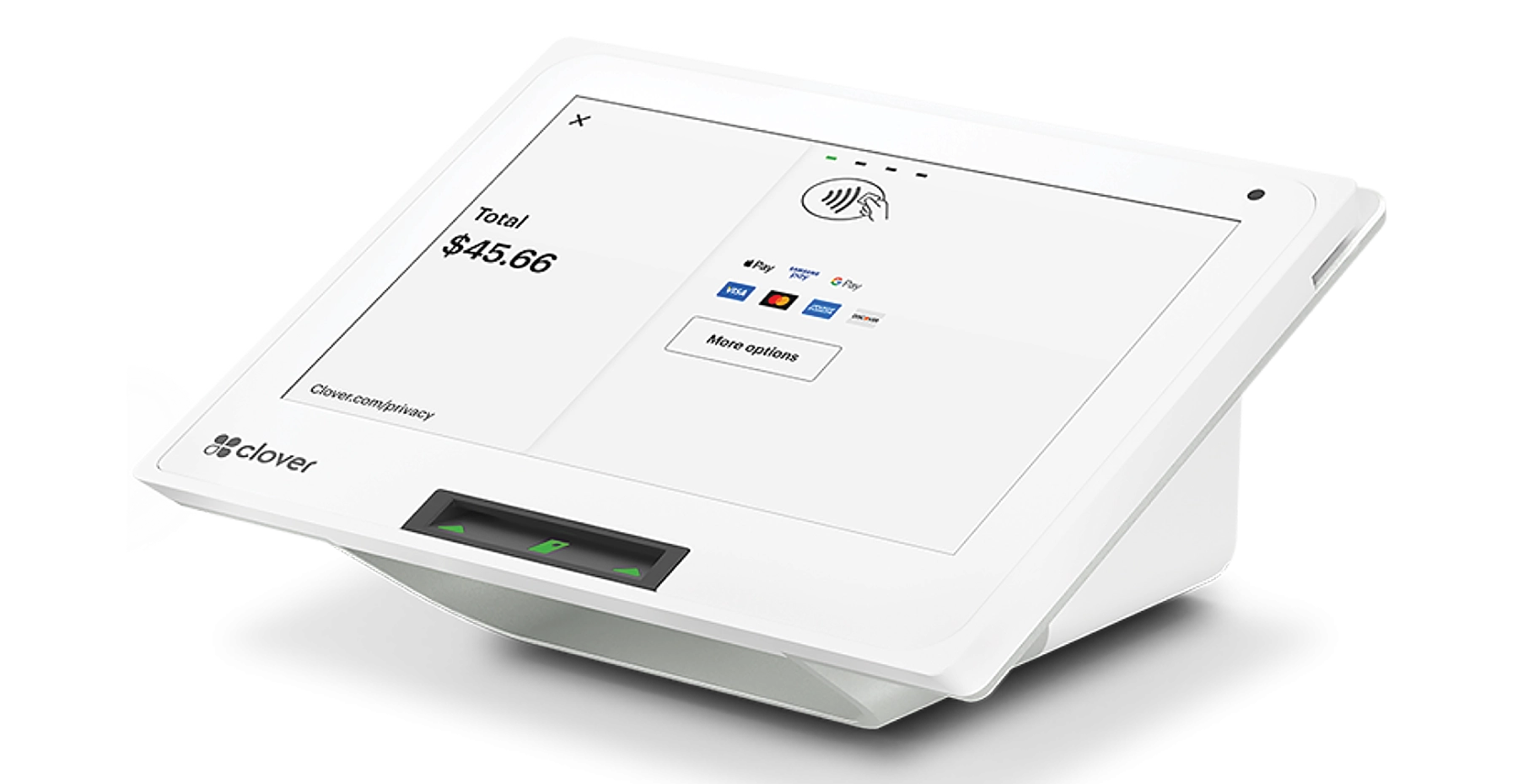
Clover’s invoicing features support automated reminders directly from your dashboard. If you’re running Clover as your primary payment system, you already have this capability built in. And if you’re not yet on Clover, VMS offers a full lineup of POS devices for small businesses that support this kind of automated workflow alongside in-store, online, and mobile payments.
4. Use Your POS System as Your Invoicing Hub
Here’s a mistake many small business owners make: they buy a POS system for in-store transactions and a separate invoicing tool for remote billing, and then wonder why their books are always a mess. Two systems mean two sets of records, two reports to reconcile, and double the learning curve.
Today’s leading POS platforms — Clover in particular — handle invoicing, payment links, recurring billing, and in-person transactions from a single dashboard. All your payment data, customer records, and cash flow reports live in one place. No duplicate entries. No manual reconciliation.
VMS clients who use Clover for both in-store and remote invoicing tell us it’s one of the single biggest time-savers they’ve found. If you’re in a service business that does both on-site work and billed-after-the-fact jobs, consolidating those into one system saves hours every month and gives you a cleaner real-time picture of your receivables.
For businesses that operate in the field — HVAC, landscaping, mobile auto detailing, in-home healthcare — the Clover Flex is worth looking at closely. It’s a handheld device that accepts chip, swipe, tap-to-pay, and contactless in person, and also generates digital receipts and payment links when the customer isn’t present. One device covers both use cases.
5. Integrate Invoicing with Your Working Capital Strategy
This one surprises most small business owners: your invoicing data is financial leverage.
When you use a professional invoicing platform tied to your merchant account, you’re building a documented record of your business’s revenue patterns, average invoice size, typical collection times, and seasonal cash flow swings. That data matters more than most people realize.
Lenders and merchant funding providers look at exactly this kind of data when evaluating working capital offers. Consistent invoicing through your payment processor — rather than sporadic paper or email invoices with no digital record — creates a paper trail that makes it easier to access fast, affordable funding when you need it.
VMS helps eligible clients access working capital based on their actual sales and payment history. Whether it’s for a large equipment purchase, a seasonal inventory buildup, or an unexpected business expense, having clean invoicing records tied to your merchant account strengthens your position significantly. Businesses that invoice consistently and collect promptly look like lower-risk borrowers — because they are.
Common Invoicing Mistakes That Cost Small Business Owners Real Money
Even businesses that have made the jump to online invoicing often leak cash through a handful of avoidable errors:
Vague payment terms. “Due upon receipt” means different things to different people. Some customers read it as “pay now”; others interpret it as net-30 or whenever they get around to it. Be explicit: “Payment due within 7 days. A 1.5% monthly late fee applies to balances outstanding beyond 14 days.” Specificity creates urgency.
Limiting customers to one payment method. Every additional hurdle between your customer and the “pay” button increases the chance they’ll delay. If they don’t have a check handy, they should be able to pay by card. If they prefer bank transfer, that option should be there too.
Waiting to send invoices. The psychological research here is consistent: the longer you wait after delivering a service to send an invoice, the lower the perceived urgency to pay it. Invoice the same day the work is done. Every day you wait gives the customer more distance from the value you delivered.
Using an unbranded or generic template. A plain-text email saying “you owe me $450” looks like a scam to some customers. An invoice with your business name, logo, contact information, and itemized services looks legitimate — and gets paid faster.
Not following up on overdue invoices. Silence doesn’t create urgency. If an invoice goes three days past due with no follow-up, the customer may assume you forgot. Automated reminders or a brief manual follow-up message close this loop quickly and professionally.
How VMS Makes Online Invoicing Simple for Small Businesses
VMS has been helping small businesses accept payments since 1998. The difference between VMS and a generic invoicing software platform is this: VMS doesn’t just hand you a tool and walk away. The team works directly with your business to build a complete payment workflow — invoicing, in-person, online, and remote — that actually fits how you operate.
Through Clover POS and virtual terminal solutions, VMS clients get seamless invoicing with embedded payment links, competitive processing rates or full Zero Fee Processing to eliminate fees, next-day and same-day deposit options, and direct support from a team that knows small business payment processing inside and out.
Visit VMS’s Merchant Services FAQs to learn how the setup process works, or check out the Payment Processing for Professionals page to see how VMS serves service-based businesses specifically.
Selling beyond the counter?
VMS sets up online ordering, payment links, and digital invoicing that sync with your in-store system — one place to track every sale.
Or call our team: 888-902-6227
Ready to Get Paid Faster?
The bottom line: businesses that get serious about online invoicing stop chasing money and start managing it. Whether you’re invoicing one client a week or fifty, the right payment system turns your outstanding balances into a predictable, manageable pipeline instead of a constant source of stress. That’s worth more than the software subscription — and with VMS, it’s built into the payment platform you’re already using.
Online invoicing for small business isn’t a nice-to-have anymore — it’s the difference between running after payments and running a cash flow-positive business. The five strategies above each make a real dent in days-to-payment. Used together and integrated into a single payment system built around your workflow, the impact is even bigger.
VMS makes this easier than you’d expect. Whether you’re looking to upgrade your POS setup, add a virtual terminal, or explore how Zero Fee Processing could eliminate your processing costs entirely, the VMS team will walk you through the options with zero pressure.
Have questions about online ordering?
Fill out the form below and a VMS payment specialist will contact you shortly.
Stop chasing invoices. Reach out to VMS and let’s build a payment system that gets you paid — on time, every time.