

You open your monthly processing statement, and there it is — the same gut punch every month. Somewhere between 2% and 4% of every card sale disappears before you’ve paid rent, payroll, or restocked a single shelf. For a business running $30,000 a month in card volume, that’s $600 to $1,200 gone every single month — quietly, automatically, without asking anyone’s permission. Over a full year, that’s up to $14,400 vanishing into the hands of banks and card networks that never served a single customer in your store.
That’s exactly why zero fee processing has become one of the most talked-about topics in small business payments. And unlike a lot of industry buzzwords, this one does exactly what it sounds like: it’s a legal, compliant payment model where the credit card processing fee is passed transparently to the cardholder at checkout — not absorbed by you. You keep 100% of your listed price on every sale. Cash-paying customers pay nothing extra. Credit card customers pay a small, clearly disclosed service fee.
At VMS, we’ve been helping Illinois small businesses accept payments since 1998, and we’ve watched zero fee processing go from a niche workaround to a mainstream option that thousands of merchants use confidently every day. In this guide, we’ll break down exactly how it works, what the major card networks say about it, and the five most important things to understand before you decide whether it’s right for your business.
What Is Zero Fee Processing?
The Core Idea: Shifting the Cost Without the Chaos
In a traditional credit card processing model, the merchant pays. Every swipe, tap, or dip results in interchange fees (set by the card networks), a processing margin (charged by your processor), and a cluster of smaller assessment fees. Add those together and you’re typically losing 2.5%–3.5% on every card transaction. That’s just the cost of doing business — or so it feels.
Zero fee processing flips that equation. Instead of the merchant absorbing the processing cost, a compliant service fee — typically around 3%–3.5% — is applied at the point of sale when a customer pays by credit card. The customer sees the fee before confirming the transaction and has the option to pay with cash or debit instead to avoid it. If they choose credit, the service fee is collected and applied toward processing costs. You receive 100% of your listed price.
A simple example: You sell a service for $200. Under traditional processing at 3.5%, you net $193. Under zero fee processing, the customer pays $207 by credit card — or exactly $200 by cash or debit — and you receive $200 either way. Same price on your menu. Same listed price at checkout. Totally different outcome for your margins.
What Zero Fee Processing Is NOT
The terminology in payment processing can get slippery, so it’s worth clearing up a few common misconceptions:
- Not a hidden charge. Proper programs require clear signage at the store entrance and at the point of sale — full disclosure is required by the card networks, and customers deserve to know before they reach the register.
- Not a price hike on your menu or shelf tags. Your listed prices stay exactly the same. The service fee is applied at checkout, not embedded into your pricing.
- Not “Cash Discount.” You may see that term used by other processors in the industry. At VMS, we use the term Zero Fee Processing — the compliance structure and disclosure requirements differ, and we make sure you’re covered correctly.
- Not applicable to debit cards. In most compliant programs, PIN debit transactions are exempt. Customers who pay with a debit card and enter their PIN pay no service fee at all. This is an important distinction your customers will appreciate.
How Does Zero Fee Processing Work in Practice?
At the Point of Sale
From the customer’s perspective, here’s what a properly configured transaction looks like:
- The customer selects credit card as their payment method.
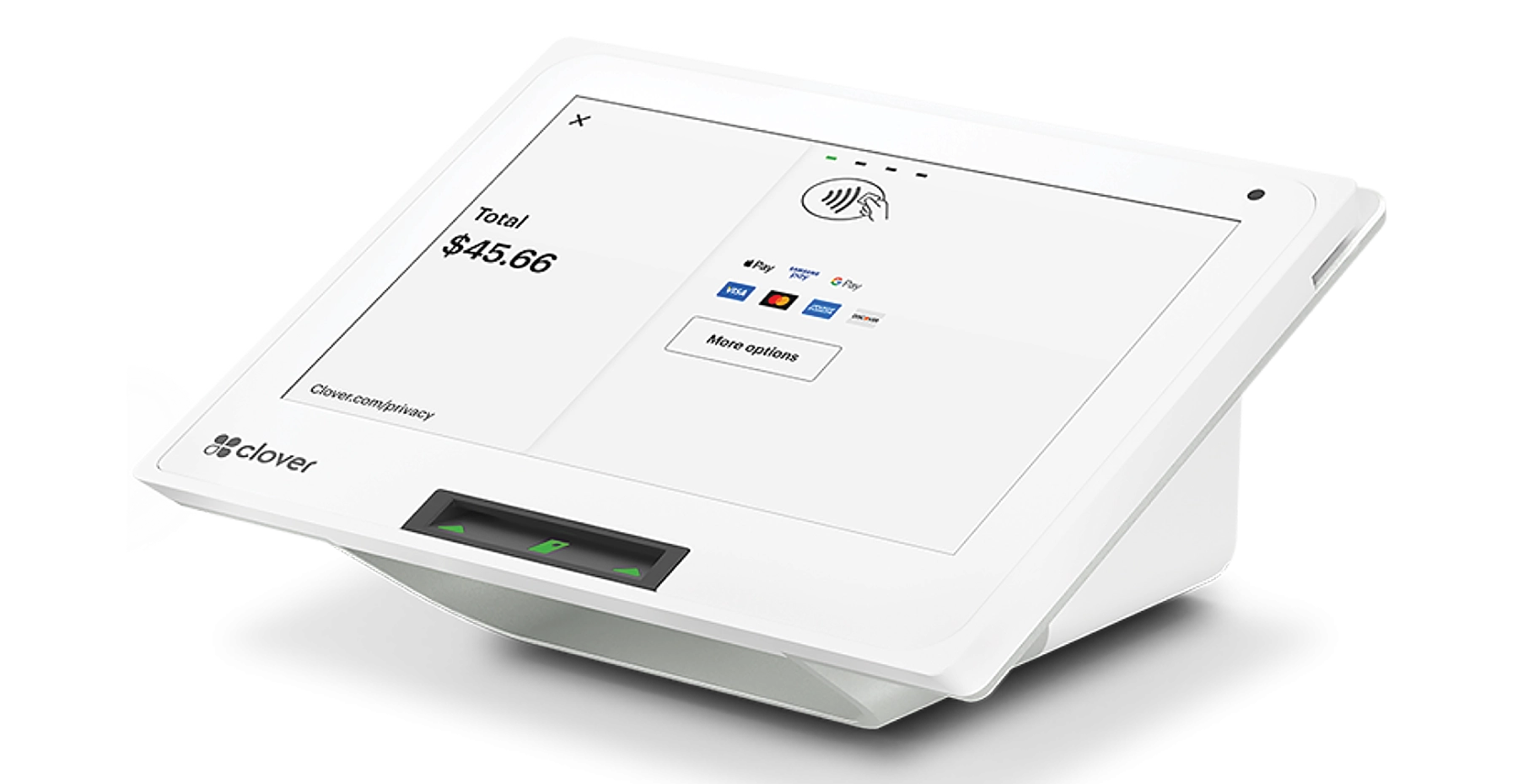
- The terminal or POS screen displays the total with the service fee added — calculated automatically, displayed clearly.
- The customer can confirm and pay by credit, or choose to pay cash or debit to avoid the fee.
- If they confirm credit, the transaction processes, the service fee is collected, and you receive your full listed price.
Your payment terminal — whether it’s a standalone reader or a full Clover POS system — handles the fee calculation in real time, with no manual math required on your end. The system manages it at every transaction, on every sale, consistently and automatically.
At the Counter: Handling Customer Questions
Most customers adapt to service fees quickly, especially once they understand they have the choice to pay cash or debit at no extra charge. The key is training your staff with a clear, calm, confident answer. Something like: “We offer a no-fee price for cash and debit, or you’re welcome to pay by credit card with a small service fee — totally your call.” That framing puts the customer in control, which almost always diffuses any friction.
What Changes on Your Monthly Statement
This is where zero fee processing really starts to feel different. Instead of a statement that looks like a tax return — pages of interchange categories, assessment fees, network charges, monthly minimums — your statement becomes dramatically simpler. The service fees collected from cardholders offset your processing costs, so that long, demoralizing column of fees shrinks or disappears entirely.
For many business owners, the monthly statement transformation is one of the most satisfying parts of making the switch. That bill that used to read like a penalty for accepting cards? It stops looking like a fine and starts looking like a recap.
One honest clarification: you may still see a small flat monthly account fee depending on your agreement. Zero fee processing eliminates the per-transaction processing costs — not necessarily every line item. A good processor will show you your new expected statement before you commit.
Is Zero Fee Processing Legal?
Yes — when done correctly, zero fee processing is fully legal and compliant with Visa, Mastercard, Discover, and American Express card network rules.
Here’s the quick regulatory history: for much of the past several decades, surcharging customers for credit card use was restricted or prohibited in many U.S. states — largely due to agreements between merchants and the card networks. That changed significantly in 2013, when a class action settlement between major merchants and Visa/Mastercard granted merchants in most states the right to add surcharges. A 2017 U.S. Supreme Court decision further reinforced that right.
Today, credit card surcharging is permitted in nearly all U.S. states. Illinois — where VMS is based and where many of our merchants operate — is fully open to compliant zero fee processing programs.
The card networks maintain specific guidelines that must be followed. According to Visa’s merchant surcharge rules, merchants must:
- Notify Visa and their acquiring bank at least 30 days before beginning to surcharge credit cards
- Cap the surcharge at the merchant’s actual cost of acceptance, not to exceed 4%
- Never surcharge debit card transactions, even if run as credit
- Post required signage at the store entrance and at the point of sale
When you set up zero fee processing through VMS, all of this is handled. We manage the required card network notifications, configure your terminal to stay within the fee cap, and provide compliant signage guidance. You’re protected from day one.
5 Things Every Small Business Owner Must Know About Zero Fee Processing
1. Your Customers Will Notice — But Most Won’t Leave
The number one fear we hear from business owners considering the switch: “What if my customers get upset and stop coming back?”
Here’s the honest answer: some customers will switch to cash or debit. A few will raise an eyebrow. Very few will leave over it. The reality is that most consumers have already encountered service fees in their daily lives — at gas stations, at government payment portals (utilities, DMV, tax payments), at restaurants and professional services. The concept isn’t foreign to them anymore.
The businesses that handle the transition best are the ones who lead with transparency. Clear, professional signage before customers reach the register. A brief, friendly explanation at the counter if questions come up. And the simple reassurance that paying cash or debit is always a zero-fee option. When customers feel informed and respected, friction nearly always dissolves.
2. It Works Better for Some Businesses Than Others
Zero fee processing is a strong fit for many small businesses — but not every single one. A good merchant services partner will tell you that honestly, even if it means recommending a different approach.
Zero fee processing tends to excel when:
- Average ticket sizes are higher. A 3.5% fee on a $400 car repair or dental service is $14 — meaningful enough to nudge some customers to pay cash. A 3.5% fee on an $8 cup of coffee is $0.28 — virtually invisible. Higher-ticket businesses typically see the best results.
- You have a loyal, returning customer base. Regulars who value your specific product or service aren’t going to walk out over a small service fee the way a one-time, price-comparison shopper might.
- Credit card transactions make up a large portion of your revenue. If 80% of your sales are card-based, the savings opportunity is enormous. If you’re already 90% cash, the financial impact is smaller.
Businesses that may want to think carefully: high-competition food service, commodity retail with many nearby alternatives, or any business where an extra $0.50 at checkout is a genuine make-or-break moment.
3. Your Clover POS Is Already Built for It
If you’re running Clover — or thinking about upgrading to a Clover system — great news: Clover’s platform fully supports compliant zero fee processing when configured correctly through VMS. Your Clover terminal automatically calculates the service fee at checkout, displays it clearly before the customer confirms, exempts PIN debit transactions, and prints compliant receipts.
You don’t need new hardware. You don’t need a separate device for “zero fee transactions.” The same Clover countertop, Clover Flex, or Clover Mini you’re already using can handle it — configured and ready.
Learn more about VMS’s Clover POS solutions, including local setup, training, and ongoing support.
4. Your Monthly Processing Costs Can Drop to Near Zero
This is the part that business owners sometimes have trouble believing until they see that first statement. When zero fee processing is running correctly, your effective processing cost can drop to essentially nothing — because the service fees collected from cardholders at checkout offset the interchange and network fees the processor owes to the card networks.
For a business currently paying $800/month in processing fees, the savings are immediate and substantial. Over 12 months, that’s nearly $10,000 back in your business. That money could fund a part-time employee, a new piece of equipment, a marketing campaign, or simply healthier margins at the end of every quarter.
Some merchants find it useful to do a quick back-of-the-envelope calculation: take your monthly processing fee, multiply by 12, and that’s the annual savings opportunity you’re walking past every year you stay on a traditional processing plan.
5. The Transition Is Simpler Than You Think
Many business owners assume switching to zero fee processing requires extensive new equipment, a complex migration process, or significant business disruption. In practice, the transition is typically faster and smoother than expected:
- Most existing terminals can be reconfigured — no new hardware purchase required in many cases
- VMS handles the card network notification that’s required before you begin surcharging
- Setup typically takes days, not weeks, and doesn’t require shutting down operations
- Compliant signage templates are provided so you’re fully protected under card network rules from the very first transaction
- Staff training is minimal — usually one short conversation about how to answer a customer question
The hardest part of switching is usually the decision itself — not the execution.
Is Zero Fee Processing Right for Your Business?
There’s no single answer that fits every merchant, and any processor who tells you otherwise isn’t being straight with you. Here’s a quick self-check that can help point you in the right direction:
- ✅ You’re currently paying more than $300 per month in processing fees
- ✅ Your average transaction size is $25 or higher
- ✅ More than half of your sales come through credit or debit cards
- ✅ You have a loyal customer base that returns for your specific product or service
- ✅ You’re comfortable with clear, professional signage at your checkout area
- ✅ Your business is located in a state that permits credit card surcharging
If you checked four or more of those boxes, zero fee processing is worth a serious, concrete conversation — not just a general inquiry.
If your business runs high volume on low margins, operates in a fiercely price-competitive environment, or processes a very low percentage of card transactions, a traditional low-rate processing plan might serve you better. VMS offers both, and we’ll give you a straight answer about which direction makes sense for your specific numbers — not just what benefits us.
The fastest way to know for certain? Let us look at your actual processing statement. In about fifteen minutes, we can show you exactly what you’re paying now, what zero fee processing would mean for your bottom line, and which program fits your business best.
Conclusion: Keep Every Dollar You Earn
Credit card processing fees have been the quiet tax on small business for decades — easy to overlook on a busy day, hard to negotiate down on your own, and nearly impossible to eliminate under a traditional processing model. Zero fee processing changes that. It’s a legal, widely adopted payment model that shifts the fee transparently to cardholders who choose the convenience of credit — while keeping your cash and debit customers free and your listed prices exactly where you set them.
For the right business, it can put thousands of dollars back every year — not from cutting corners, not from raising prices, just from changing where the processing cost lands.
At VMS, we’ve been setting up small businesses with payment solutions that actually make sense since 1998. Whether zero fee processing is your answer or a different approach fits your situation better, you’ll get a straight answer from a local team that knows this industry inside and out.
Ready to find out how much you could be saving? Contact VMS today for a free processing review — no pressure, no obligation, just the numbers you need to make a smart decision.