

Every small business keeps a second set of books nobody brags about: the invoices that went out, got a friendly nod, and never came back. Accounts receivable management is the unglamorous work of turning that pile into deposits, and for most owners it is the largest stack of money they have already earned but cannot spend. The numbers are ugly and getting uglier. In Intuit QuickBooks’ 2026 Small Business Late Payments Report, 59% of businesses said they were carrying invoices more than 30 days overdue, up from 47% the year before, with an average of $17,700 sitting unpaid. Nearly two in five owners said a single late payment made it hard to cover payroll or bills.
Here is the good news buried in that: almost none of it requires a collections agency, an awkward phone call, or a lawyer. Most of what passes for a collections problem is really a process problem — and process problems are fixable on a Tuesday afternoon.
What Accounts Receivable Management Actually Means When You Send the Invoices
Accounts receivable is money your customers owe you for work you already finished. Accounts receivable management is everything you do between finishing that work and seeing the deposit hit your account: how you set terms, how fast you invoice, how easy you make it to pay, how you follow up, and when you escalate.
Two numbers tell you how well your accounts receivable management is going.
The first is your aging report — your open invoices sorted into buckets: current, 1–30 days late, 31–60, 61–90, and 90-plus. Every accounting tool builds this for you, and it is the single most useful page in your business. The second is days sales outstanding, or DSO: the average number of days between sending an invoice and getting paid. You do not need a finance degree to calculate it. Take your receivables balance, divide by the sales you billed in a period, then multiply by the days in that period. If you billed $60,000 last month and $40,000 is still outstanding, your DSO is roughly 20 days.
Why bother? Because receivables that age past 90 days rarely get paid in full. Collectibility falls off a cliff the longer an invoice sits, which means accounts receivable management is mostly a game of preventing invoices from ever reaching that bucket — not heroically rescuing them once they do.

Late Payments Cost Far More Than the Invoice Amount
Weak accounts receivable management does not just delay money, it destroys some of it. An overdue invoice is not a neutral event where you simply wait a few extra weeks: it costs real money in four directions at once.
You pay to bridge the gap. When a $12,000 invoice slips 45 days, something has to cover payroll in the meantime — a credit card balance, a line of credit, or a draw you skip yourself. QuickBooks found 19% of owners took on debt they otherwise would not have, and 26% delayed their own paycheck. You also pay in attention: every hour spent reconstructing who owes what is an hour not spent selling.
Then there is the compounding effect. In the Federal Reserve’s Small Business Credit Survey, roughly half of employer firms report uneven cash flow as a financial challenge — and uneven cash flow is what turns a healthy, profitable business into one that cannot take the next big job. Profit on paper means nothing if the cash shows up 60 days after your supplier wants theirs.
Run the math on your own shop and it stops feeling abstract. Say you bill $40,000 a month and your customers pay, on average, 42 days after the invoice goes out. That means roughly $56,000 of your money is sitting in other people’s bank accounts on any given day. Pull that average down to 28 days — not by being aggressive, just by invoicing faster and making payment easier — and about $18,000 comes home permanently. No new customers, no price increase, no loan application. It is the cheapest money in your business, and it has been yours the whole time.
Finally, slow receivables quietly change how you run the place. Owners who have been burned start demanding deposits from good customers, turning down work that requires float, or taking expensive money. A 13 week cash flow forecast will show you exactly where the squeeze lands, and a short-term working capital advance can bridge a gap you cannot engineer away. But both are treatments. Good accounts receivable management is the cure.
Five Habits Behind Strong Accounts Receivable Management
None of these are clever. All of them work — together they are what accounts receivable management looks like on an ordinary week.
Agree on payment terms before the work starts
Most late payments trace back to a conversation that never happened. “Net 30” means nothing if your customer’s accounting department runs a 45-day check cycle and nobody mentioned it. Put the terms in writing before the first hour of work: when payment is due, what methods you accept, whether there is a deposit, and what happens after the due date. For larger projects, bill in progress payments rather than one terrifying invoice at the end.
Invoice the same day, every time
The slowest part of most receivables cycles is not the customer — it is the week between finishing the job and sending the bill. If you invoice from a laptop on Sunday nights, you have built a seven-day delay into every single sale. Invoicing from the field the moment the work is done removes it. Online invoicing for small business tools send, track and remind automatically, so the clock starts while you are still in the driveway.
Make paying effortless
Every extra step between “I should pay this” and “paid” is a place your money goes to die. A mailed check requires a human to open an envelope, print a check, get a signature and find a stamp. A payment link in a text message requires a thumb. Text to pay in particular tends to collapse DSO because it meets people where they already are, and a stored card on file for repeat customers removes the decision entirely.
Work the aging report on a schedule
Pick a day. Open the aging report. Start at the oldest bucket and work backwards. Owners who do this weekly almost never have a 90-day problem, because they catch the 35-day problem while it is still a friendly reminder. Owners who only look when they feel broke are always working the 90-day bucket — the hardest and least pleasant part of accounts receivable management there is.
Escalate on a timetable, not on emotion
Write your sequence down once and follow it for everybody: a courtesy reminder three days before due, a short note the day after due, a direct call at 14 days, a formal letter with a late fee at 30, and a decision at 60 about whether to keep extending credit. A timetable removes the awkwardness, because you are not singling anyone out. You are running a process, and your customer can tell the difference.
The Accounts Receivable Management Mistakes That Cost the Most
The habits above fix the common cases. These four mistakes are the ones that quietly drain the most cash from otherwise well-run businesses, and every one of them is self-inflicted.
- Treating every customer the same. A customer who has paid on time for six years and a brand-new commercial account are not the same credit risk, and they should not get the same terms. Extend your friendliest terms to the people who have earned them, and start new accounts with a deposit or shorter terms until they prove themselves.
- Letting one customer become your bank. When a single account owes you more than a comfortable share of your monthly revenue, you are financing somebody else’s operation, uninsured. Set a credit limit per customer, write it down, and pause new work when an account blows past it.
- Giving a discount for nothing. Owners often knock money off a late invoice just to close the file. If you are going to discount, trade it for speed instead: a small early-payment discount, offered up front, changes behavior. A discount offered at day 75 only teaches people that waiting works.
- Never charging the late fee you wrote down. A late fee that appears in your terms and never on an invoice is not a policy, it is a bluff, and repeat customers learn it quickly. Apply it consistently once an invoice crosses your stated line, or take it out of your terms and lean on easier payment methods instead.
The thread running through all four: accounts receivable management works when the rules exist before the invoice does, and it falls apart when you improvise after the fact.
Where Your POS and Payment Tools Do the Chasing for You

This is where accounts receivable management stops being a spreadsheet exercise. The right payment setup collects quietly in the background while you work.
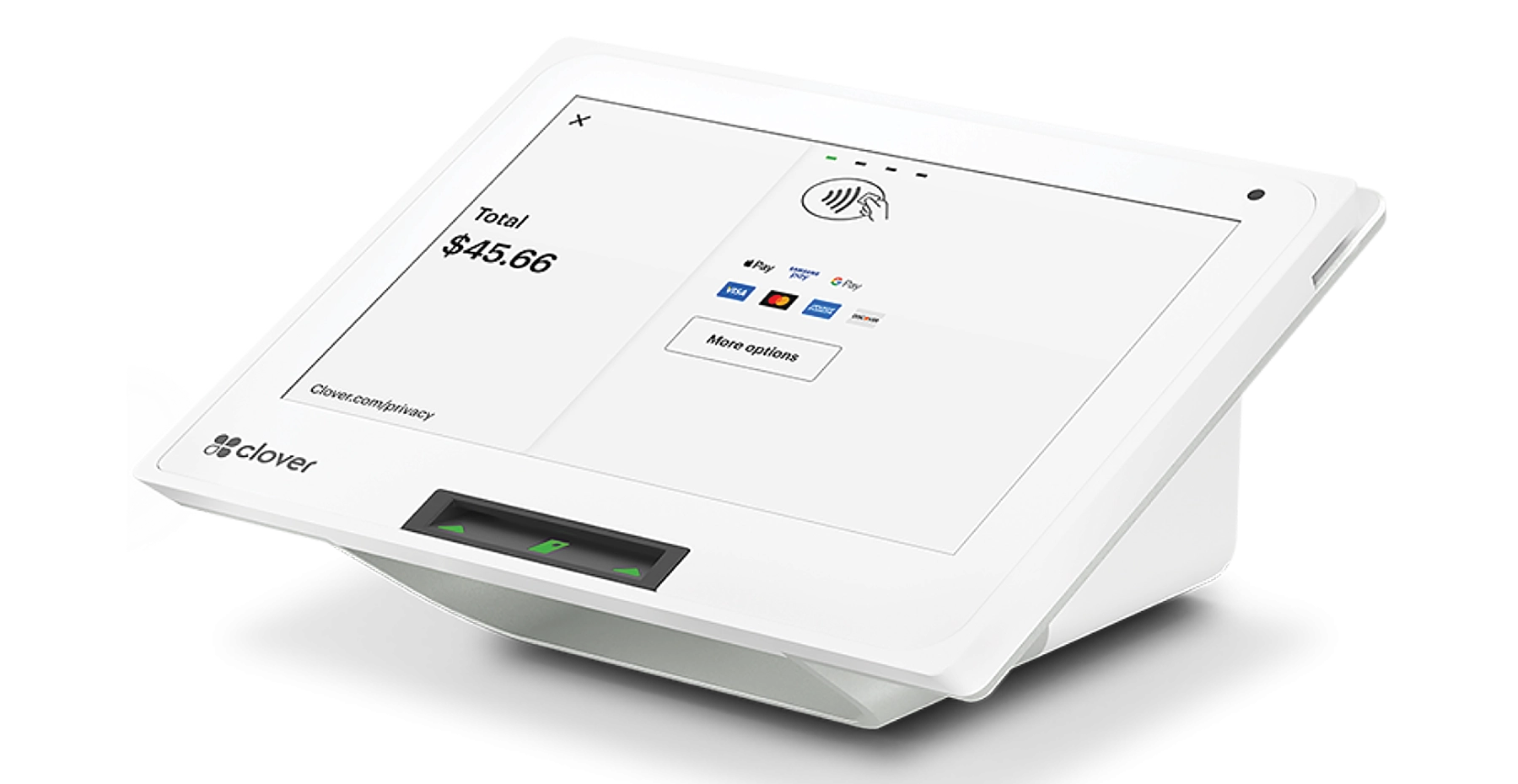
Take payment at the moment of relief. The best time to get paid is the instant the customer is happiest — the job is finished, the room is clean, the problem is gone. A handheld terminal like the Clover Flex turns that moment into a tap instead of an invoice. An invoice that never has to be sent cannot be paid late.
Keep a card on file for repeat customers. For maintenance plans, retainers and standing orders, recurring billing eliminates the receivable entirely. The charge runs, the receipt sends, and nobody has to remember anything.
Use a virtual terminal for phone payments. When a customer calls to settle up, a virtual terminal lets you key the payment in from any browser rather than mailing a reminder and hoping.
Add ACH for your big, slow accounts. Commercial customers who insist on checks will often happily pay by bank transfer, which clears faster and costs less than a card on a five-figure invoice. That is the heart of B2B payment processing, and it is where contractors and suppliers find the most hidden time.
Stop letting fees punish you for getting paid properly. If card acceptance is what finally gets invoices paid on time, make sure the processing cost is not eating the win. Zero Fee Processing shifts that cost off your margin, which makes the fastest payment method the cheapest one for your business too. Trades and service businesses can see how the whole stack fits together in our guide to payment processing for contractors, and professional practices can start with our payment processing for professionals overview.
A 20-Minute Weekly Routine That Keeps Receivables Honest
Strong accounts receivable management does not require a bookkeeper or a new software subscription. It requires twenty minutes on the same day every week.
- Minutes 1–5: read the aging report. Note anything that crossed into a new bucket since last week. Those are your only targets today.
- Minutes 5–12: send the reminders. Short, warm, specific. “Hi Dana — invoice 1042 for the Linden Street job hit 30 days yesterday. Here is the payment link; it takes about ten seconds. Let me know if anything looks off.” Never lead with an accusation. Nine times in ten the invoice is sitting in a spam folder or on somebody’s desk.
- Minutes 12–17: make the one call. Pick the single oldest or largest overdue account and call a human. Email is for reminders; the phone is for problems. Ask one question: “Is there anything holding this up on your end?” The answer is usually a missing PO number or a wrong email address, and you just saved sixty days.
- Minutes 17–20: fix the leak upstream. Ask why the oldest invoice is old. No terms agreed? A job invoiced ten days late? No card on file? Fix that one cause this week.
Track one number as you go: your DSO — the scoreboard for your accounts receivable management. Watch it monthly, not daily. Shaving it from 40 days to 25 on $500,000 of annual billing frees roughly $20,000 of cash that used to live in other people’s accounts. That is a real raise, and you did not have to sell a thing to get it.
Tired of waiting on invoices that should already be paid?
VMS sets you up with tap, text-to-pay, ACH and card-on-file tools that collect while you work — most businesses are taking payments within days, not weeks.
Or call our team: 888-902-6227
Get Paid Without the Chase
Accounts receivable management is not about becoming tougher. It is about removing the friction and the guesswork so that getting paid is the default outcome rather than a monthly campaign. Clear terms before the work. Same-day invoices. Payment methods that take seconds. A weekly pass through the aging report. A sequence you follow for everyone, so nothing feels personal.
Do that consistently and the pile of quiet invoices shrinks into something you barely think about — which is exactly how it should feel when the money you already earned shows up when you expect it. If you want help building the payment side of that system, the VMS team has been setting small businesses up since 1998.
Have questions about getting your invoices paid faster?
Fill out the form below and a VMS payment specialist will contact you shortly.