

Most small business owners can tell you last month’s sales without looking. Far fewer can tell you their break even point — the exact amount you have to sell before the shop stops losing money and starts making it. That is a strange gap, because your break even point is the single number that explains almost everything else: why a busy week still left the account thin, why that second location felt riskier than it looked, and why a price change can feel scary and obvious at the same time.
The good news is that the math is friendlier than it sounds. If you can add up your monthly bills and subtract what a sale costs you to deliver, you can find your break even point on the back of a receipt. This guide walks through the formula, runs it on a real-world example, and shows the levers that bring the number down — including a few that most owners overlook, like what you pay every time a customer taps a card.
What Your Break Even Point Really Tells You
Your break even point is the level of sales where your total revenue exactly equals your total costs. Below it, you lose money. Above it, every extra sale drops straight toward profit. You can state it two ways: as a number of sales (“we need 1,600 transactions a month”) or as a dollar amount (“we need $14,500 in monthly revenue”). Both describe the same finish line.
Think of it as the line on the floor of a running track. Until you cross it, you are paying for the privilege of being open. Once you cross it, the shop is working for you instead of the other way around. That is why owners who know their break even point sleep better: a slow Tuesday stops being a mystery and becomes a fraction of a target.
It also turns vague worries into specific decisions. Should you hire a part-timer? Add a second terminal? Sign a bigger lease? Each of those moves your break even point up or down, and once you can see the number move, the answer usually shows itself. The U.S. Small Business Administration’s guidance on managing your finances puts cost control and cash visibility at the center of running a healthy business, and your break even point is the simplest way to put both on one line.
The Break Even Point Formula, Step by Step
There are only three ingredients: your fixed costs, your variable costs per sale, and your average sale price. Get those three honest, and the rest is division.
Step 1: Add up your fixed costs
Fixed costs are the bills that show up whether you sell one thing or one thousand. Rent, base payroll, insurance, loan payments, software subscriptions, utilities, your accountant, and the monthly fee on your payment processing account all belong here. Pull twelve months of statements, divide by twelve, and be honest about the ones you tend to forget — annual licenses and equipment repairs love to hide.
Step 2: Work out your variable cost per sale
Variable costs rise and fall with every sale: ingredients or inventory, packaging, hourly labor you flex up and down, shipping, and — this is the one people miss — the percentage you pay on every card payment. If you have never added up your credit card processing fees as a per-sale cost, now is the time. At a few percent of every ticket, they are often the third or fourth largest variable cost in a shop that takes mostly cards.
Step 3: Find your contribution margin
Subtract your variable cost per sale from your average sale price. What is left is your contribution margin: the slice of each sale that is available to pay the fixed bills. If you want a refresher on how that differs from the percentage you add on top of cost, our guide to markup vs margin clears up the confusion.
Then divide. Break even point (in sales) = fixed costs ÷ contribution margin per sale. To get it in dollars, multiply by your average sale price. Or divide your fixed costs by your contribution margin percentage and skip a step.

A Worked Example: The Corner Coffee Shop
Numbers stick better with a real shop, so let’s borrow a small coffee shop. Her monthly fixed costs look like this: $3,200 rent, $4,500 in base payroll, $550 utilities, $800 equipment loan, and $450 for insurance and software. That is $9,500 a month before she sells a single latte.
Her average ticket is $9.00. On each ticket she spends about $2.52 on ingredients (28 percent), $0.30 on cups and supplies, and roughly $0.27 on card processing at about 3 percent. Her variable cost per sale is $3.09, so her contribution margin is $5.91 per sale, or about 66 percent of the ticket.
Now the division. $9,500 ÷ $5.91 is about 1,608 sales a month, or around 54 transactions a day over a 30-day month. In revenue terms that is roughly $14,470. Every sale after number 1,608 puts about $5.91 into her pocket. Every day that lands under 54 sales needs to be made up somewhere else.
There is one more number worth knowing: the margin of safety. If she actually averages 2,000 sales a month, she is running about 20 percent above her break even point. That cushion is what absorbs a rainy week, a broken espresso machine, or a new competitor across the street. If your cushion is under 10 percent, a single bad month can erase a good quarter.
Five Ways to Lower Your Break Even Point
You can only improve the number by raising your contribution margin or shrinking your fixed costs. Each of these moves one of the two. Rerun the coffee shop math after each lever and you can see exactly what it buys you.

Raise the average ticket, even a little
Add one dollar to her average sale and the contribution margin climbs from $5.91 to $6.91. Her break even point drops from 1,608 sales to about 1,375 — roughly 233 fewer sales a month, without a single new customer. Bundles, a smarter menu layout, suggested add-ons at the counter, and tidy prices all work. If you are nervous about pricing changes, our walkthrough of how margin really works will give you the confidence to make the move.
Trim the variable cost on each sale
Look at what you spend per sale, not per month. A cheaper cup, a smaller portion of the priciest ingredient, a better supplier quote on your top five items: each saves pennies, and pennies multiply across thousands of transactions. Your reporting is where this gets easy. Good POS reporting shows your best-selling items and the ones quietly eating margin.
Take card costs off your side of the ledger
Back to the coffee shop. At about 3 percent, card processing costs her $0.27 per sale. If that cost came off her margin entirely, her contribution would rise from $5.91 to $6.18 per sale and her break even point would fall from 1,608 to roughly 1,538 sales — about 70 fewer sales a month, every month. That is the logic behind Zero Fee Processing, which VMS offers so eligible merchants stop absorbing card fees as a cost of doing business. It is the rare lever that does not ask you to change your menu, your hours, or your staff.
Renegotiate or right-size your fixed costs
Fixed costs are sticky, but they are not carved in stone. Move the coffee shop’s rent down $500 and her break even point falls to about 1,523 sales. Review insurance quotes annually, cancel software nobody opens, and ask whether every subscription on your statement is still earning its place. For leases, a year of honest sales data is the best negotiating tool you own.
Make every hour of labor earn its keep
Payroll is usually the biggest cost in the building, and it is partly fixed and partly variable. Schedule to your busy hours, not your habits. If you want a deeper dive on keeping great people without overspending, our post on your labor cost percentage is a good companion read.
Break Even Point Mistakes That Skew Your Numbers
A break even point is only as good as the inputs behind it. These are the mistakes that make owners trust a number that is quietly wrong.
- Forgetting your own pay. If your salary is not in the fixed costs, your break even point is flattering you. Put a realistic owner draw in the list, even if you are not taking it yet.
- Using one average ticket for everything. A shop that sells $4 drinks and $40 gift sets does not have one average ticket. Calculate a blended average from a real month of sales, or run the math for each product line.
- Skipping processing fees and chargebacks. Card costs, monthly statement fees, and the occasional dispute all belong in your numbers. Treat them as real costs, because they are.
- Calculating it once and never again. Your break even point changes whenever rent, wages, supplier prices, or your menu change. Recalculate quarterly, and any time a major cost moves.
- Ignoring seasonality. A shop that earns most of its profit in November and December has a very different monthly target than the annual average suggests. If that sounds like you, our guide to running a seasonal business shows how to plan around the swings.
The thread through all five: your break even point is a living number. Treat it like a gas gauge rather than a framed certificate.
Track Your Break Even Point With the Tools You Already Own
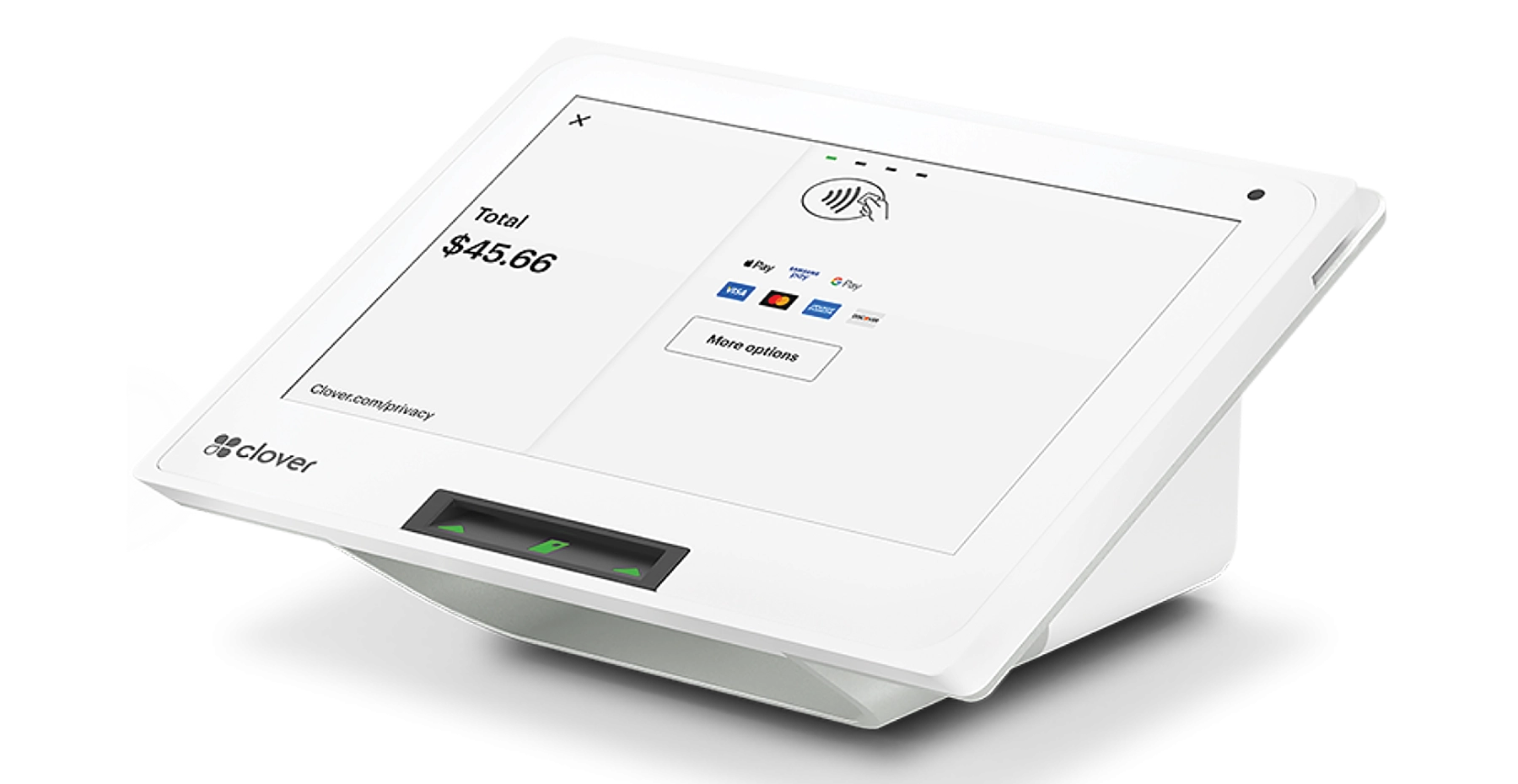
Here is the unglamorous truth: the formula takes ten minutes, and keeping the answer current is the hard part. That is where your point-of-sale system earns its keep. A modern POS like the Clover Mini records every sale, every item, and every tip as it happens, so your average ticket and transaction count are sitting in a report instead of in your memory.
Make it a habit. Each morning, glance at yesterday’s transaction count against your daily break even target. Each Friday, check the week. Each month, drop the real figures into your profit and loss statement and see whether the break even point you assumed matches the one you earned. When the two drift apart, that is your cue to investigate.
If you are building a cushion for a slow stretch, pair your break even point with a 13 week cash flow forecast so you can see how long the lean weeks last. And if you are still working out what it costs to open the doors in the first place, the real cost of starting a business is the right place to begin before your fixed costs ever get calculated.
When you need a bridge to cover the gap between where you are and the break even point you are chasing, working capital can fill it, and the VMS team will tell you plainly whether it makes sense for your shop.
Ready to lower your break even point?
VMS pairs a modern Clover setup with Zero Fee Processing so card costs stop eating every sale — talk to a specialist and see what your numbers could look like.
Or call our team: 888-902-6227
Know Your Number, Then Beat It
Your break even point is not a scorecard, it is a map. It tells you how far you are from profit, which roads get you there faster, and which detours cost more than they are worth. Add up the fixed costs, find your contribution margin, and divide. That is the whole trick, and it is worth doing this week.
Once you have the number, the fastest wins tend to be the quiet ones: a slightly higher average ticket, a tighter supplier quote, and card costs that stop eating every sale. That last one is where we can help directly. The VMS team has been helping small businesses accept payments since 1998, and we will happily run your numbers with you, show you what you pay today, and show you how a modern Clover setup with Zero Fee Processing can bring your break even point down. Fill out the form below and a payment specialist will reach out.
Want help lowering your break even point?
Fill out the form below and a VMS payment specialist will contact you shortly.