

You bought it for $60. You sell it for $100. Someone asks what you make on it and you say “about forty percent.” You are right, and you are also off by two-thirds, depending on which number you meant. The markup vs margin distinction is the least glamorous arithmetic in small business and quietly the most expensive, because the two numbers describe the exact same sale from opposite ends, and only one of them tells you whether you can cover rent this month.
Nobody sits you down and teaches this. You learn pricing from a supplier rep, a competitor’s shelf tag, and a gut feel that is usually close enough. Then costs move, a discount goes out the door, a big quote gets accepted, and the money that was supposed to be there simply is not. So here is the whole markup vs margin question in plain English: the math, a conversion table worth taping to the register, and the costs sitting inside your margin whether you have counted them or not.
Markup vs Margin: Two Numbers, One Sale
Markup is your profit as a percentage of what you paid. Margin is your profit as a percentage of what you charged. That is the entire difference, and it is the whole problem.
Take that $60 item sold at $100. Your gross profit is $40 either way. Nothing about the transaction changes. But the markup is $40 divided by $60, which is 66.7%, while the margin is $40 divided by $100, which is 40%. Two honest answers to “what are you making on this,” twenty-six points apart. That spread is the markup vs margin problem in a single line.
The reason markup vs margin trips up so many owners is that markup is the number your supply chain speaks. Vendors, distributors and trade guides all quote in markup because cost is what they know. Margin is the number your business speaks, because your rent, payroll and card fees all come out of the selling price, not out of the cost.
Say it out loud once and it sticks: markup is measured against cost, margin is measured against price. Margin can never exceed 100%. Markup can be 300% and often should be. Any time somebody hands you a percentage without saying which one it is, the markup vs margin question is the first thing to ask.

The Conversion Table Worth Taping to Your Register
You do not need to memorize formulas. You need to recognize the markup vs margin pairs, because a handful of them show up over and over in real pricing conversations.
| If your markup is | Your margin is | On a $60 cost, you charge |
|---|---|---|
| 25% | 20.0% | $75.00 |
| 50% | 33.3% | $90.00 |
| 66.7% | 40.0% | $100.00 |
| 100% (keystone) | 50.0% | $120.00 |
| 150% | 60.0% | $150.00 |
| 233% | 70.0% | $200.00 |
Two formulas cover every case you will ever hit. To go from cost to price at a target margin, divide instead of multiplying: price = cost divided by (1 minus margin). A $60 item at a 40% target margin is $60 divided by 0.60, which is $100. To convert a markup you already use into the margin it actually produces: margin = markup divided by (1 plus markup). A 50% markup is 0.50 divided by 1.50, which is 33.3%.
That division is the single most useful habit in this whole article. Multiplying a cost by your target margin gets you the wrong answer: $60 times 1.40 is $84, and $84 is a 28.6% margin, not the 40% you asked for. Same markup vs margin confusion, now baked into every shelf tag in the store.
Where the Markup vs Margin Mix-Up Actually Bites
The definitions are dry. The consequences are not. Here are three places the markup vs margin gap turns into real lost money.
Discounts eat margin, not markup
A 20% off sale sounds like it costs you 20% of your profit. It does not. Back to the $60 item at $100 with a 40% margin. Take 20% off and you sell at $80, so your profit drops from $40 to $20. You gave away 20% of the price and 50% of the profit. If the same item were carrying a 25% margin, that identical 20% discount would wipe out 80% of the profit on it. Run the markup vs margin numbers before you print the sign, not after.
This is why “we’ll just run a sale” is such a dangerous reflex in a thin-margin business, and why the owners who track this well tend to discount slowly and deliberately. If you want the fuller treatment, our guide to raising prices without losing customers walks through the alternative, and mastering the art of pricing a product covers the strategy side.
Quotes and jobs get underpriced
Service and trade businesses live on this mistake. You total your materials and labor at $4,000, add “30%,” quote $5,200, and feel good about a 30% margin. Your actual margin is 23%. On a $5,200 job that is a $364 gap, and if you run thirty jobs like that a year you have quietly given away more than $10,000 for no reason other than a markup vs margin slip.
Wholesale and retail stop reconciling
If you sell both ways, the markup vs margin gap shows up as two sets of books that never agree. Your wholesale sheet is built in markup because that is how you buy, and your retail floor is managed in margin because that is how you measure. Pick one language, make it margin, and convert everything into it before you compare anything. The same discipline applies to the numbers you pull off your register each night, which is exactly what our breakdown of the retail metrics hidden in every receipt is about.
Keystone Pricing, and Why “Just Double It” Stopped Working
For a long time the default in retail was keystone pricing: double the cost. Keystone is a 100% markup, which lands you at a clean 50% margin, and for decades that was enough cushion to absorb freight, shrink and a seasonal markdown while still leaving a living behind.
It was a decent heuristic because it was conservative. The problem is that everything keystone was built to absorb has gotten more expensive at once. The Federal Reserve’s 2026 Report on Employer Firms, drawn from 6,525 small employers across all 50 states, found that rising costs of goods, services and wages was the single most common financial challenge firms reported over the prior twelve months. More than four in ten also flagged higher tariff-related costs, and 77% reported one or both. Nearly half of firms source at least some inputs from outside the United States, and most of those said those inputs got more expensive from 2024 to 2025.
When your landed cost moves three times in a year, doubling it is not a pricing strategy, it is a pricing echo, and it hides the markup vs margin question instead of answering it. Keystone quietly passes every cost increase straight through at a fixed ratio and never asks whether 50% is still the right number for the category. Some items should carry far more. Some cannot carry that much and should be priced for traffic on purpose, with your eyes open.
The fix is not to abandon a rule of thumb. It is to hold the margin constant and let the multiplier float, so a cost increase gets priced correctly instead of approximately. Restaurants run into the same wall from a different direction, which our look at restaurant profit margin and menu engineering for profit gets into.
The Costs That Quietly Live Inside Your Margin
Here is where most margin math goes wrong in practice. Owners get the markup vs margin conversion right, compute gross margin off the invoice cost, and stop there, when several real costs come out of the selling price before anything reaches the bottom line.
Card acceptance comes off the top of every sale
Every card transaction takes a cut of the price, which means it comes directly out of margin, not markup. The scale is not trivial. U.S. merchants paid a record $198.25 billion in card processing fees in 2025, according to Nilson Report data, and for every $100 in card payments accepted, merchants paid about $1.57 in fees.
On our $100 sale at a 40% margin, roughly $2.60 to $3.50 of processing cost turns that 40% into something closer to 37%. On a 20% margin item, the same fee is eating an eighth of your profit on the sale. That is why the number to know is not your advertised rate but your effective rate, meaning total fees divided by total volume, and why it belongs in your margin math rather than filed under overhead. Card fees are also the clearest illustration of why markup vs margin matters at all: they scale with the price you charge, never with the cost you paid. Our breakdown of credit card processing fees and the difference between interchange-plus and tiered pricing covers how to read that off a statement.
There is also a structural option many owners do not realize they have. Zero Fee Processing moves the cost of card acceptance off your margin entirely and into the posted price, which does more for a thin-margin category than any amount of clever markup ever will.
Shrink, freight, labor and returns
The rest of the list is unglamorous and adds up fast. Inventory you paid for and cannot sell is pure margin loss, which is why inventory shrink deserves a line in your pricing rather than a shrug at year end. Inbound freight and fuel surcharges belong in landed cost, not in overhead. Labor is its own discipline, and our piece on labor cost percentage is the companion to this one. Every return is a sale that gave back its margin while keeping its processing cost, which our look at return fraud gets into.
Count those and you get a contribution margin, which is what a sale really leaves behind. It is always lower than the number on your pricing sheet, and knowing the size of that gap is the difference between pricing and guessing.

The Markup vs Margin Fix: Price From the Margin You Need
Work backwards instead of forwards. It takes an afternoon, and you only have to do it properly once.
Start with the margin the business requires
Add up rent, payroll, insurance, software, utilities and the owner’s pay you actually intend to take, and if that last one is fuzzy, our guide to paying yourself like an owner is worth ten minutes. Divide that by realistic sales. That is the blended gross margin your business must hold to survive, and it is the floor every category gets measured against.
Convert, then divide
Take your current markup rules and run the markup vs margin conversion on each one. Do not be surprised when a category you thought was at 45% turns out to be at 31%. Then reprice using cost divided by one minus your target margin, category by category, with fast movers and slow movers on different targets. Traffic drivers can sit below the blended number as long as something else sits above it on purpose.
Check what is coming off the top
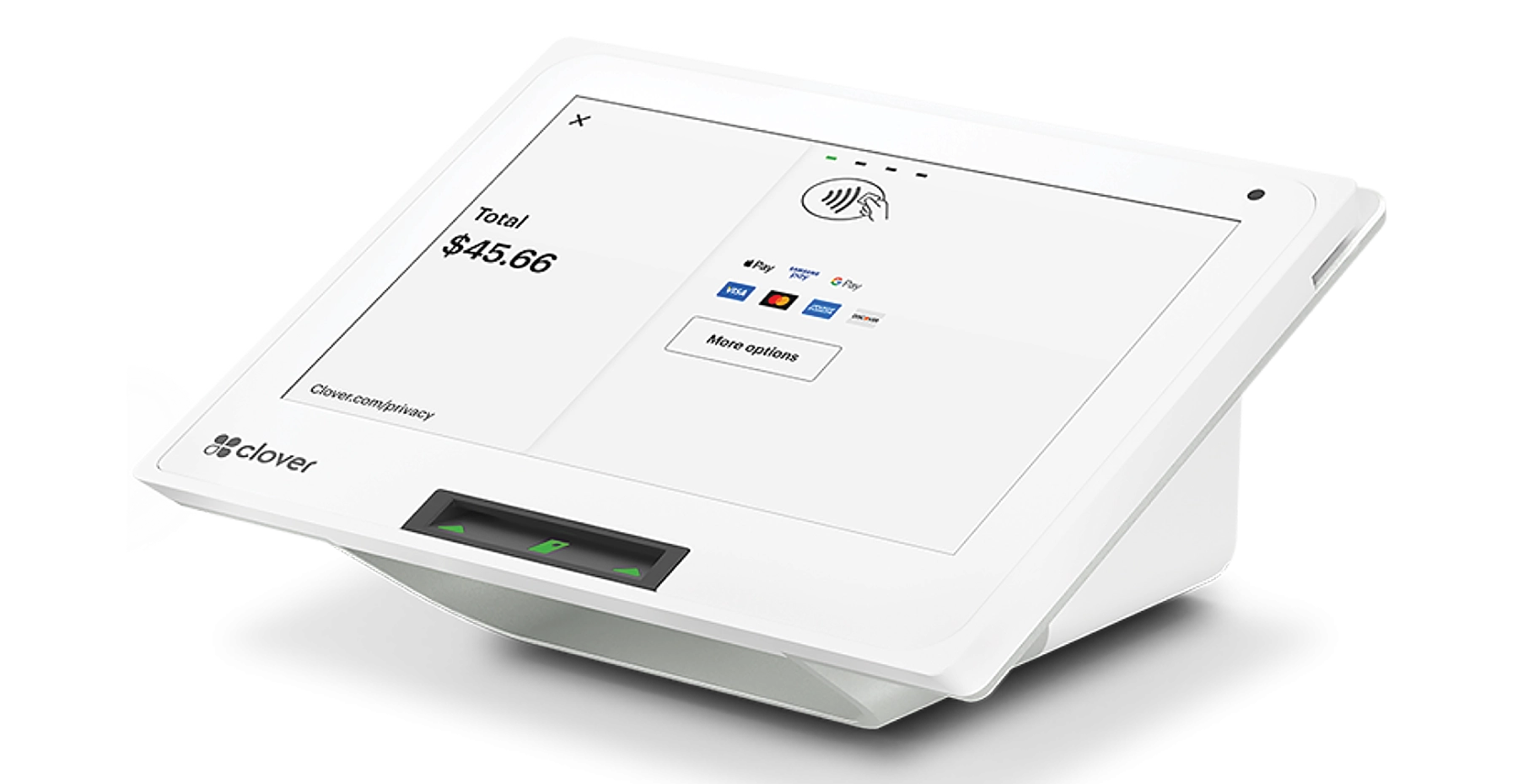
Pull three months of statements, total the fees, divide by total card volume, and write that effective rate down. Then subtract it from every category margin you just calculated. If your point-of-sale system reports cost of goods alongside sales, and a Clover Mini or Clover Flex will, you can watch true margin by item instead of reconstructing it in a spreadsheet in January. Scanning at the register instead of keying prices helps too, for reasons our post on the POS barcode scanner makes clear.
Review on a schedule, not on a scare
Put it on the calendar quarterly. Costs drift up continuously and prices move in steps, so the gap between them is always widening a little. Twenty minutes with the markup vs margin table four times a year beats one panicked repricing after a bad quarter. Retailers can start with the same margin discipline our retail payment processing customers use. And if cash timing is the constraint rather than the margin itself, working capital is the right tool for that job, not a price cut.
Ready to stop losing margin at the terminal?
VMS reviews your real effective rate and shows you exactly what card acceptance is costing per sale — usually in under a day.
Or call our team: 888-902-6227
Get the Markup vs Margin Math on Your Side
None of this is complicated. It is just never taught, and the cost of getting it wrong compounds silently across every sale you make. Markup is the language your suppliers speak, margin is the language your business lives in, and the owners who hold onto their profit are the ones who translate deliberately instead of assuming the two are close enough.
The part we can help with directly is the slice coming off the top of every card sale. Most of the statements we review are quietly costing more than the owner thinks, in fees buried under categories nobody ever explains. If you want to know your real effective rate, and what your margin looks like once it is corrected, that is a short conversation and a free review.
VMS has been doing exactly this for small businesses since 1998: transparent processing, honest pricing models including Zero Fee Processing, and Clover point-of-sale systems that report margin by item so you are not guessing. Questions are welcome at our merchant services FAQ, our support team is local and answers the phone, and if you want to know who you would be working with, about VMS is a good place to start. Fix the markup vs margin math first, then make sure nothing unnecessary is coming out of the margin you just protected.
Have questions about your pricing and processing costs?
Fill out the form below and a VMS payment specialist will contact you shortly.