

Modern point-of-sale (POS) systems are a game-changer for small businesses, especially for small business owners and retail shops looking for efficient and easy-to-use solutions. Two of the top contenders in the market today are Clover and Square. These platforms are packed with essential features that help businesses run smoother, sell smarter, and scale faster. Whether you run a coffee shop, a mobile boutique, a retail shop, or a multi-location grocery store, choosing the right POS can make a big difference. In this comprehensive comparison, we break down everything you need to know about Clover vs Square—from features and hardware to industry fit and customer support—so you can choose the best POS system for your unique business.
Introduction to POS Systems
A point-of-sale (POS) system is the backbone of any modern business, providing the tools needed to accept payments, manage inventory, and keep track of sales in real time. For small businesses, choosing the right POS system can make daily operations more efficient and help deliver a better customer experience. Among the many options available, Clover and Square stand out as two of the most popular and trusted solutions. Both clover and square offer robust point of sale features that go beyond just ringing up sales—they help you manage inventory, generate reports, and streamline your workflow. Whether you run a retail shop, a bustling restaurant, or a service-based business, understanding how these POS systems work can help you make smarter decisions for your business. In this guide, we’ll break down the key differences between Clover and Square, so you can find the best fit for your unique needs.
Clover vs Square: An Overview
Clover and Square both allow businesses to accept payments, track sales, manage inventory, and run day-to-day operations. The key difference lies in how they’re set up. Square is a straightforward all-in-one system—often described as an all in one solution for small businesses—you sign up online, and you’re instantly ready to process payments. Clover, on the other hand, is sold through merchant service providers, offering more flexibility in how you process payments and what features you use. When comparing Clover vs Square, it’s clear each one has its sweet spot—one shines in simplicity, while the other thrives on flexibility. Square users typically value simplicity and ease of use, preferring a seamless, user-friendly experience, while Clover users seek customization and flexibility, appreciating the ability to tailor the system with various apps and integrations.
Square uses a flat-rate pricing model and doesn’t require a traditional merchant account. It’s easy to set up and provides a full ecosystem for payments, marketing, appointments, and more. Clover, by contrast, requires a merchant account, and the Clover POS system is known for its flexibility. Clover gives business owners the ability to negotiate processing fees and choose their own provider, which can result in lower costs over time. Payment processing fees can vary depending on the provider and plan, impacting overall expenses for businesses using Clover.
Features and Capabilities
When comparing Clover vs Square, both systems accept all major forms of payment (swipe, chip, tap, mobile), support multiple payment options—including contactless payments like NFC and mobile wallets—calculate tax, support tipping, and offer receipts. Both also provide robust pos software for managing transactions. You’ll get inventory management, analytics, employee permissions, and customer directories right out of the box. But there are differences:
-
Loyalty Programs: Clover includes a built-in loyalty program; Square charges extra for its loyalty add-on.
-
Online Selling: Square provides a free online store platform that integrates seamlessly with in-person sales and offers online ordering capabilities that work directly with the POS. Clover integrates with third-party platforms like Shopify or WooCommerce through apps. Square POS also includes free pos software for basic sales and inventory management.
-
Gift Cards and Promotions: Both support digital and physical gift cards, but Square requires an additional subscription for advanced marketing and promotion tools, while Clover offers these features as part of its plan tiers.
-
Returns and Exchanges: Both systems allow for easy returns and exchanges, but Clover allows more customization in handling complex returns, such as splitting payments and applying restocking fees.
Ease of Use
Both systems are user-friendly and require minimal training. Square shines for beginners with its plug-and-play setup and intuitive design that works on iOS and Android devices. It’s ideal for business owners who want to start accepting payments with minimal setup. This ease of use is especially beneficial for small business owners who may not have access to technical support. Clover, while requiring a bit more onboarding since it’s purchased through a provider, has a clean and responsive interface with guided setup that makes it easy for users to learn quickly.
Square’s app interface feels like any other smartphone app, which many users find comforting. Square also offers a free plan, making it easy for new users to get started without upfront costs. Clover’s proprietary hardware uses a customized Android-based OS, which feels more professional and optimized for business, though it requires a bit more familiarity upfront.
Integrations and Customization
Square comes with a pre-integrated suite of tools for accounting (QuickBooks, Xero), marketing (Mailchimp), eCommerce (Wix, WooCommerce), and more. It also offers APIs for custom integrations, which is great for tech-savvy businesses. However, some integrations and features are only available on advanced plans or a premium plan.
Clover, however, has an edge in customization. The Clover App Market features hundreds of third-party apps that extend functionality across payroll, appointment booking, tax compliance, inventory, and beyond, making it one of the most versatile cloud-based POS systems for small businesses. You can even find apps tailored to specific industries like salons or delis. Clover’s open API also allows businesses to build proprietary integrations or custom solutions.
Scalability and Growth
Clover is built with long-term growth in mind. It supports multi-location management, inventory transfers, centralized reporting, and more. Its flexible pricing and negotiable processing rates make it cost-effective for high-volume businesses. Features like scale integration, advanced inventory tools, and kitchen display systems make Clover especially appealing for growing restaurants and retail chains. Both Clover and Square offer retail plans tailored for multi-location businesses, providing options that address the specific needs and budgets of expanding retail operations.
Square does offer multi-location support, and you can assign roles, transfer inventory, and run reports across stores, helping streamline the management of a business’s payments as it grows. However, the flat-rate pricing model can become expensive as you scale. High-volume businesses often prefer Clover’s ability to reduce processing costs through negotiation.
Customer Support
One of the major differences with Clover vs Square is Support. Support can make or break your POS experience. Clover offers 24/7 customer service via phone, email, and often live chat, with phone support available at any time. Having 24/7 phone support is especially important for businesses that may need immediate, direct assistance, ensuring help is always just a call away. This around-the-clock support is a huge benefit for businesses that operate outside the 9-to-5 window, like bakeries, bars, or late-night food trucks.
Square provides customer support during regular business hours and relies heavily on a robust self-help center and community forums. While efficient, it’s less personal, and there’s no dedicated account manager for small businesses.
Hardware Options
Square provides flexible hardware options, starting with free magstripe readers and extending to full-blown countertop terminals:
Square Reader: Tiny, portable, plugs into a smartphone for basic swiped payments. Square Terminal: All-in-one handheld device with built-in receipt printer. Square Stand: Turns an iPad into a full register with added accessories. Square Register: Dual-screen countertop system with customer-facing display.
Clover’s hardware lineup is more premium and purpose-built:
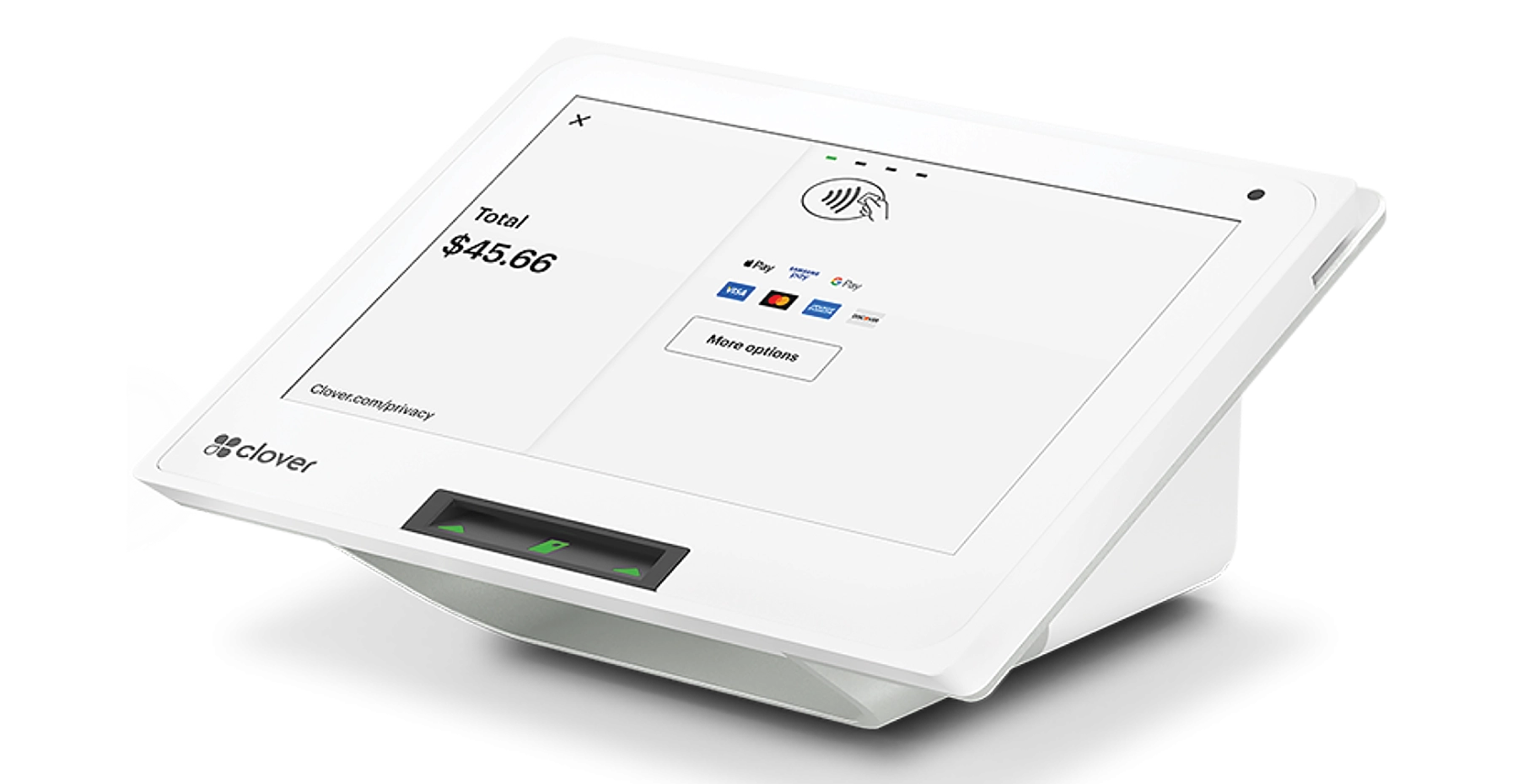
Clover Go: Portable card reader paired with your phone. Clover Flex: Handheld terminal with screen, printer, scanner, and full software. Clover Pocket: A compact, ultra-portable version of the Clover Flex that fits in your pocket. Ideal for on-the-go businesses, it handles payments, prints receipts, and offers full POS functionality in a smaller form factor. Clover Compact: A streamlined POS device designed for speed and efficiency. With a sleek display, built-in printer, and full access to Clover software, it’s perfect for busy counters and compact spaces. Clover Mini: Compact countertop terminal with full POS capabilities. Clover Duo: Powerful full-size POS with customer-facing screen, built-in printer, and accessories. These options are continually evolving, and Clover’s new POS devices in 2026 further expand the choices available for different business types.
Clover’s hardware is durable, sleek, and designed for heavy use. Clover hardware offers a comprehensive solution, fully integrated with Clover’s POS software to meet a wide range of business needs. Unlike Square, which can run on off-the-shelf devices, Clover’s proprietary hardware offers a more integrated, reliable experience.
Virtual Terminal and Merchant Account
For businesses that need to process payments beyond traditional in-person transactions, a virtual terminal is an essential tool. This web-based solution allows you to accept payments online or over the phone, providing flexibility for remote sales, invoicing, or taking orders without physical POS hardware. Both Clover and Square offer virtual terminal capabilities, making it easy to process payments wherever your customers are.
When it comes to payment processing, the way each system handles merchant accounts is a key difference. Clover gives businesses the option to set up their own merchant account, which can offer more control over how you process payments and may lead to lower processing fees in the long run. This approach is ideal for businesses that want to negotiate rates or need a customized payment solution. On the other hand, Square offers a simplified setup by aggregating all users under a single merchant account. This means you can start accepting payments quickly, without the paperwork or complexity of a traditional merchant account, though it may come with slightly higher fees.
By understanding how both Clover and Square handle virtual terminals and merchant accounts, you can choose the payment processing setup that best matches your business’s needs—whether you prioritize ease of use, lower fees, or more advanced features. With these options, you can process payments online, in person, or over the phone, ensuring your business never misses a sale.
Clover vs Square for Small Businesses and Different Business Types
-
Restaurants: Square for Restaurants offers table mapping, conversational ordering, and integrates with delivery platforms. Clover Dining offers advanced features like QR code ordering, kitchen printers, and table-side service. Clover also supports scale integration—useful for delis and yogurt shops. Additionally, Clover provides features specifically designed for full service restaurants, such as reservation management and table service.
-
Retail: Square for Retail includes barcode printing, inventory management, and multi-location stock views. Clover’s retail tools are customizable and support variable pricing, inventory by weight, and advanced reporting. Clover can also integrate with weight scales and supports grocery-specific features. Both systems support cash payments and provide tools for manual entry and bookkeeping.
-
Grocery and Markets: Clover is better suited for grocery stores due to built-in scale compatibility and handling PLU codes. It supports checkout lanes, barcode scanning, and fast item lookup. Square can handle small markets but lacks native scale integration.
-
Service-Based Businesses: Square Appointments is a powerful tool for salons, spas, and consultants. It includes online booking, client reminders, and no-show protection. Clover uses third-party apps for scheduling, but its built-in loyalty tools and inventory management make it ideal for hybrid businesses offering services and retail. Both systems support card not present transactions for phone or online payments.
-
Mobile Vendors: Square is the go-to for mobile sellers thanks to its low entry cost and easy phone integration. Clover Flex, however, offers more robust functionality with LTE connectivity, a built-in printer, and barcode scanning—great for high-volume or on-the-go businesses. Square also offers a free magstripe card reader for new users.
Both Clover and Square offer a range of payment processing services tailored to different business types.
Payment Processing, Security and Reliability
Both Clover and Square are PCI compliant and encrypt customer payment data. They also offer offline modes to continue transactions even during internet outages. Square may occasionally place account holds for high-risk transactions because it aggregates users under one merchant ID. Clover, with a traditional merchant account, offers more stability and fewer disruptions.
Pricing Models
Square charges a flat processing rate per transaction, making the processing fee and transaction fees key cost considerations. There are no monthly fees for the basic POS, but add-ons (like loyalty, appointments, and advanced reports) cost extra. Square’s pricing structure is transparent and avoids hidden fees. For many micro-merchants, this predictability is helpful.
Clover’s pricing varies by provider. You’ll pay for hardware, a monthly software plan, and negotiated processing fees—both the monthly fee and payment processing fees can vary depending on the provider and plan, so it’s important to pick the best Clover POS plan for your business. While upfront costs can be higher, long-term savings on processing fees and custom features may offset this for businesses with higher volumes.
Still running an outdated register?
VMS sets up a modern Clover POS matched to how your business actually runs — installed, configured, and supported by a team that answers the phone.
Or call our team: 888-902-6227
Final Thoughts: Which POS is Best for You?
Choosing between Clover vs Square ultimately comes down to your business goals and how you plan to scale over time. If you’re just starting out and want something easy and inexpensive, Square is a fantastic option. Many experts recommend Square for small businesses seeking simplicity and affordability. It’s simple, streamlined, and effective for getting a small business up and running fast. But if you’re looking ahead and planning to scale, Clover is likely the better investment. Its customization options, powerful hardware, and support structure make it a long-term partner for serious business growth. It can be a tough decision for Clover vs Square so always weigh the positives and negatives of both.
Square excels at simplicity. When comparing square and clover, Square is ideal for hobbyists, pop-up shops, or solo entrepreneurs who need a functional, affordable system with minimal commitment. Square Online is a great benefit, offering an easy-to-set-up online store that integrates with Square’s free plan, making it even more attractive for new businesses. But once your business starts expanding—more locations, more inventory, higher transaction volume—you may find Square’s limits and start looking for a more robust option.
Clover, with its expandable app ecosystem, flexible hardware lineup, and dedicated support channels, is built to handle complexity. Whether you’re opening a second store, adding a loyalty program, or needing more detailed reporting, Clover can evolve alongside your business.
Think Clover might be the right fit? Velocity Merchant Services is here to help. As a trusted Clover provider, VMS will walk you through everything from choosing the right device to setting up your system, training your staff, and providing ongoing support. Whether you need the powerful Clover Station for your restaurant or the mobile Clover Flex for your delivery team, we’ll make sure your setup is seamless. Ready to upgrade your business with a powerful POS solution? Contact Velocity Merchant Services and let’s make it happen! Clover vs square can be a hard decision especially for new businesses.
With VMS, you don’t just get a POS system—you get a partner who believes in small business success. Both Clover and Square offer a free plan to help businesses get started. Let us help you grow, one transaction at a time.
Have questions about POS systems?
Fill out the form below and a VMS payment specialist will contact you shortly.