

Last Tuesday you probably spent forty minutes on a social post. It reached maybe six percent of your followers, collected eleven likes — two of them from your cousin — and sent exactly nobody through your door. Meanwhile, the customer contact list sitting inside your point-of-sale system, the one you have never once exported, is quietly the most valuable marketing asset your business owns. That is the uncomfortable math behind email marketing for small business: the channel everyone writes off as old-fashioned still outperforms the one everyone obsesses over.
The gap is not subtle. Email returns roughly $36 for every $1 spent, according to Litmus benchmark research — a return no social platform comes close to matching. More importantly, nobody can take your list away from you. An algorithm change can halve your organic reach on a Tuesday afternoon. Your email list does not care what Meta shipped this quarter.
This is a guide to doing email marketing for small business properly — where the addresses come from, what to send, what it actually costs, and how to stay on the right side of the law. Written for owners who do not have a marketing department, because most of you don’t.
Why Email Marketing for Small Business Still Beats the Algorithm
Social media is rented land. You build an audience on someone else’s platform, and that platform decides how many of those people ever see you. Organic reach for business pages has been sliding for a decade, and the fix on offer is always the same: pay to boost.
Email is different in three ways that matter to a small operator.
You own the asset. A list of 800 customer emails is yours. It moves with you if you rebrand, relocate, or open a second location. No platform can throttle it, suspend it, or start charging you for access to the people on it.
It reaches people who already bought. Social marketing mostly spends money finding strangers. Your email list is made of people who have already walked in, handed you a card, and liked what they got. Selling to them is dramatically cheaper than acquiring someone new — the same reason customer retention beats acquisition on nearly every measure.
It shows up predictably. An email lands in an inbox. It might be ignored, but it is not quietly filtered out by a ranking system that never explains itself.
None of this makes social media worthless. It is genuinely good at discovery — being found by people who have never heard of you. But discovery is the top of the funnel. Email marketing for small business is where the repeat revenue actually lives, and most owners have the order backwards: hours poured into posts, zero minutes spent on the list.
Your POS Is Already Collecting the List (You Just Aren’t Using It)

Here is the part that surprises people. You probably do not need to build an email list from scratch. You have been building one by accident for years.
Every time a customer chooses an emailed receipt instead of a printed one, your point-of-sale system captures a verified, actively-used email address. Not a typo-ridden address scribbled on a paper sign-up sheet — a real one, typed by the customer, attached to a real transaction.
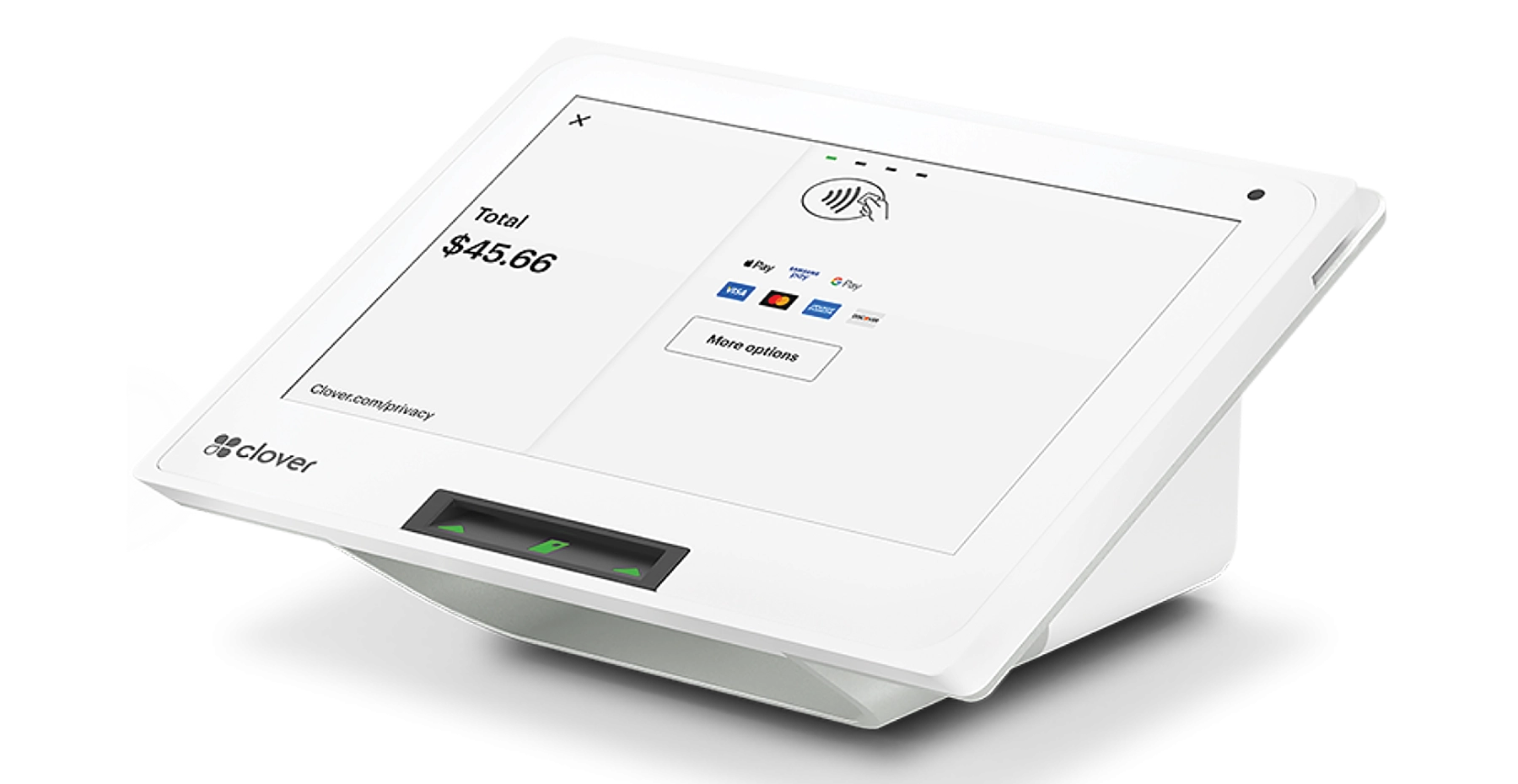
On a Clover Mini at the counter or a Clover Flex in your hand, digital receipts are a default part of checkout. The customer taps their card, the screen asks how they want the receipt, and a share of them type in an email. Do that four hundred times a month and you have a list — one built entirely out of paying customers.
A few things make that list grow considerably faster:
- Ask, don’t wait. Train staff to say “email or printed receipt?” rather than handing over paper by default. The phrasing does most of the work.
- Give the address a job. “Want your receipt emailed? I’ll send the coupon with it” converts far better than a silent prompt on a screen.
- Check what you already have. Before you buy any software, export the customer list your POS system has been quietly accumulating. Most owners are startled by the number.
- Connect the loyalty side. If you run a loyalty program, enrollment already collects contact details. Those two lists should be one list.
One caution before you get excited: a receipt email address is not automatically permission to send marketing. We will get to that below, because it matters more than most owners realize.
Five Emails That Actually Make Money
Most email marketing for small business programs die the same death. The owner sits down to “write a newsletter,” runs out of things to say by paragraph two, and never sends another one. Skip the newsletter entirely. Send these instead.
The welcome email
Triggered the moment someone joins the list. It is consistently the highest-opened email any business sends, because interest is at its absolute peak. Keep it short: who you are, what they will get from you, and one reason to come back this week.
The receipt follow-up
A day or two after a purchase, a short note — thanks, here is how to care for what you bought, here is what pairs well with it. This is the natural extension of receipt marketing: you already have their attention at the transaction, and email carries it past the door.
The win-back
Segment anyone who has not bought in 60 or 90 days and send a single, specific offer. For most businesses this is the highest-value email on the entire list, because reactivating a lapsed regular costs almost nothing next to finding a brand new customer.
The date-based offer
Birthdays, membership anniversaries, the anniversary of a first purchase. They feel personal, they are entirely automated, and redemption rates are reliably strong.
The slow-period push
Every business has a dead stretch — Tuesday afternoons, the second week of January, the lull right after a holiday. An email sent Monday morning offering something specific for Tuesday is the closest thing to a revenue dial a small business has.
Notice what none of these are: a monthly roundup of company news. Nobody wants that. Every email above is tied to a customer behavior or a date, which means you can automate it once and leave it running.
Is your POS actually capturing customer emails?
VMS sets up digital receipts and customer capture on your Clover so your list builds itself at checkout — usually live within a few days.
Or call our team: 888-902-6227
Building a List Without Annoying Anyone (and Staying Legal)
Two rules keep email from turning into a liability.
Rule one: get real permission. An emailed receipt is a transactional message the customer asked for. A promotional blast is not the same thing. The clean approach is an explicit opt-in — a checkbox at signup, a line on the loyalty enrollment form, a simple “can I add you to the list for offers?” at the counter. Permission collected honestly produces a smaller list that performs far better than a big list of people who never agreed to hear from you.
Rule two: follow CAN-SPAM. The federal rules for commercial email are short and genuinely readable, and the penalties for ignoring them are not small. The FTC’s CAN-SPAM compliance guide covers the whole thing, but the essentials are:
- Don’t use deceptive subject lines or false header information.
- Identify the message as an advertisement if that is what it is.
- Include a valid physical postal address for your business.
- Give people a clear, working way to unsubscribe — and honor it within 10 business days.
That last point trips up small businesses more than any other. If someone unsubscribes and keeps receiving mail, you are out of compliance regardless of intent. Any reputable email platform handles this automatically, which is a solid argument for using one rather than blind-copying two hundred people from your own inbox.
Beyond the legal floor there is a practical one: send at a frequency you can actually sustain. Two thoughtful emails a month beats eight rushed ones followed by six months of silence. A cadence you can keep is worth more than a cadence you can imagine.
What Email Marketing for Small Business Actually Costs

This is where the channel separates itself from every other option on the table.
Most email platforms are free below a threshold — commonly a few hundred contacts and a few thousand sends a month — then move to tiered pricing that scales with list size. A typical small business with one to two thousand contacts lands somewhere in the $20 to $50 per month range. Compare that to a single boosted social post that vanishes in 48 hours, or a print ad that costs more than a full year of email and cannot tell you whether a single person read it.
The real cost is not the software. It is the hour you spend setting up the automations. Build the welcome email, the win-back, and the birthday offer once, and they run on their own more or less indefinitely. That is the entire pitch: email marketing for small business is one of the very few marketing investments with a genuine set-up-once, earn-forever structure.
Budget honestly for one thing, though. Someone has to write the emails. If that someone is you, block thirty minutes twice a month and protect it like an appointment. If it is a staff member, make it an actual assigned responsibility rather than something they do when things are quiet. Programs almost never fail for lack of budget — they fail because nobody owned them.
And while you are looking at that side of the ledger, it is worth asking what your processing is costing you. Marketing spend and processing fees come out of the same margin, and a Zero Fee Processing setup can free up more monthly cash than most marketing tools will ever cost you.
The Three Numbers Worth Watching
Your email platform will show you a dozen metrics. Three of them matter.
List growth rate. New subscribers minus unsubscribes, month over month. If this goes flat, your collection process at the counter has quietly stopped happening — usually because a staff member left and nobody retrained their replacement. It is the earliest warning signal you get.
Click-through rate, not open rate. Open rates became unreliable once Apple’s Mail Privacy Protection began pre-loading images, which inflates opens for a large share of your audience. Clicks are the honest measure of whether the email did anything at all.
Revenue per email sent. Total revenue attributable to a campaign, divided by the number of emails delivered. This is the number that tells you whether the whole exercise is worth your Tuesday morning. Even rough attribution — a unique promo code per campaign — is enough to answer it.
If you go the promo-code route, your retail POS setup can tell you exactly how many redemptions came through the register, which closes the loop between the email you sent and the money that landed in the drawer.
Where Email and Text Message Marketing Overlap
Owners often ask whether they should just be texting customers instead. The honest answer is that the two do different jobs. Text is immediate and nearly always read within minutes, which makes it excellent for time-sensitive things — a table is ready, an order is up, a one-day promotion. It is also more intrusive, more expensive per message, and governed by stricter consent rules than email.
Email is patient. It is where the longer message goes: the story behind a new product, the seasonal menu, an explanation of a change in hours. Most small businesses are better off doing email well before adding text, then using text sparingly for genuine urgency.
If you already use text-to-pay for invoicing, or take orders through online ordering, you have a second stream of customer contact details flowing in. Those addresses belong on the same list. Fragmented contact data spread across three systems is the single most common reason a small business believes it has no list when it actually has a perfectly good one.
Start With the List You Already Have
Email marketing for small business does not need a marketing degree or a real budget. You need to do three things this month: export the customer emails your POS has already collected, pick a platform, and write the welcome email. That is the entire on-ramp.
Email marketing for small business works because it is built on people who already chose you once. Every other channel spends its money convincing strangers. This one simply asks the people who already like you to come back — and it does that for roughly the price of a couple of coffees a month.
If your point-of-sale system is not capturing customer emails at checkout, that is the first thing to fix, and it is worth a conversation before you spend a dollar on software. Our team can walk you through what your current setup is already collecting and what it is missing. Have a look at the merchant services FAQs if you want the groundwork first, or just reach out below.
Have questions about email marketing for small business?
Fill out the form below and a VMS payment specialist will contact you shortly.