

There is a number every independent jeweler should sit with for a minute. In 2025 the average ticket at independent jewelry stores climbed to $255, up from $223 the year before, but the number of pieces sold actually fell. Revenue grew because prices grew, not because more people walked through the door. That quietly changes the math on everything, and it puts real pressure on the jewelry store POS system ringing up every one of those sales.
Most owners think of a POS as a nicer cash register. It is not. A jewelry store POS system decides how fast you close a $4,000 engagement ring, whether a custom order deposit gets tracked or forgotten, how much of that sale you keep once processing fees come out, and how exposed you are when someone disputes the charge six weeks later. Get it right and it pays for itself in a quarter. Get it wrong and it bleeds you slowly, on your very best sales.
Why a Jewelry Store POS System Is a Different Animal
Walk into a coffee shop and the POS problem is speed: dozens of $6 tickets an hour, and the only thing that matters is the line moving. Walk into a jewelry store and the problem inverts. You might write twelve tickets in a day, and one of them is worth more than the coffee shop takes in a week. Low volume, high value, long consideration cycles, and a product that gets serialized, appraised, insured, repaired, resized and sometimes sold on memo before it is ever paid for.
That combination breaks generic retail software fast, because a jewelry counter has to handle things most retail setups never contemplate:
- Serialized, one-of-a-kind inventory. You are not selling forty identical mugs. You are selling one specific ring with its own cost, certificate and margin.
- Custom orders and deposits taken weeks or months before the piece is delivered.
- Repair and service tickets that move through a bench, not a shelf.
- Layaway and payment plans that stretch across months.
- Trade-ins, memo goods and consignment pieces you do not technically own yet.
- Customer histories worth real money such as ring sizes, anniversaries and past purchases.
Miss any of those and the workarounds start: a spiral notebook for repairs, a shoebox of deposit slips, a spreadsheet somebody updates on Sundays. Every workaround is a place where money, time and customer trust leak out, and none of them show up on a profit and loss statement until the year is over. A proper jewelry store POS system closes those gaps by default, which is a very different promise from what a standard retail payment processing package makes.
The Fee Math Nobody Runs Until It Is Too Late
Here is where the jewelry store POS system conversation gets expensive, and it has almost nothing to do with the hardware on the counter. It has to do with the pricing sitting behind it.
Most all-in-one systems bundle payment processing at a flat rate, commonly around 2.9% plus 30 cents for a card-present sale. That sounds tidy, and on a $6 latte it costs pennies. On a $4,000 engagement ring it costs $116.30. On a $12,000 anniversary piece it costs $348.30. Flat-rate pricing is a rounding error for a low-ticket business and a serious line item for yours.
| Sale | Flat rate (2.9% + $0.30) | Interchange-plus (approx. 2.45% + $0.10) | Difference |
|---|---|---|---|
| $255 (average ticket) | $7.70 | $6.35 | $1.35 |
| $1,500 | $43.80 | $36.85 | $6.95 |
| $4,000 | $116.30 | $98.10 | $18.20 |
| $12,000 | $348.30 | $294.10 | $54.20 |
Now scale it. A jeweler running $800,000 a year in card volume pays roughly $23,200 at a flat 2.9 percent. Trim the effective rate by half a point and you keep about $4,000 more a year, which is in the same neighborhood as what a complete hardware setup costs in the first place. Read that again: the right jewelry store POS system can pay for itself out of the fees it stops wasting. If you have never had somebody walk you through a statement line by line, our breakdown of credit card processing fees is the place to start, and what a POS system actually costs explains what the equipment side really runs.
The trap is that flat-rate pricing looks harmless when you sign, because nobody demos it on a $4,000 sale. It is worth knowing your own numbers here; if you have never calculated it, your average ticket size is a five-minute exercise that changes how you read every quote you get.

What a Jewelry Store POS System Should Actually Track
Strip away the sales pitch and a jewelry store POS system earns its keep in six places. If a system cannot do these, it does not matter how good the demo looked:
- Serialized inventory, piece by piece. Every item with its own SKU, cost, vendor and margin, so you know what is moving and what has been sitting in the case for eighteen months tying up cash.
- Custom orders and deposits. A deposit is a liability until the piece is delivered. It belongs in the system with a due date, not on a slip in a drawer.
- Repair and service tickets. Intake, promised date, bench notes, status and pickup. When a customer calls to ask if it is ready, anyone on the floor should be able to answer in three seconds.
- Layaway and payment plans. Scheduled payments, running balances and automatic reminders, so you are not the one chasing people.
- Customer profiles that earn. Ring size, anniversary date, past purchases, wish-list items.
- Reporting you will actually read. Margin by category, by vendor and by salesperson, not just a daily sales total.
That fifth one is where a jewelry store POS system quietly turns into a marketing asset. Someone who bought an engagement ring is a near-certain wedding band customer within a year, an anniversary customer after that, and eventually a customer for their daughter’s first real piece. That is a decade-long relationship, and it lives or dies on whether anybody wrote the details down. Pairing that history with a loyalty program is one of the cheapest growth levers an independent jeweler has, and it costs far less than chasing new traffic, which is exactly the argument we make in our guide to customer retention for small business.
Jewelers Get Hit Harder by Fraud and Chargebacks
Jewelry is compact, valuable, easy to resell and hard to trace, which makes it a standing target. Card-not-present jewelry orders carry some of the highest fraud rates in retail, and disputed high-end jewelry orders average in the neighborhood of $2,500, an order of magnitude above a typical retail chargeback. One bad transaction can wipe out the margin on a very good month.
There is also a threshold most owners have never heard of until they cross it. If disputes climb past roughly one percent of your transactions, the card networks can drop you into a monitoring program, add fines, or push you toward a high-risk merchant account with worse terms. For a store writing a few hundred tickets a year, that is a frighteningly small number of bad sales. Visa publishes its merchant rules and fee guidance, and they are worth ten minutes of your time.
What actually moves the needle:
- Take high-value sales card-present whenever you can. A dip or a tap beats a keyed transaction on both fee rate and fraud liability.
- Turn on address verification and CVV checks for every phone or online order.
- Use tokenization so raw card data never sits in your system.
- Keep signed receipts and delivery confirmation for anything that ships.
- Slow down on rushed, high-value, ship-to-a-different-address orders. That is the classic pattern, and it has not changed in twenty years.
- Print your return, resizing and special-order policy on the receipt itself.
A jewelry store POS system that captures signatures, stores receipts and tokenizes cards hands you the evidence to actually win a dispute. A notebook hands you nothing. We go deeper on the mechanics in our guides to card not present fraud and preventing chargebacks.

The Pricing Model Behind the Counter
Three pricing models dominate, and the difference between them at your ticket size is not academic.
Flat rate is the simplest and the most expensive for you. One blended percentage on every sale, which is generous to the processor precisely when the sale is large. Interchange-plus shows you the wholesale cost set by the card networks plus a fixed, disclosed markup. It is less tidy on a statement and materially cheaper on high-ticket sales, which is why it suits jewelers so well.
Zero Fee Processing is the third path, and for some stores it is the whole answer. It sets a cash price and a card price so the cost of acceptance is carried by the transaction rather than absorbed out of your margin. It has to be implemented correctly, disclosed clearly at the counter and on the receipt, and kept in line with card brand rules, but done properly it can take processing from a five-figure annual expense to something close to zero. If that sounds too good to be true, that is a fair instinct, and it is exactly the sort of thing worth asking hard questions about before you sign anything.
Whichever model you land on, the rule is the same: you should be able to see what you are paying and why. If a provider will not show you that, the answer is not a better jewelry store POS system, it is a better provider. Our merchant services FAQ page covers the questions worth asking.
Choosing Hardware That Fits a Jewelry Counter
Jewelry stores care about how the counter looks in a way that most retailers do not, and rightly so. A customer deciding on a $5,000 purchase is reading every signal in the room. Bulky beige equipment sends the wrong one. The good news is that the current generation of POS devices for small businesses is compact and genuinely attractive.
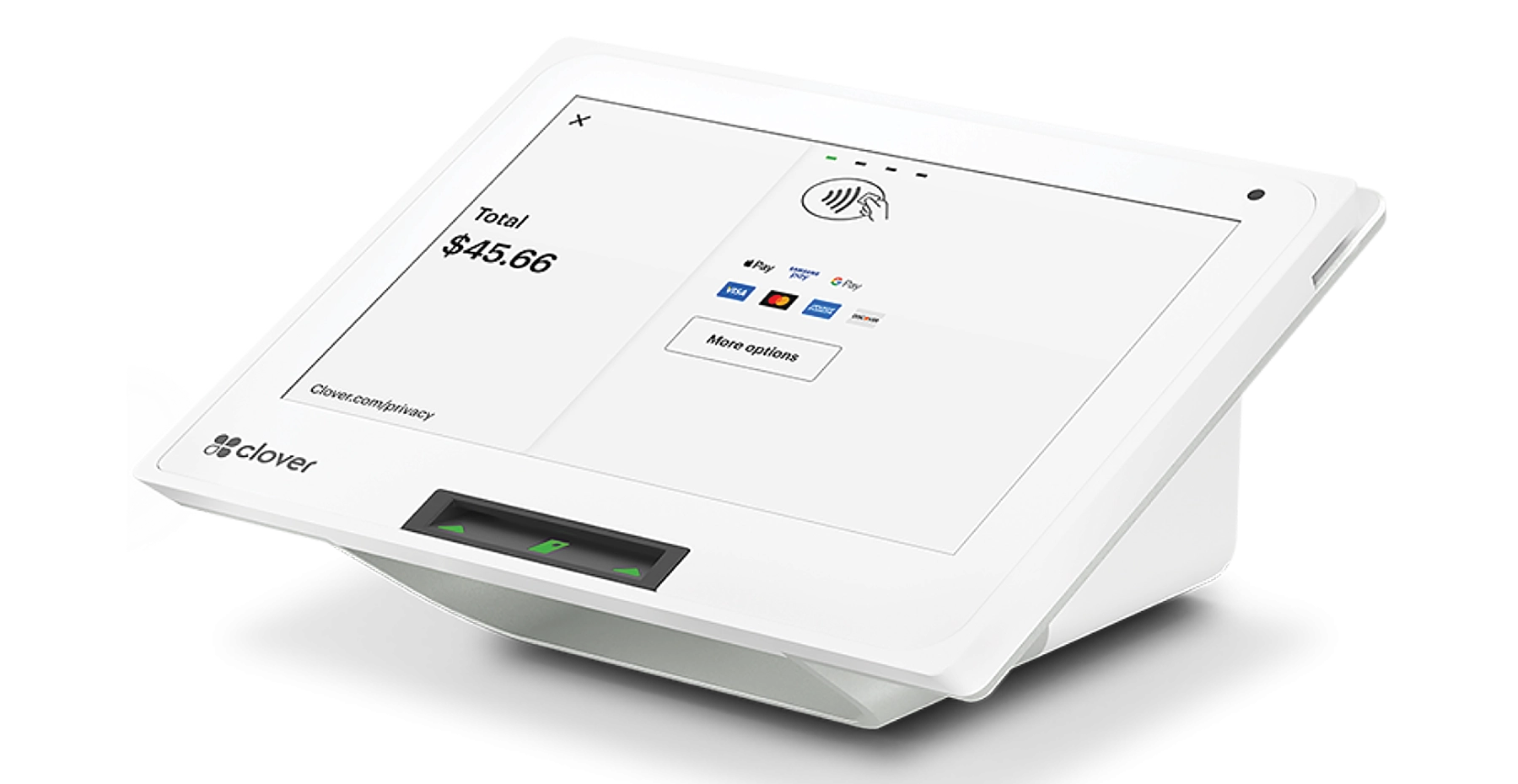
- The Clover Mini is the natural fit for a glass display counter. Compact footprint, a clean tilted screen, and it does not crowd the case or the conversation.
- The Clover Flex is the handheld. Close the sale standing at the case where the customer fell in love with the piece, take deposits at a trunk show or a private appointment, and run curbside pickups for repairs.
- The Clover Duo adds a customer-facing screen, which helps when a second person is involved in the decision or you want the total and the tip line visible without anyone leaning over.
Plenty of stores run a Mini on the main counter and a Flex in a drawer for appointments and events, which is a genuinely good setup for the money. If you want to compare configurations before you commit, our Clover POS pricing guide lays out the plans, and if cash flow is the sticking point rather than the decision itself, merchant working capital can bridge it. Our team is also on support if you would rather just ask a person.
Ready to stop losing margin on your biggest sales?
VMS sets up jewelry-ready Clover systems and transparent processing, usually with your rate reviewed the same week.
Or call our team: 888-902-6227
Your Best Sales Deserve Better Than a Generic Register
The jewelry business has spent two years learning to make more money from fewer transactions. That is a harder way to run a store, and it means the cost of getting the small things wrong has gone up. A deposit nobody logged, a repair nobody can find, a dispute you cannot answer, half a point of margin handed to a processor on every ring in the case: none of these are dramatic on their own, and together they are the difference between a good year and a flat one.
The fix is not complicated. Pick a jewelry store POS system that understands serialized inventory, custom work and repairs. Get pricing you can actually read. Take the high-value sales card-present, protect the ones you cannot, and use the customer history you are already collecting. Trade bodies such as Jewelers of America publish solid guidance on running an independent store, and VMS has been helping small retailers get the payments side of it right since 1998. We are happy to look at your current statement and tell you honestly whether you are already in good shape.
If you would like a straight answer on what your jewelry store POS system and processing should actually cost, fill in the form below and a VMS specialist will walk you through it. No pressure, no jargon, and no surprises on the statement.
Have questions about jewelry store POS systems?
Fill out the form below and a VMS payment specialist will contact you shortly.