

Walk behind almost any small business counter and you will find one piece of equipment nobody thinks about until something goes wrong: the POS cash drawer. It sits under the terminal, it opens, it closes, and it earns exactly zero attention — right up until the night the count comes up eleven dollars short and nobody can explain why.
Then it gets all of your attention. Usually at nine at night. Usually while you are tired and doing math on the back of a receipt.
Here is the part most owners get wrong. When a POS cash drawer comes up short, the first instinct is almost always to suspect a person. Sometimes that is right. Far more often it is not, and treating a process problem like a trust problem is how good businesses lose good employees. The real cause is usually sitting in plain sight, in how the drawer is set up, who can open it, and what happens in the ninety seconds after the last customer walks out.
Cash Did Not Die, It Just Got Quieter
There is a persistent myth that cash handling stopped mattering somewhere around the time everyone started tapping their phones. The data says otherwise.
According to the Federal Reserve’s 2026 Diary of Consumer Payment Choice, cash still accounts for about 14% of all payments — roughly one payment in seven. Four out of five consumers used cash at some point in the previous thirty days, and ninety percent said they plan to keep using it. It has been the third most-used payment instrument for six years running.
What changed is not whether cash shows up. It is how often. When cash was forty percent of your sales, your team counted drawers constantly and got very good at it. Now that it is closer to one sale in seven, the counting muscle has atrophied. Staff handle bills a few times a shift instead of a few times an hour, and skills you do not practice are skills you lose.
That is the quiet trap. Lower cash volume feels like lower cash risk. It is actually the opposite: fewer, less-practiced transactions on a drawer nobody has re-examined in years. Rural businesses feel this most — the Fed found rural consumers average nine cash payments a month against six in urban and suburban areas.
So your POS cash drawer sees less traffic than it did a decade ago. It has not stopped mattering, and the shrinking share is precisely why it now deserves a second look.
What a POS Cash Drawer Actually Does All Day
Most people picture a metal box with a bell. A modern POS cash drawer is closer to a logged, permissioned safe that happens to live on your counter.

Connected properly, it does four things that a standalone till cannot:
- It only opens when something justifies opening it. A cash sale, a refund, or a manager override. Not because somebody leaned on it.
- It stamps every open with a name and a time. You get a record, not a mystery.
- It reconciles against what the system expected. The terminal knows what it rang. The drawer knows what is in it. The gap between those two numbers is the only number that matters.
- It separates the count from the counter. Whoever balances the drawer does not have to be the person who ran it.
That last one is doing more work than it looks. A POS cash drawer that logs its own activity converts an argument into a report. Instead of “somebody was short,” you get “drawer two, 2:14pm, no-sale open, no transaction attached.” One of those is a conversation. The other is a conflict.
This is also where a POS cash drawer stops being hardware and starts being a control. It is the same logic behind a POS barcode scanner — the value is not the beep, it is that the beep removes a place where a human can guess.
Where the Shortage Really Comes From
Nine times out of ten, a POS cash drawer that will not balance is telling you about a process, not a person. The usual suspects, in rough order of how often they turn out to be the culprit:
No-sale opens nobody tracks. If any employee can pop the POS cash drawer without ringing anything, you have no baseline. Every count is a guess against a moving target.
Making change from the wrong drawer. Two people on one till during a rush is the single most reliable way to generate a shortage. Two sets of hands, one accountability line.
Tip-outs and petty cash taken from the register. The twenty that went to the delivery driver at 4pm is not theft, but if it left no paper it is indistinguishable from theft at 9pm.
Change orders logged late, or not at all. A drawer that got a fifty in fives at noon and never recorded it will look wrong all night.
Rounding and quick math under pressure. This is the boring, unglamorous, extremely common one. A line of six people, a $17.43 total, a twenty handed over, and a distracted cashier. Nobody stole anything. The drawer is still short.
Compare that list to the National Retail Security Survey, where the NRF put total retail shrink at 1.6% of sales — about $112.1 billion — with theft, internal and external combined, making up roughly two-thirds of it. Shrink is real and worth defending against. But notice that the survey measures *inventory* shrink across an entire operation. Your nightly drawer variance is a much smaller, much more diagnosable number, and it responds to process fixes long before it responds to suspicion.
If you want to know which one you are dealing with, the test is simple: random shortages of odd amounts are almost always process. Consistent shortages of round amounts, on the same person’s shifts, are worth a closer look.
Choosing a POS Cash Drawer That Fits Your Counter
Shopping for one of these is deceptively annoying, because every product page lists the same specs and none of them tell you what actually matters. Four things do.
Size, honestly assessed. A full-size drawer is about sixteen inches wide and wants real estate you may not have. A compact drawer fits a coffee bar or a food truck but holds fewer bill slots. Measure your counter before you fall in love with a model. The most common regret is a POS cash drawer that technically fits but blocks the path a customer’s card has to travel.
Bill and coin configuration. Five bill slots is standard; a business that takes a lot of small cash wants more coin space, and a business that mostly takes twenties does not. Removable coin trays are worth the small premium because they make the count portable.
The interface, which is where people get burned. Most drawers connect over RJ-11 or RJ-12 through the receipt printer rather than directly to the terminal. That means the drawer is not really talking to your POS — it is talking to the printer, which is talking to your POS. If you swap printers later, check the drawer still opens.
Build quality where it counts. A POS cash drawer is rated in open/close cycles. A busy retail counter can put a quarter of a million cycles on one. The difference between a cheap slide and a good one shows up in year three, not month three, and replacing a failed drawer mid-shift is a genuinely bad afternoon.
If you want a broader view of how the drawer fits alongside everything else on the counter, our guide to POS hardware and what your business actually needs walks through the full stack, and the POS devices overview covers the terminals a drawer pairs with.
Connecting a POS Cash Drawer to the Rest of Your System
A drawer that is merely *near* your point of sale is a cash box with extra steps. The gain comes from integration.
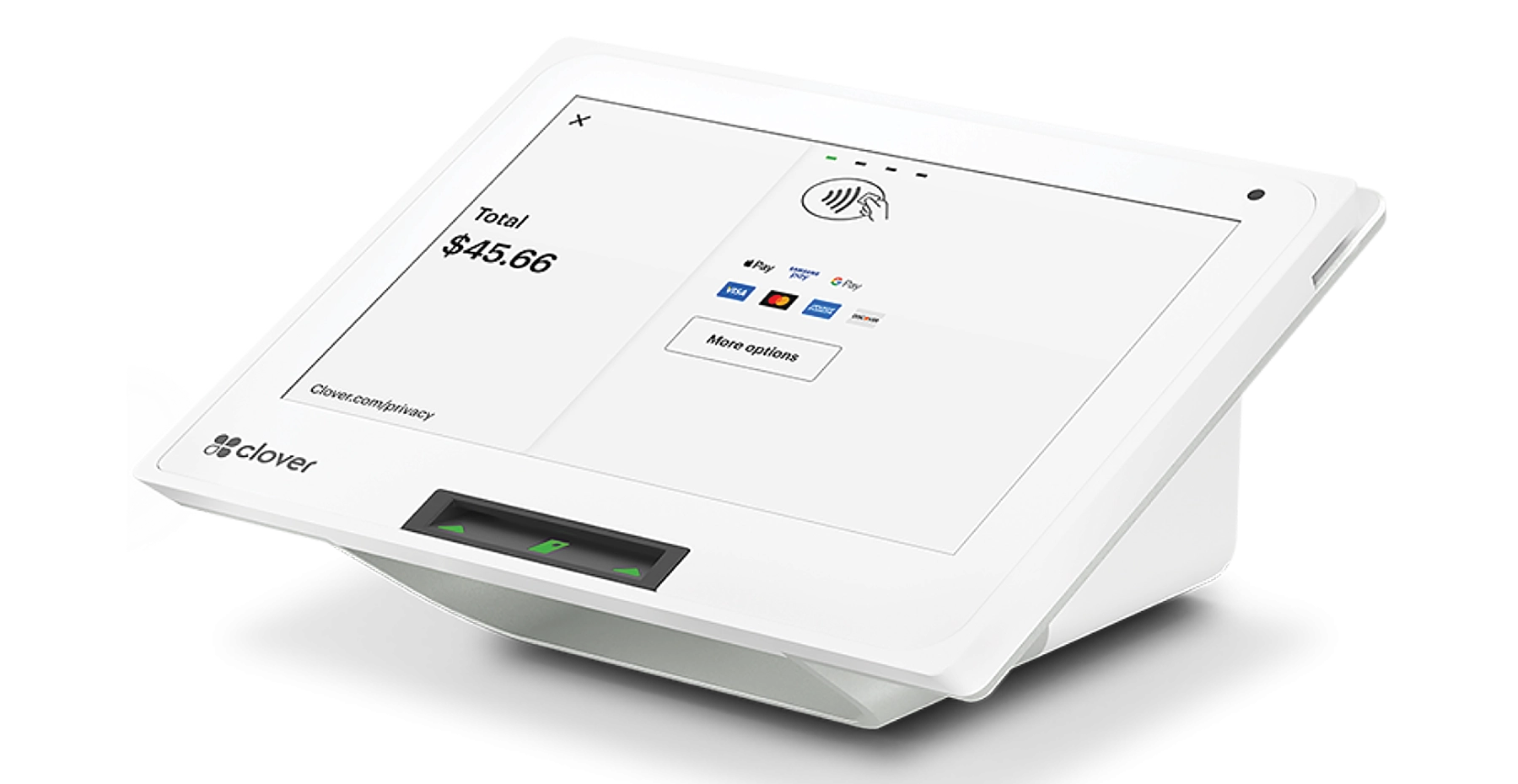
On a countertop setup, the Clover Mini is the natural anchor — it sits flat on the counter, drives the receipt printer, and the drawer hangs off that. For a busier counter running two stations, the Clover Duo adds a customer-facing screen, which quietly reduces disputes about what was owed in the first place. Mobile and tableside work is a different animal; a Clover Flex usually means the drawer stays at a home base rather than travelling.
Once a POS cash drawer is properly integrated, three things become available that were not before:
- Per-user drawer assignment. Each cashier signs in, and the system knows whose hands were in the till. This pairs naturally with the employee management tools you are probably already using for scheduling.
- Enforced blind counts. The system does not show the expected total until the count is entered. This is the single highest-return change most businesses can make, and it costs nothing.
- Variance reporting over time. One short drawer is noise. The same drawer short every Thursday is a signal. You cannot see the pattern without the history.
Retail and quick-service counters get the most out of this. If you run either, our pages on payment processing for retail and quick-service restaurants go deeper on the workflow around the counter.
None of this requires replacing your whole setup. In most cases the POS cash drawer you already own can be re-pointed, re-permissioned and brought into the reporting you are already paying for — the hardware was rarely the problem.
The Closing Routine That Ends Shortages for Good
Most POS cash drawer problems die quietly when the closing routine gets five minutes of structure. This is the part you can fix tonight, without buying anything.

Count blind, always. The person counting should not know the target. If they know the system expects $412.80, the count will find its way to $412.80 — not dishonestly, just humanly.
Count away from the counter. Somewhere without customers, without a line, without the door chiming. Distraction is the enemy of arithmetic.
Set a float and never raid it. Same starting amount every shift, counted in, counted out. A float that drifts makes every downstream number meaningless.
Log every non-sale movement on paper, in the moment. Petty cash, tip-outs, change orders, the twenty for the window cleaner. If it leaves the POS cash drawer and it was not a sale, it gets written down before the drawer closes.
Set a variance threshold and actually respect it. Pick a number — a couple of dollars is typical for a small counter — and treat anything inside it as normal. Investigate what falls outside. Chasing every forty cents burns goodwill and teaches your team that the number is arbitrary.
Review the log weekly, not nightly. Patterns live in weeks. Nightly review produces anxiety; weekly review produces information. The same principle applies to the rest of your numbers, which is why tracking retail metrics over time beats staring at any single day.
And train it once, properly. A surprising share of drawer variance traces straight back to nobody ever formally showing a new hire how to close — a gap that POS system training is designed to close.
Tired of a drawer that never quite balances?
VMS sets up Clover counters with per-user drawer control, blind counts and variance reporting, and we can usually have you running in days.
Or call our team: 888-902-6227
A POS Cash Drawer Is a Small Purchase With a Long Memory
Of everything on your counter, the drawer is the cheapest component and the one most likely to be chosen carelessly. That is a strange combination, because it is also the only one that touches physical money.
Get it right and it disappears again — which is exactly what you want. The counts balance, the closing routine takes six minutes, nobody is accused of anything, and the number you look at on Monday is a number you trust. Get it wrong and it generates a small tax on every single shift: time, suspicion, and the slow erosion of believing your own reports.
A good POS cash drawer will not make you money. It will stop you from losing money you already earned, and it will keep a bad night from turning into a bad conversation. On a piece of hardware this inexpensive, that is a remarkably good trade.
If you are rethinking the counter anyway, it is worth checking what you are paying to accept the other six-sevenths of your payments. Our Zero Fee Processing program and a quick look at how cash flow moves through a small business are usually where the bigger savings hide. Questions about any of it? The merchant services FAQs and our support team are a good place to start, and you can always learn more about VMS.
Have questions about a POS cash drawer?
Fill out the form below and a VMS payment specialist will contact you shortly.