

Every owner has watched this movie. Six people in line, one new hire at the register, and a sale that should take fifteen seconds stretching past two minutes while they hunt for the right button. Nobody blames the employee, and nobody should. The real culprit is POS system training that got squeezed into ten rushed minutes on someone’s first morning, somewhere between the stockroom tour and the tax paperwork.
It feels like a small thing. It is not. Your point of sale is the last thing a customer touches before deciding whether to come back, and it is the first thing an employee touches when they are trying to look competent in front of a stranger. When POS system training is thin, both of those moments go sideways at the same time, and the cost never shows up as a line item on any statement you receive.
The good news: this is one of the cheapest problems a small business can fix. You do not need a training department or a binder nobody opens. You need about ninety minutes, a clear order of operations, and a register that was built to be learned. Here is what weak training is quietly costing you, what every new hire has to know before their first solo shift, and how to build POS system training that holds up when the shop gets slammed.
What Weak POS System Training Really Costs You
The bill arrives in pieces, which is exactly why it stays invisible. No single mistake is big enough to notice. Forty of them across a month is a different story.
Start with speed. A trained cashier closes a routine sale in fifteen to twenty seconds. An untrained one takes forty-five, sometimes ninety when a customer wants to split payment across two cards. During a lunch rush that difference is the whole ballgame. Every extra thirty seconds at the counter is a customer at the back of the line doing the math on whether the sandwich is worth the wait, and some of them walk. You never see those sales, so you never miss them.
Then come the errors that cost real dollars:
- Mis-rings and voids. An item rung at the wrong price or the wrong quantity, then voided badly, leaves your inventory counts drifting further from reality every week.
- Discount leakage. A new hire who cannot find the ten percent employee discount applies twenty percent instead, because that button is easier to reach.
- Refunds done the long way. Cash back on a card sale is the classic one. It feels helpful in the moment and it is a straight loss.
- Missed tips. Skipping the tip prompt to move the line along costs your staff money and costs you goodwill with the people you are trying hardest to keep.
- Manager interruptions. Every override request pulls the one person who was doing something more valuable back to the register.
Run the arithmetic once and it stops feeling abstract. Say a rushed cashier costs you one walked-away customer a day at an average ticket of eighteen dollars. That is roughly five hundred dollars a month, from one register, traceable to one gap in POS system training. Add a handful of mis-rings and one badly handled refund a week and you are into four figures a month without a single dramatic incident. Nothing broke. Nothing showed up on a report with a red flag next to it. The money simply never arrived.
There is a staffing side to this too, and it is the reason POS system training is a permanent operating cost rather than a one-time task. The U.S. Bureau of Labor Statistics tracks how often workers quit by industry in its Job Openings and Labor Turnover Survey, and accommodation and food services has carried the highest quits rate of any private industry for years running. Retail is not far behind. If you run a counter business, you are not training a team once. You are training a rotating cast, several times a year, forever.
Which means the question was never whether you will spend time on training. You will. The question is whether that time produces someone genuinely useful by shift three, or someone still asking where the gift card button lives in week six.

The Five Skills Every New Hire Needs Before a Solo Shift
Resist the urge to teach the whole system. Most platforms do a hundred things and a front-line employee needs five of them cold. Teach those five to the point of boredom and let everything else wait.
1. Ring a sale and take every payment type you actually accept
Not just a card tap. Cash with correct change, chip insert, contactless tap, mobile wallet, and split tender across two payment methods. If you accept EBT, that flow gets its own rehearsal, because fumbling a SNAP transaction in front of a customer is a uniquely uncomfortable moment for everyone involved. Our guide on how to accept EBT walks through what that looks like at the register.
2. Void, refund, and reopen a ticket without panicking
This is the skill that separates a calm counter from a chaotic one. A new hire who knows how to fix a mistake makes fewer expensive ones, because they stop freezing. Walk them through voiding a line item before payment, refunding after payment, and reopening a closed ticket. Then have them explain the difference back to you in their own words.
3. Handle discounts, comps, and gift cards the same way every time
Write down your actual rules. Who can comp. What the friends-and-family discount is. Whether a gift card balance can be cashed out. Ambiguity here is where margin disappears, and it disappears politely, one generous employee at a time.
4. Close out a shift cleanly
Counting the drawer, running the end-of-day report, and knowing what a normal number looks like. An employee who has seen a normal close is an employee who notices an abnormal one, and that is worth more than any camera you could mount.
5. Know the three things that go wrong, and what to do about each
The receipt printer jams. The internet drops. A card declines three times for a customer who is getting visibly embarrassed. Give them a scripted response for all three. Confidence in front of a customer is mostly just having seen the situation once before.
How to Build POS System Training That Actually Sticks
Here is the structure that works for small teams, and it fits inside a single shift.
Start before open, on a real device. Twenty minutes on a live terminal with no customers beats two hours of watching videos. Ring fake sales. Refund them. Break things on purpose. Most systems have a practice or training mode; if yours does not, a one-cent test item and a refund at the end does the same job.
Make a one-page cheat sheet and tape it inside the counter. Not a manual. One page: the five flows above, in the order they appear on screen. New hires will read a single laminated page. They will not read a binder, and pretending otherwise is how POS system training quietly becomes fiction.
Shadow, then reverse-shadow. The first hour they watch you. The second hour you watch them, standing close enough to help but far enough that the customer is talking to them rather than to you. Reverse-shadowing is the step most owners skip, and it is the step that actually builds the skill.
Use teach-back. At the end of day one, ask them to walk you through a split-tender sale and a refund out loud. Whatever they stumble on becomes your day-two lesson plan. This takes four minutes and is the highest-value diagnostic in the whole process.
Refresh on day seven and day thirty. Ten minutes each. People forget the flows they have not used yet, and the rare ones, gift cards and partial refunds, are exactly the ones that cost you money when they are done wrong. Spaced repetition is not a corporate buzzword here. It is the difference between a skill and a vague memory.
Pick the right trainer, not just the available one. The fastest employee on your floor is often the worst teacher, because they stopped consciously thinking about the steps years ago and skip three of them without noticing. Your best trainer is usually the person who learned the system most recently and still remembers which parts were confusing. Ask them to run the walkthrough while that memory is fresh.
Set permissions before anyone needs them. Good POS system training includes guardrails, not just instructions. If a new employee cannot issue a refund over fifty dollars without a manager code, you have removed an entire category of expensive mistakes without a single awkward conversation.
Let Your POS Do Half of the POS System Training for You

The best training program in the world cannot rescue a badly configured register. A well-configured one teaches your staff quietly, all day, without anybody noticing it is happening.
Put your real top sellers on the front screen. If eighty percent of your sales come from twelve items, those twelve items should be one tap away, laid out the way your staff thinks about them rather than alphabetically. This single change removes most of the hunting that makes new employees slow.
Turn on modifier prompts. When the system asks hot or iced, or which size, the register is doing the remembering so your employee does not have to. Every prompt you configure is a mistake that never happens.
Give everyone their own login. Individual logins plus role-based permissions let you see who needs a refresher instead of guessing, and they make the drawer accountable without anyone feeling accused. Employee management tools handle clock-in, permissions, and per-employee sales reporting in one place.
Read the per-employee reports. If one person’s average transaction time is double everyone else’s, or their void count is triple, that is not a discipline problem. That is a training gap with a name and a number attached, and now you can close it in ten targeted minutes.
Front-load it before your busy season. The worst possible time to onboard four seasonal hires is the week the rush actually starts, yet that is precisely when most owners do it. Move your POS system training two weeks earlier and the new people get their fumbling out of the way on quiet Tuesdays instead of on your highest-revenue Saturday. Same hours invested, dramatically different outcome, and your veterans are not stuck babysitting during the only shifts that really matter.
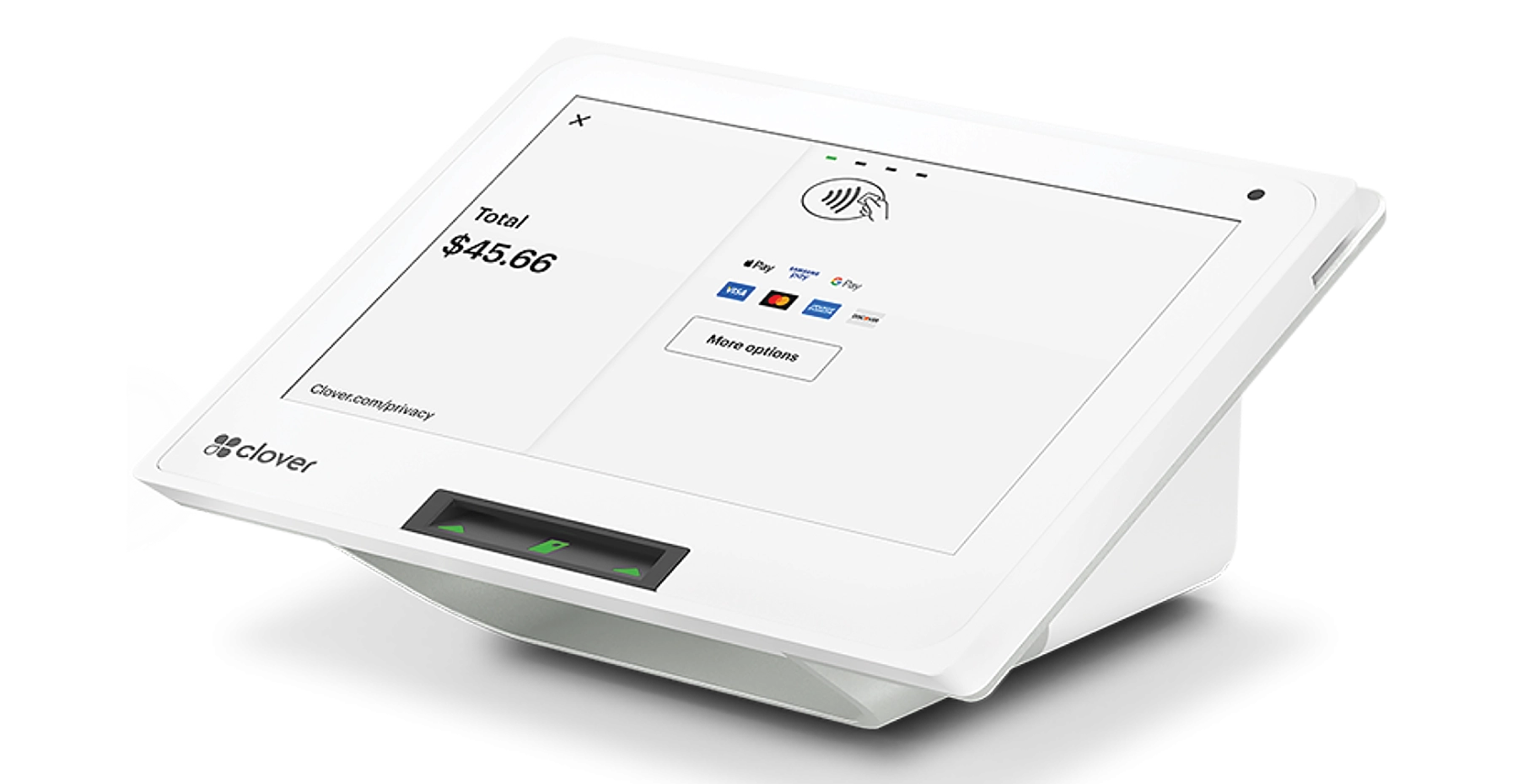
Hardware matters more than people expect. A cramped screen, or a device that does not match how your business actually moves, makes every flow harder to learn. A Clover Mini suits a fixed counter, a Clover Flex travels to the table or the curb, and a Clover Station gives a high-volume counter the screen space to keep everything one tap away. If you are not sure which fits, our POS devices lineup lays the differences out side by side.
Kitchens have their own version of this problem. A kitchen display system retires the handwritten-ticket telephone game, which means a new server’s order error stops turning into a remade entree. And if you run a loyalty program or Zero Fee Processing, both belong in day-one training rather than in an afterthought, because both require saying something specific to the customer at the register.
Want a register your staff can learn in one shift?
VMS builds your menu, sets employee permissions, and walks your team through the whole flow before you go live.
Or call our team: 888-902-6227
Train Once, Then Let Every Shift Pay You Back
POS system training is the rare small-business investment where the payback lands the same week. Ninety focused minutes on a new hire’s first day buys you faster lines, cleaner inventory numbers, fewer refund mistakes, and an employee who stops interrupting you every fifteen minutes. Skip it and you spend those ninety minutes anyway, in thirty-second increments, spread across their first three months and every customer who waited too long.
Build the cheat sheet. Do the reverse-shadow. Set the permissions. Configure the screen so it teaches on its own. Refresh at day seven and day thirty, and the whole thing starts running itself.
And if your register is fighting you rather than helping you, that is worth a conversation. VMS has been setting up small businesses with Clover systems since 1998, and we handle the configuration, the menu build, and the staff walkthrough as part of getting you live rather than as an upsell. Our support team is based here and picks up the phone, which matters at 7pm on a Friday when something is not behaving the way it did that morning.
Have questions about POS system training?
Fill out the form below and a VMS payment specialist will contact you shortly.