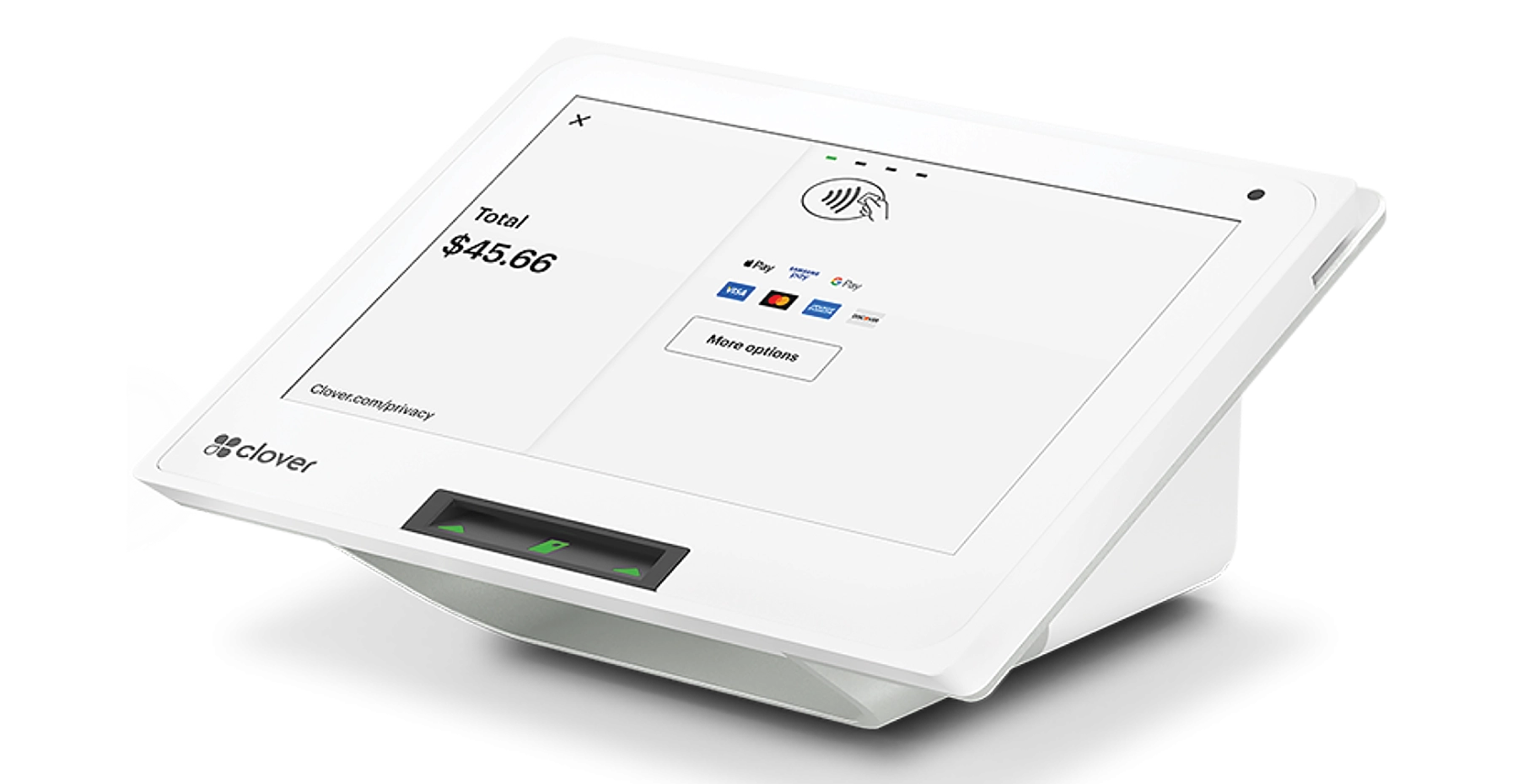


There is a moment almost every growing shop hits. The line is four deep, your card reader is balanced on a stack of receipt paper, somebody is asking whether you take Apple Pay, and the day’s totals are going on the back of an envelope. That is usually the moment a Clover Station starts looking less like an expense and more like a fix. It is also the moment a lot of owners overspend, because the honest answer to whether you need a Clover Station depends entirely on what actually happens at your counter.
So let’s skip the brochure language. This guide covers what the hardware really does, how the two Station models differ, what you should expect to pay, and just as importantly, which businesses are better off with something smaller and cheaper. By the end you will know whether a Clover Station belongs on your counter or whether that money is better spent somewhere else in the business.
What a Clover Station Actually Is
A Clover Station is the countertop, all-in-one end of the Clover family. It is not a card reader you plug into something else. It is the register itself: a large tiltable touchscreen on a weighted pedestal base, a receipt printer built into that base, and a cash drawer underneath the counter. It runs the full Clover operating system, so orders, payments, inventory counts, staff logins and reporting all live on one device instead of scattered across a tablet, a terminal and a spreadsheet.
According to Clover’s published device specifications, the Station runs a 14-inch full-HD tiltable display, roughly the footprint of an open laptop, with EMV chip, magnetic stripe and NFC contactless reading all built in. Connectivity covers Ethernet, Wi-Fi and 4G LTE, which is the quiet feature that saves your Saturday when the shop’s internet drops.
That contactless reader matters more than the spec sheet suggests. The Federal Reserve’s 2026 Diary of Consumer Payment Choice found debit cards are now the most preferred in-person payment method at 40% of consumers, with credit right behind at 38%. That is roughly four in five in-person sales riding on a card or a phone tap. A counter that handles taps slowly, or not at all, is quietly taxing every one of those transactions in customer patience.
Here is the part people miss, though. The same research found cash still accounts for 14% of all payments, four in five consumers used cash in the past month, and 90% say they plan to keep using it. A Clover Station takes that seriously in a way tablet-only setups do not. The cash drawer and the receipt printer are part of the unit, not accessories you bolt on later and hope stay connected.
One more practical note. Because everything runs on one device, you stop paying for the little pile of separate services that tend to accumulate: a separate terminal, a separate reporting tool, a separate tip-management workaround. That consolidation is often where the real savings hide, and it is a point we have made before about how Clover replaces several devices you may still be paying for.
Clover Station Solo vs Clover Station Duo
Clover sells the Station in two configurations, and the difference between them is one screen. The Solo is a single 14-inch display facing you. The Duo adds a second, smaller customer-facing screen, 8 inches per Clover’s specs, mounted on the same base and angled toward the person paying.

That second screen does more work than its size suggests. The customer watches their own order build line by line, which cuts the “wait, what am I being charged for?” conversation down to almost nothing. They confirm the total, tip on their own screen without you awkwardly spinning the device around, and sign or tap themselves. If you take tips, the Duo often pays back its premium within a few months on tip averages alone, because people tip more consistently when they are choosing on their own screen rather than under a cashier’s gaze.
| Station Solo | Station Duo | |
|---|---|---|
| Merchant screen | 14″ tiltable full HD | 14″ tiltable full HD |
| Customer-facing screen | None | 8″ HD, angled to the customer |
| Customer tips & signs themselves | No, you turn the screen | Yes, on their own screen |
| Receipt printer & cash drawer | Included | Included |
| Typical street price | Around $1,799 | Around $1,899 |
| Best for | Back-of-house, workshops, appointment-based counters | Retail, cafes, restaurants, anywhere tips matter |
Footprint is the other honest difference. Both models sit on the same weighted pedestal, so the counter space they need is similar, but the Duo’s second screen has to face the customer, which means it needs a clear line to where people actually stand. On a deep counter with a display case in front of it, that is worth measuring before you order rather than discovering on install day.
The rough rule: if money changes hands face to face and tips are part of your business, get the Duo. If you run a counter where the customer rarely stands in front of the register, such as a workshop, a back-of-house operation or an appointment-based studio that settles up in the back, the Solo does the same job for less. The Clover Duo page walks through the dual-screen setup in more detail, and we built a full Clover Flex vs Clover Mini comparison for owners who are not sure a countertop unit is the answer at all.
What a Clover Station Really Costs
Hardware first. Street pricing on a Station Solo generally lands around $1,799 and the Duo around $1,899, though what you actually pay swings widely depending on who sells it to you and whether it is bundled into a monthly plan. Some resellers spread the hardware across a 36-month agreement instead. Neither approach is automatically better, but a 36-month hardware lease with an early termination fee is a very different commitment from buying the box outright, and that difference is rarely explained at signing.
Then there is software. Clover charges a monthly software plan on top of the hardware, and the plan you need depends on whether you are running retail, full-service dining or a quick-service counter. We break the tiers down in our guide to Clover POS pricing plans, because this is the line item that surprises people about six weeks in.
And then there is the part that dwarfs both. Over a three-year life, what you pay in credit card processing fees on a busy counter will almost always exceed the cost of the hardware and the software combined, often by a wide margin. A shop running $40,000 a month through the register is paying somewhere in the neighborhood of $1,000 a month in card fees depending on the card mix. That is the number to negotiate hardest on, and it is the one most owners never see broken out.
This is also where Zero Fee Processing is worth a serious look. It shifts the card-acceptance cost off your margin, and on a Clover Station it is handled right at the register rather than through a workaround taped to the counter. Whatever you decide, get the effective rate in writing: the all-in percentage you actually pay, not the headline rate printed on the first page of the proposal.
Who Belongs on a Clover Station and Who Doesn’t
A Clover Station earns its keep when three things are true: you have a fixed counter, you have real transaction volume moving across it, and more than one person rings up sales.
Retail shops fit this almost perfectly. A boutique, a bottle shop, a hardware store, a garden center. If that is you, our retail payment processing page covers the setup in more depth. So do full-service restaurants running a host stand and a bar, and quick-service restaurants where speed at the register is the entire game.
Who should not buy one? Mobile businesses, for a start. If you sell at markets, fairs, client sites or out of a truck, a Station is dead weight and you want a Clover Flex in your hand instead. Very low-volume counters are the other case. If you ring up fifteen sales a day, a Clover Mini does nearly everything a Station does in a smaller, cheaper package, and nobody has ever regretted keeping counter space.

There is also a middle path people forget. A Station at the main counter plus a Flex for line-busting or tableside is a common and genuinely effective combination: the Station anchors the operation and the Flex goes wherever the customer is. For high-traffic self-order setups, a Clover Kiosk alongside the Station takes the simplest orders off your staff entirely. You can see the full range on our POS devices for small businesses page.
The Software Side: Apps, Reporting and Staff
Hardware is the part you can see, but the reason a Clover Station tends to stick is what runs on it. Every sale posts to the Clover Dashboard, which you can open from your phone at home. Our Clover Dashboard guide walks through what is actually worth checking daily versus monthly, which is a shorter list than most people assume.
A few things are worth turning on early. Employee management gives every staff member their own login, so you can see who rang what and end the mystery of the unexplained void. Loyalty programs run natively at the register, which is the only place customers reliably sign up. And online ordering flows into the same system, so web orders and counter orders land in one queue instead of two.
If you run a kitchen, pairing the Station with a Clover KDS screen replaces the printed ticket rail entirely, which is either a small change or a transformative one depending on how many tickets you lose in a rush.
One caution worth building in: any system that runs your whole counter is a single point of failure, so it pays to know the fallback before you need it. We wrote up what to do during a Clover outage for exactly that reason. It is a short read that can save a very bad afternoon.
Getting Set Up Without Overpaying
A few practical things to sort out before you sign anything.
- Get the effective rate, not the headline rate. Ask what percentage of your total volume went to fees last month, all in. Any processor that will not answer that plainly is telling you something.
- Separate the hardware deal from the processing deal. Bundling them makes it very hard to see what you are really paying for either one.
- Ask about the early termination fee before you ask about the monthly. It is the number that traps people.
- Confirm what happens when the internet goes down. The Station supports 4G LTE, so make sure your plan actually includes it.
- Plan the counter layout first. A Duo needs room for two screens and a drawer. Measure before it arrives, not after.
Setup itself is usually a same-week job. The unit arrives configured, your menu or catalog gets loaded, and staff need maybe an hour to get comfortable. If you already keep inventory in a spreadsheet, that imports. If you are switching from another system, ask specifically whether your historical sales data comes with you, because very often it does not.
And if cash flow is the only thing standing between you and a proper register, that is a solvable problem rather than a reason to wait. Working capital based on your card volume exists for exactly this kind of purchase.
Not sure which Clover Station fits your counter?
VMS reads your actual statement, sizes the right device, and quotes the all-in rate up front — usually same day.
Or call our team: 888-902-6227
The Bottom Line on a Clover Station
A Clover Station is a genuinely good piece of hardware for the business it suits: a fixed counter with real volume and more than one person on the register. The Duo’s second screen is worth its small premium almost any time customers pay face to face, and the built-in drawer and printer mean you are not assembling a register out of spare parts.
It is the wrong buy for mobile sellers and overkill for a very quiet counter. The most expensive mistake is not choosing the wrong model, though. It is signing a hardware agreement and a processing agreement in the same breath without reading either one. Get the effective rate, get the termination terms, and then pick the device.
VMS has been helping small businesses sort exactly this out since 1998. We will look at your actual statement, tell you honestly whether a Clover Station is the right call for your counter, and quote it transparently. Have a question first? Our merchant services FAQs cover the common ones, and our support team is real people in Downers Grove, Illinois.
Have questions about a Clover Station for your counter?
Fill out the form below and a VMS payment specialist will contact you shortly.