

Running a restaurant is one of the hardest businesses in the world. Your margins are thin — the National Restaurant Association puts the average restaurant profit margin somewhere between 3% and 9%, and that is before you factor in the one expense most owners rarely scrutinize: restaurant payment processing fees.
Here is the reality: restaurant payment processing costs typically run between 1.5% and 3.5% of every card transaction. If your restaurant processes $60,000 a month in card sales — modest for most full-service spots — you could be handing over $900 to $2,100 every single month just to accept payment. That is $10,800 to $25,200 a year. Enough to hire an extra line cook, fund a kitchen upgrade, or carry you through a slow winter.
The frustrating part? Most restaurant owners have no idea how much they are actually paying — and their processor is happy to keep it that way.
Restaurant payment processing does not have to be a black box. With the right setup, the right partner, and a few deliberate decisions, you can dramatically reduce what you pay and put more of every sale back in your pocket. Here are five proven strategies to get you there.

What Restaurant Owners Actually Pay in Processing Fees
Before we get into the solutions, it helps to understand what you are really paying for. When a customer swipes, taps, or inserts their card at your restaurant, that transaction passes through several parties:
- The card network (Visa, Mastercard, Amex, Discover) collects an interchange fee — typically 1.5% to 2.5% depending on the card type. Rewards cards and corporate cards cost more than basic debit cards.
- The issuing bank gets a portion of that interchange fee.
- Your payment processor adds a markup on top — this is where your cost goes from “set by Visa” to “set by whoever you signed your contract with.”
- Your equipment or software provider may add gateway fees, monthly fees, or per-transaction fees on top of everything else.
The problem is that most processors bundle all of this into a number that looks simple — say, “2.7% flat” — but that simplicity comes at a price. Flat-rate pricing is almost always more expensive for restaurants with decent volume, because it averages the cheap transactions like debit with the expensive ones like Amex rewards and adds a comfortable margin for the processor on both.
Understanding this structure is the first step toward paying less.
1. Eliminate Card Fees Entirely with Zero Fee Processing
The most powerful move a restaurant can make is to stop paying processing fees altogether. VMS offers a compliant Zero Fee Processing program that legally shifts the cost of card acceptance to the cardholder — typically as a small service charge added to card transactions, while cash-paying customers see a slight discount.
Done right, this means you keep 100% of every card transaction. Nothing goes to Visa. Nothing goes to your processor. Zero.
Your menu prices stay the same for cash customers. Card customers see a small service charge — typically 3% to 4% — added at checkout. This is disclosed at the entrance, on the menu, and on the point-of-sale screen, in full compliance with Visa and Mastercard rules. Customers have a choice, and most simply swipe their card without a second thought.
Is Zero Fee Processing right for every restaurant? Not always. Fine dining spots where the guest experience is paramount sometimes prefer to absorb fees rather than add a line item to a $200 check. But for fast-casual restaurants, cafes, delis, lunch counters, and high-volume quick-service operations, it has been a game-changer. Many VMS restaurant clients who have made the switch report saving thousands of dollars per month with almost no pushback from customers.
The important caveat: compliance matters. A card-brand-compliant program requires proper signage and disclosure — it cannot simply be a hidden surcharge tacked on silently. VMS handles all the setup and compliance details so you do not have to navigate Visa and Mastercard rules on your own.
2. Upgrade to a Restaurant-Grade POS System
Your POS system is the beating heart of your restaurant payment operation. An outdated system — one that cannot handle contactless payments, misreads cards, drops connections, or forces manual workarounds — is not just annoying. It costs you real money in the form of slower table turns, frustrated customers, and transaction errors.
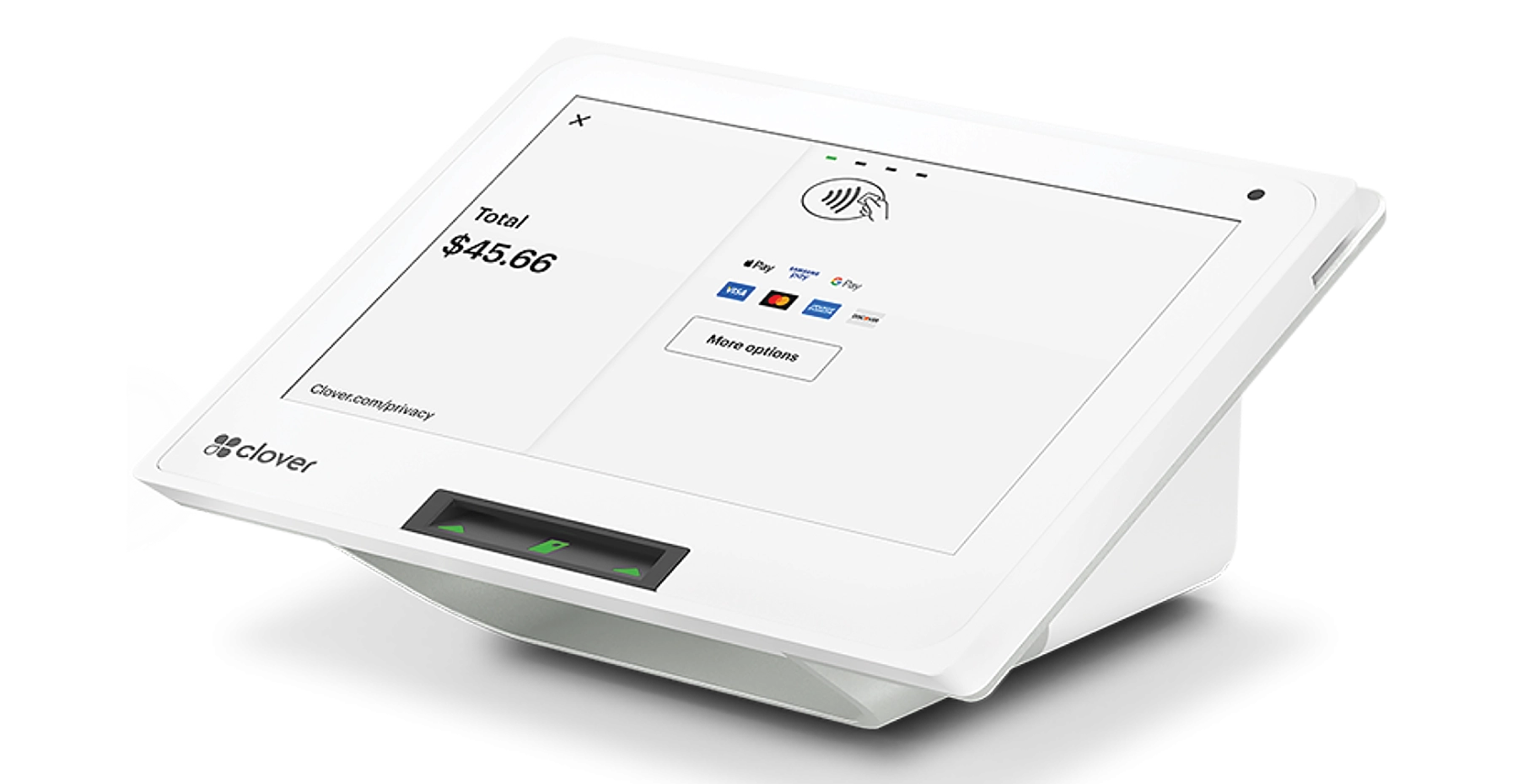
Modern restaurant POS systems like Clover do far more than accept payment. They manage your menu, track inventory, handle split checks, prompt for tips, run sales reports, and give you real-time visibility into your busiest shifts. That operational intelligence compounds over time — you make better staffing decisions, reduce food waste, and catch discrepancies before they become problems.
For full-service restaurants, the Clover Flex is ideal for tableside payment. Customers pay right at their seat, which speeds up table turns meaningfully. Faster turns mean more covers per shift, which directly increases revenue. VMS works with full-service restaurants of every size to find the right hardware configuration.
For quick-service and fast-casual spots, the Clover Mini or Clover Duo handles high-volume transaction flow without slowing down the line. When you are running 300 transactions during a lunch rush, every second at the POS matters.
What to look for in a restaurant POS:
- Tip management built in — on-screen tip prompts reduce friction, increase average tips, and eliminate manual entry errors
- Offline mode — if your internet has a hiccup at 6:30pm on Saturday, the system keeps processing and syncs when connectivity returns
- Menu flexibility — add a daily special, 86 an item, or modify modifiers in seconds without a tech support call
- Real-time reporting — see what is selling, who your top servers are, and when your peak hours hit, all from a tablet or your phone
If you are currently on Toast and frustrated with rising software fees, mandatory hardware rental, or limited third-party integrations, our post on leaving Toast POS breaks down exactly why hundreds of restaurants have made the move to a more flexible setup.
Paying too much to accept cards at your restaurant?
VMS gives you a free statement review and can wipe out card fees with Zero Fee Processing — often in days.
Or call our team: 888-902-6227
3. Read Your Restaurant Payment Processing Statement
This one sounds obvious, but most restaurant owners have never actually read their processing statement — and their processor is relying on that. Statements are intentionally dense, with fees scattered across multiple line items, categories that sound official, and rates that shift month to month without explanation.
Interchange fees are set by Visa, Mastercard, Amex, and Discover. They are non-negotiable, but they vary widely by card type. A basic Visa debit card costs around 0.05% plus $0.22. A Visa Signature Preferred rewards card costs 2.10% plus $0.10. If your processor charges you a flat 2.75% on every transaction regardless, you are overpaying on debit and mid-tier cards to subsidize the processor profit on premium cards.
Processor markup is your processor actual margin — the spread between what Visa charges them and what they charge you. A fair markup for a restaurant doing $50,000 a month might be 0.2% to 0.5% plus a small per-transaction fee. If you see a markup that is not broken out at all, that is a red flag.
Monthly and batch fees — statement fees, gateway fees, batch settlement fees, PCI compliance fees, minimum monthly fees — some are legitimate, many are not. Add them up. A $7.95 statement fee plus a $9.95 gateway fee plus a $19.95 PCI non-compliance fee is $37.85 before you process a single transaction.
The Federal Reserve Payments Study found that the majority of in-person restaurant transactions are now made by card. That means your processing costs apply to most of your revenue — understanding your statement is not optional if you want to protect your margins.
If you have never reviewed your statement and do not know what you are paying, request a free statement analysis from VMS. We will break it down line by line and show you exactly where you are overpaying.
4. Accept Every Payment Type Your Customers Expect
A payment method you cannot accept is a sale you might lose — or at minimum, a moment of friction that leaves a bad impression. Contactless payments such as tap-to-pay, Apple Pay, Google Pay, and Samsung Pay have moved from novelty to expectation, especially among younger diners. According to Visa, contactless now accounts for more than 25% of all U.S. in-person transactions — and that figure is higher in food service, where speed matters.

If your terminal is more than three years old, there is a real chance it does not support NFC tap-to-pay. That means a customer reaches for their phone or taps their card and nothing happens — an awkward moment that did not need to happen.
In a full-service restaurant, the payment step is one of the last touchpoints of the guest experience. If it is clunky, it colors the entire meal. In a quick-service environment, a slow or failed transaction creates a line that can stretch out the door and kill lunch service. When every transaction is smooth and under 10 seconds, you:
- Turn tables faster, increasing covers per service
- Keep staff focused on hospitality, not troubleshooting
- Reduce transaction disputes and chargebacks from frustrated customers
Clover devices support every payment type: EMV chip, magstripe, contactless NFC, Apple Pay, Google Pay, and QR code payments. If you also offer online ordering, your payment gateway should support digital wallets there too — a disconnected online and in-store experience creates administrative headaches.
Pairing your payment setup with a loyalty program can amplify these gains. Customers who earn points come back more often and spend more per visit. Clover has built-in loyalty tools that tie directly into your POS and payment data.
5. Work with a Local Merchant Services Partner Who Knows Restaurants
Here is something the big payment processors do not advertise: their pricing models are designed for the average business, not for your restaurant. Square, Toast, and Stripe offer simple, flat-rate pricing because it is easy to market — not because it is the best deal for a restaurant doing real volume with a real mix of card types.
A local merchant services partner like VMS builds a pricing structure around your actual numbers. Your average ticket size, your card mix, your monthly volume, your peak seasons — all of that factors into what your rate should be. For most restaurants doing $40,000 or more per month in card volume, a customized pricing model is significantly cheaper than any flat-rate option on the market.
Beyond pricing, the service model matters. When your terminal freezes during dinner service, you do not want to be in a remote chat queue with someone reading from a script. VMS is a team you can actually call — local support, real people, fast response — because we understand that payment downtime in a restaurant does not happen during business hours.
Working with VMS also opens the door to working capital — merchant funding based on your card processing volume that can help you cover a kitchen upgrade, fund a renovation, or bridge a seasonal slowdown. Because we process your payments, we can often offer better terms than a traditional business loan.
The Bottom Line on Restaurant Payment Processing
Your payment processing setup is one of those back-of-house costs that quietly compounds over time. A percentage point here, a monthly fee there, a hardware rental you never renegotiated — it adds up. And unlike food costs or labor, your processing fees are largely invisible until you actually look.
The five strategies above — Zero Fee Processing, a modern restaurant POS, statement transparency, broad payment acceptance, and a hands-on local partner — give you a clear playbook for taking control of what you pay. None of them require a massive overhaul. Each can be implemented in stages, starting with a free statement review.
If you process more than $20,000 a month in cards and have not reviewed your payment setup in the past year, there is a good chance VMS can save you money. Our full-service restaurant payment solutions page shows what we do for dine-in operations, and we work with quick-service spots, cafes, and everything in between.
The best time to cut your restaurant payment processing costs was last year. The second-best time is right now.
Have questions about your restaurant payment processing?
Fill out the form below and a VMS payment specialist will contact you shortly.