

Something strange is starting to happen at small business checkouts, and most owners have not noticed yet. A sale comes through. The customer never visited your website, never scrolled your product photos, never added anything to a cart. An AI assistant did all of that on their behalf, compared you against three competitors, decided you were the best fit, and paid. That is what agentic payments are, and they are no longer a conference-stage thought experiment. They are live, they are growing fast, and the businesses that get set up for them first are quietly picking up sales that used to go somewhere else.
If that sounds like a problem for giant retailers only, the numbers say otherwise. The plumbing for agentic payments is being built by Visa, Mastercard, Stripe, OpenAI and PayPal right now, and every one of them is racing to plug in small merchants specifically. This is a rare moment where the small shop can move faster than the chain store, because there is no committee to convince. Let’s walk through what is actually happening, what it costs, and the short list of things worth doing about it.
What Agentic Payments Actually Are
Strip away the jargon and agentic payments describe one shift: an AI agent is allowed to complete a purchase, not just recommend one. For years AI has been a research assistant. You asked it for the best cast iron skillet under sixty dollars and it gave you a list with links. You still did the clicking, the typing, the card entry, the confirming.
Agentic payments remove those last steps. The customer says “order it,” and the agent talks directly to the merchant’s system, submits the order, and authorizes payment using a credential the customer has already approved. The shopper is still in charge of the decision and the money. They are simply no longer the one filling in the form.
That distinction matters enormously for your business, because it changes who you are selling to. For the first time, part of your customer base is software. Software does not fall for a pretty homepage. It reads your product data, your price, your availability, your shipping window, and your return policy, and it makes a cold comparison. The good news is that a well-run small business often wins that comparison, because the things agents weigh most are the things small shops are frequently better at.
The Numbers Behind the Agentic Payments Shift
This is where the story stops being speculative. Adobe Analytics, drawing on more than a trillion visits to U.S. retail sites, found that traffic arriving from AI sources grew 393% year over year in the first quarter of 2026. Stretch the timeline and it looks even more dramatic: AI-referred traffic to retail sites is up 1,324% since October 2024, when Adobe first started tracking it at all.
Volume alone would be interesting. What makes it urgent is quality. In March 2025, shoppers who arrived from an AI assistant converted 38% worse than everyone else. Twelve months later that had flipped completely, and by March 2026 the same traffic converted 42% better than non-AI traffic. By May 2026 the gap had widened again to 54% better. These are not window shoppers. Once they land, they spend 48% more time on the page, browse 13% more pages, and generate revenue per visit roughly 37% above other channels.
Visa saw the same wave from a different vantage point. The company reported a 4,700% surge in AI-driven traffic to online merchants, which is precisely why it introduced an open framework to help merchants tell a legitimate shopping agent apart from a malicious bot. When a card network builds infrastructure that fast, it is responding to real volume, not a forecast.
Put simply: the traffic is already arriving. The only open question is whether your business is set up to take the order when it does.
How an AI Agent Actually Buys From You
The mechanics are less mysterious than they sound, and three of the biggest names in payments have each published their approach.
OpenAI and Stripe co-developed the Agentic Commerce Protocol, the open standard behind Instant Checkout inside ChatGPT. When a shopper places an order, the agent passes the order details to the merchant’s own backend. The merchant accepts or declines it, runs the payment through their existing processor, and handles fulfillment and support exactly as before. U.S. Etsy sellers went live first, with more than a million Shopify merchants following, and PayPal’s own server is set to bring tens of millions of additional small businesses onto the platform through 2026.
Mastercard took the credential angle with Agent Pay, which issues what it calls Agentic Tokens. A token is bound to one specific agent, one merchant scope, and one consent policy, so an assistant can finish a checkout without ever touching the real card number. If you have read our explainer on credit card tokenization, this is that same idea pushed one step further.
Visa’s Trusted Agent Protocol, built with more than ten partners on existing web infrastructure, tackles identity: proving to your store that the thing at the door is an authorized buying agent rather than a scraper. More than 100 partners are working with Visa across the commerce ecosystem, with dozens of agents already integrating directly.
Notice the common thread. In all three designs, the merchant keeps control of the order, the processing relationship, and the customer. Nobody is trying to take your business out of the loop. They are standardizing how an agent knocks on the door.

Why Your Product Pages May Be Invisible to AI Shoppers
Here is the least glamorous and most valuable finding in the whole dataset. Adobe scored how readable retail sites actually are to machines, and the results are humbling. Homepages averaged 75%. Category pages came in at 74%. Individual product pages, the ones that actually get bought, scored just 66% — and the spread between the best and worst performers ran from 82.5% down to 54.2%.
Translate that: roughly a third of the content on a typical product page is effectively invisible to the AI doing the shopping. If an agent cannot reliably parse your price, your stock status, your sizes, or your shipping estimate, it does not argue with you. It just recommends the competitor whose data it could read.
This is the part of agentic payments that is entirely inside your control, and it does not require new technology. It requires boring discipline:
- Complete, structured product data. Real titles, real descriptions, accurate prices, actual variants. No “call for pricing.”
- Honest inventory status. An agent that gets burned by a phantom in-stock listing learns not to trust you.
- Clear shipping and return terms stated in plain text on the page, not buried in an image or a PDF.
- A checkout that does not fight back. Many of the same friction points we covered in common checkout mistakes trip up agents even harder than humans, because an agent will not persevere through a broken step.
If you already run online ordering through a modern platform, most of this is a data-hygiene project rather than a rebuild. That is a much smaller lift than the headlines suggest.
Who Is Holding the Card? The Security Side of Agentic Payments
Every owner asks this, and it is the right question. If software is paying, who is liable when it goes wrong?
The architecture is deliberately built so the agent never holds your customer’s actual card number. Credentials are tokenized and scoped, which means a token issued for one agent and one merchant is useless anywhere else. That is a meaningfully better security posture than a customer typing a full card number into a form, and it is the reason the networks moved to tokens before opening the door to agents at all.
That said, agentic payments are still card-not-present transactions, and they inherit that world’s risks. Everything you already know about card-not-present fraud still applies. So does your obligation around PCI compliance — an AI-placed order does not change your responsibility for how card data moves through your systems.
The new wrinkle is bot discrimination. You genuinely want to admit authorized shopping agents and block hostile automation, and those can look similar from the outside. That is exactly the gap Visa’s trusted-agent work is designed to close, and it is a good reason to stay on a processor that keeps current with network standards rather than one that quietly falls behind. If you are unsure where your setup stands, our merchant services FAQs is a reasonable place to start, and a five-minute conversation will settle it faster.
What Agentic Payments Do to Your Processing Costs
Let’s talk about the number nobody puts on the slide. OpenAI charges merchants a 4% transaction fee on every completed Instant Checkout purchase. The shopper pays nothing extra. That fee sits on top of your normal processing cost, not instead of it.
Four percent is real money, so it deserves a clear-eyed look rather than a reflex. Two things are worth holding at once.
First, it is a customer-acquisition cost, not a processing rate, and it should be judged against what you already pay to acquire a customer. If you are spending meaningfully on ads to reach a buyer who may or may not convert, a 4% fee on a sale that already closed can compare favorably. Remember that this traffic converts far better than average.
Second, it makes the rest of your cost stack matter more, not less. Every point you are overpaying elsewhere hurts more when a new channel takes its own cut. This is the moment to actually read your statement and understand your interchange fees, and to look hard at whether a program like Zero Fee Processing fits your in-store business so your card-present margin can carry a thinner online channel. Note that surcharge-style programs generally do not travel into an agent-driven checkout, which is another argument for knowing your true blended cost before you lean in.
The businesses that will do well here are the ones that treat agentic payments as one channel among several, priced and measured on its own terms, rather than a mandate to be accepted or refused wholesale.

Getting Your Checkout Ready Before the Agents Arrive
None of this requires a moonshot. Here is the practical sequence, roughly in order of payoff.
Start with your data, not your technology. Audit your top twenty products the way an agent would: is the price current, the stock status true, the variant list complete, the shipping window stated? Fix those twenty before touching anything else. That single pass closes most of the readability gap the Adobe data exposed.
Ask your processor and your platform two direct questions. Are you supporting the agentic standards, and what will I need to do when it is my turn? If your commerce platform is on a major stack, enabling agent checkout can be close to a configuration change rather than a project. Getting a straight answer now tells you whether you are positioned or stuck.
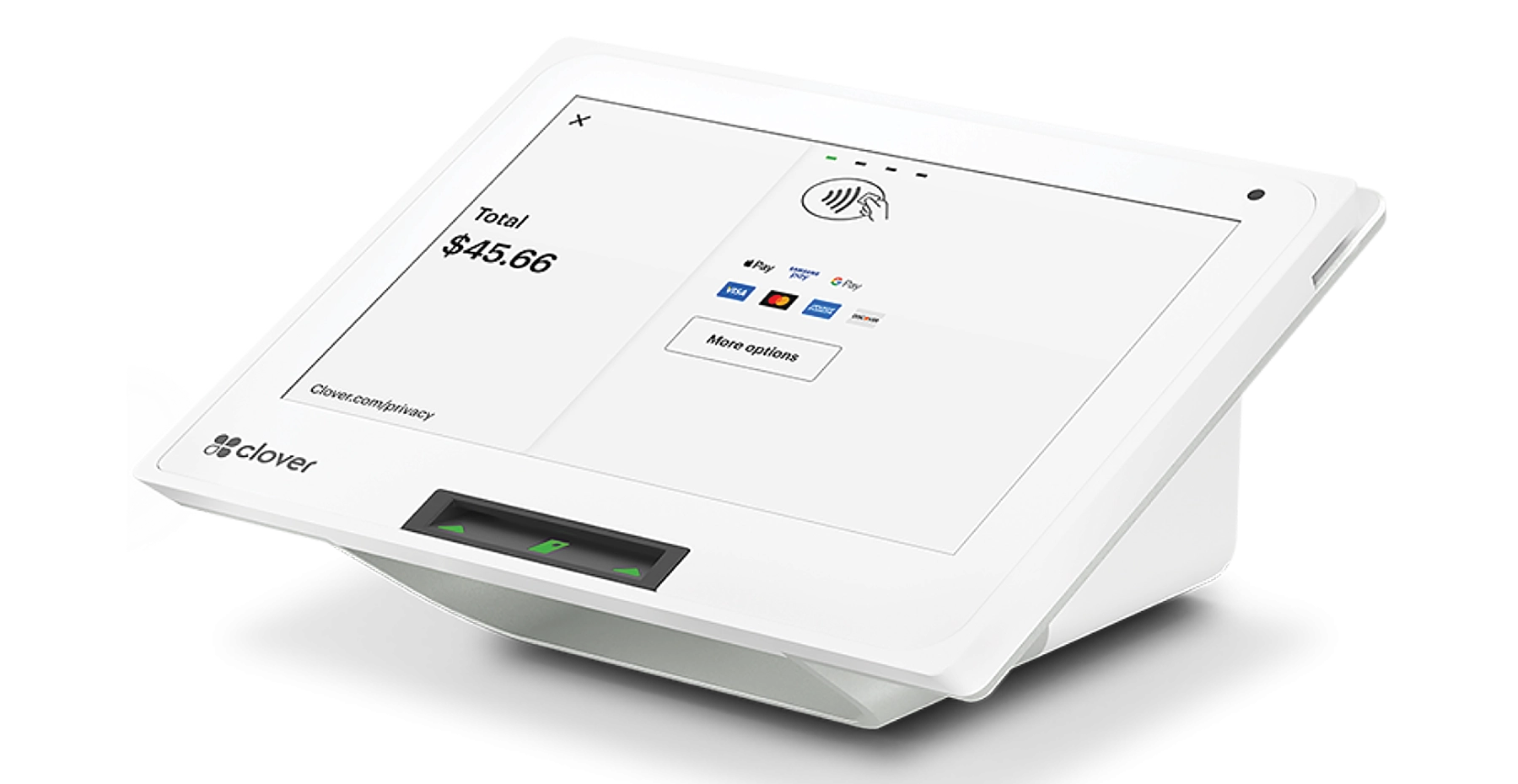
Make sure in-store and online tell the same story. An agent that sees one price online while your counter shows another is a trust problem waiting to happen. If your POS devices and your web catalog share one inventory and one price list, this is already handled. If they do not, that reconciliation is worth doing on its own merits, and a countertop system like the Clover Mini is built to keep the two in sync.
Do not surrender the relationship. The real risk in agentic payments is not the fee, it is becoming an interchangeable SKU. An agent can place the order; it cannot make someone love your shop. Packaging, a note in the box, a follow-up, and a real loyalty program are how a machine-brokered first sale becomes a human second one. Capture the customer, not just the transaction.
Watch the channel like a channel. Tag agent-originated orders if your platform allows it and review them monthly. Conversion, average order value, return rate, support load. Six months of your own data beats anybody’s forecast, including this article’s.
Is your checkout ready for agentic payments?
VMS helps small businesses get their payments, POS and online ordering working as one clean system – usually up and running in days, not months.
Or call our team: 888-902-6227
The Bottom Line on Agentic Payments
Every so often the way customers buy genuinely changes, and the window where preparation is cheap is short. Tap-to-pay went that way. So did Click to Pay. Agentic payments are following the same curve, only faster, because the card networks and the AI platforms are building it together instead of fighting over it.
You do not need to predict how big this gets. You need your product data clean, your checkout unobstructed, your costs understood, and your customer relationship intact. Every one of those is worth doing even if not a single AI agent ever places an order with you. That is what makes this an unusually low-risk bet.
The shops that win the agentic payments era will not be the ones with the biggest technology budget. They will be the ones whose information was accurate and whose checkout simply worked when the agents started shopping. That is a fight a well-run small business can absolutely win.
Have questions about agentic payments?
Fill out the form below and a VMS payment specialist will contact you shortly.