

Nobody opens a small business thinking they will spend a Tuesday morning on hold with their bank’s fraud department, reading a check number out loud for the fourth time. Yet that call happens constantly, and it almost always starts the same way: a check left the building, someone else got their hands on it, and the money moved before anyone noticed. Good check fraud prevention is the difference between a five-minute habit at your counter and a five-week fight to get your own money back.
Here is the part that surprises most owners. Checks are the payment method you use least and lose the most on. The Federal Reserve Payments Study has tracked check volume falling by roughly three quarters since 2000, but the average check written today is worth far more than it used to be. Fewer checks, bigger checks, and the same flimsy piece of paper protecting them. Criminals noticed that math long before most business owners did.
This guide walks through how check fraud actually reaches a small business, the check fraud prevention steps that genuinely work at the counter and in the back office, and the quiet structural fix that keeps paying off long after the fraud headlines fade.
Why Check Fraud Prevention Suddenly Matters Again
For about a decade, check fraud felt like a solved problem. Then mail theft exploded.
In early 2023, FinCEN issued a nationwide alert on mail theft-related check fraud, reporting that financial institutions filed roughly 680,000 check fraud suspicious activity reports in 2022 — nearly double the approximately 350,000 filed the year before. That is not a slow drift upward. That is a doubling in twelve months, and the trend has not meaningfully reversed since. The full FinCEN alert on mail theft-related check fraud is short, and worth ten minutes.
The Association for Financial Professionals, which surveys treasury teams every year, has found the same thing from the other direction: checks remain the payment method most frequently targeted by fraud, year after year, with roughly two-thirds of surveyed organizations reporting attempted or actual check fraud. No other payment type comes close. Not cards, not ACH, not wires.
Why checks? Because a check is a public document that hands a stranger everything they need. Your business name. Your address. Your bank’s name. Your routing number. Your account number. Your signature. A card number gets tokenized and locked down six ways; a check gets dropped in a blue mailbox with all of it printed in plain sight.
That is the honest case for taking this seriously even if you have never been hit. The exposure is not proportional to how often you get defrauded. It is proportional to how many checks carry your account number out the door.
How Check Fraud Actually Reaches a Small Business
Forget the Hollywood version. The schemes that drain small business accounts are boring, repeatable, and mostly low-tech.

Check washing
Someone steals an outgoing envelope, soaks the check in a common solvent to lift the ink, and rewrites the payee and the amount. Your $340 payment to a supplier becomes a $3,400 payment to a name you have never heard. The signature is real, the paper is real, the account is real — which is exactly why it clears.
Mail theft and mailbox fishing
Thieves target outgoing mail from unlocked curbside boxes, apartment lobbies, and blue collection boxes. Your business is a prime target because business checks tend to be considerably larger than personal ones.
Counterfeit business checks
Once someone has a clean image of one of your checks, printing convincing copies is trivial. They do not need your checkbook. They need one check and a decent printer.
Altered deposits and the overpayment scam
A customer “accidentally” pays you far too much with a check, apologizes, and asks you to refund the difference by wire, app, or gift card. You send the refund. Days later the original check bounces. This one hits service businesses and contractors hardest, and it is a close cousin of the Zelle business account scams making the rounds.
Inside the building
Unpleasant but real: blank check stock left in an unlocked drawer, one person handling both the books and the deposits, a departing employee who knows where everything lives. Most internal check fraud is opportunity, not conspiracy.
Notice what all of these have in common. None of them require hacking anything. They require a piece of paper to be somewhere it should not be.
A Check Fraud Prevention Routine You Can Set Up This Week
You do not need a treasury department. You need a handful of habits in three places.
At the counter
- Accept checks on your terms, not the customer’s. Post a clear policy: business and personal checks only, matching the name on a valid ID, no third-party checks, no post-dated checks, no checks written for more than the purchase.
- Look at the paper. Real check stock has a microprint signature line that blurs under a magnifier, a padlock icon, and a security screen on the back. A check printed on plain copy paper feels wrong the moment you handle it. Train whoever is at the register to actually touch it.
- Never refund an overpayment on the same day. No exceptions, no sympathetic stories. A legitimate customer will wait the week it takes for a check to truly clear. “Funds available” is not the same as “check cleared” — banks make funds available long before they know the check is good.
- Endorse immediately. Stamp every check “For Deposit Only” with your account number the moment it hits the drawer. An unendorsed check sitting in a till is a bearer instrument.
At the bank
- Ask about Positive Pay. You upload a file of the checks you issued, and the bank flags anything that does not match on number, amount, or payee. It is the single most effective check fraud prevention tool a business can buy, and many banks will discount or waive the fee if you ask. Payee Positive Pay, which also matches the payee name, is the version you actually want.
- Turn on ACH debit blocks and filters so nobody can convert your routing and account numbers into an electronic debit.
- Set balance and transaction alerts at thresholds low enough to be annoying. Annoying is the point.
- Reconcile daily, not monthly. Most banks give you only 30 days from the statement date to report an altered or forged check. Miss that window and the loss is legally yours. The same discipline that helps you catch merchant statement red flags on your processing statement applies here.
In the back office
- Lock the check stock. Blank checks belong in a locked cabinet with a log, treated like cash, because that is effectively what they are.
- Separate duties. Whoever writes checks should not reconcile the account. In a two-person shop, the owner reviews the statement personally. That alone stops most internal fraud.
- Take outgoing mail to the counter. Hand bills to a postal clerk or use a locked collection box. Never leave outgoing payments in an unsecured box with the flag up — that red flag is a signal to thieves too.
- Shred, do not toss. Voided checks, deposit slips, and old statements all carry your account number.
Run through that list once and you have closed the doors that nearly every real-world scheme walks through.
The Quiet Fix: Give People Better Ways to Pay You
Every habit above is defense. The structural fix is simpler, and it is the one that compounds: the fewer checks that move through your business, the less of this you have to do at all.

A check is the only payment type where you hand over your bank credentials and then wait days to find out whether you were paid. Compare that to how modern payments behave.
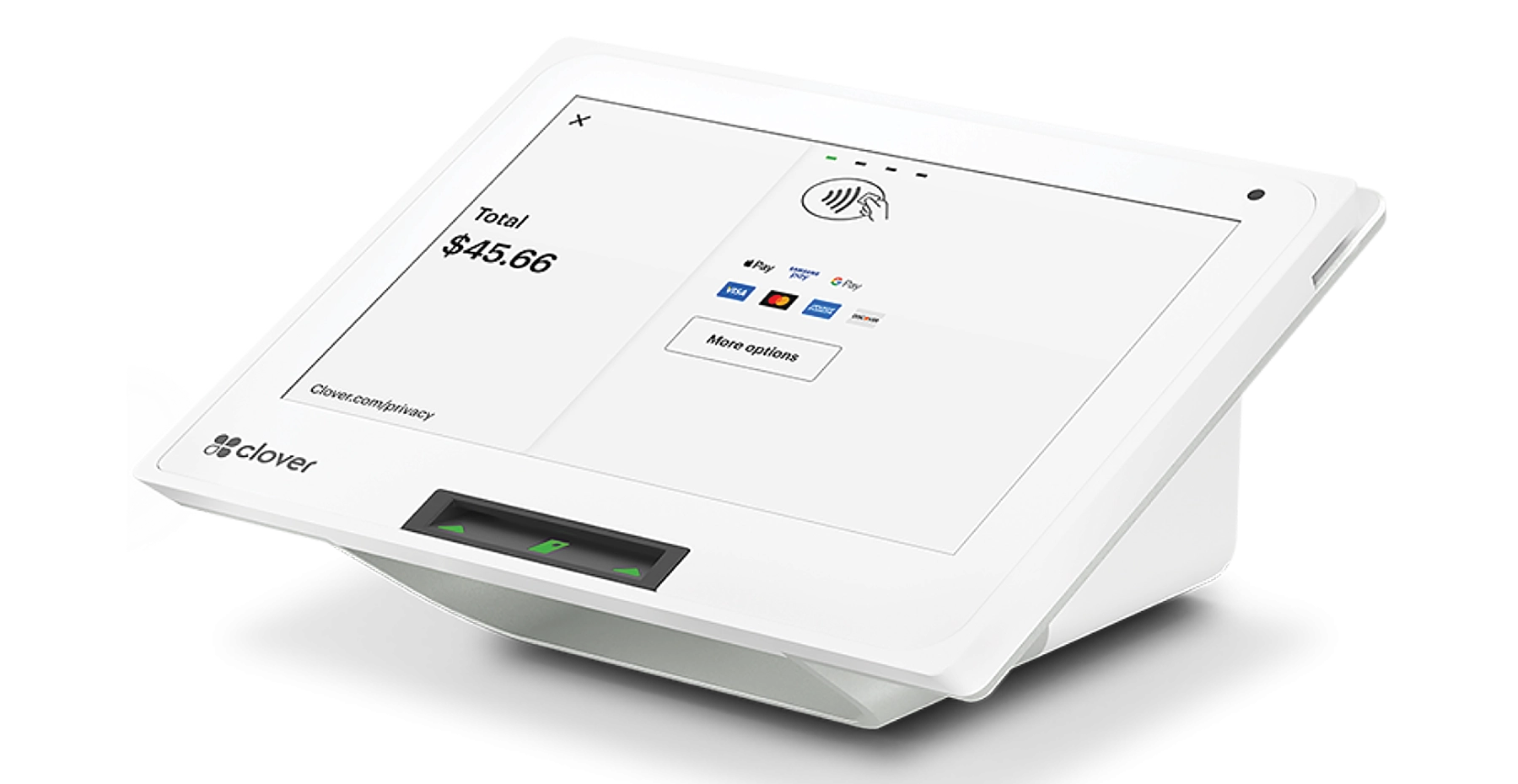
Cards settle and stay settled. When a customer taps a card or a phone on a terminal, the funds are authorized in about two seconds and your account number never leaves your building. Contractors, mobile services, and anyone invoicing on-site can take that payment at the kitchen table with a handheld like the Clover Flex instead of waiting on a check that may or may not arrive. If you are still choosing hardware, the POS device lineup for small businesses is a reasonable place to start.
Payment links and invoices remove the envelope entirely. Text or email a secure link, the customer pays from their phone, and the money lands in your account on the normal funding schedule. No paper, no mailbox, no window for anyone to intercept anything. Payment links for small business take about ten minutes to set up.
ACH and pay-by-bank keep the control on your side. For recurring B2B relationships, pulling an authorized ACH payment is far safer than waiting on a mailed check, because you initiate it and you know the exact date. Pay by bank is worth a look for larger invoices where card fees matter.
Recurring billing ends the monthly check ritual. Clients on retainer, memberships, service plans — recurring billing for small business replaces twelve chances a year for a check to go missing with one authorization.
The usual objection is cost: checks feel free and cards do not. That math rarely survives contact with reality once you price in the deposit trips, the collection calls, the NSF fees, the bookkeeping time, and the occasional washed check you eat entirely. And if card acceptance costs are what is holding you back, Zero Fee Processing is designed to move that cost off your side of the ledger legally and transparently.
Professional service firms tend to see the fastest payoff here, because their checks are the biggest and their payment cycles are the longest. Payment processing for professionals covers how that transition usually goes.
What to Do in the First 24 Hours After Check Fraud
If a bad check has already cleared, speed is the whole game.
- Call your bank’s fraud line immediately and ask them to place a hold on the account and open a claim. Do it the same business day you find it.
- Put it in writing. Verbal notice is not enough to preserve your rights. Send a written affidavit of forgery or alteration, and keep a dated copy.
- File a police report, and if mail theft is involved, report it to the U.S. Postal Inspection Service. Banks frequently ask for a report number before reimbursing.
- Close the compromised account and open a new one. Painful, but your routing and account numbers are known to the thief now. Changing them is the only real fix.
- Document everything — copies of the check front and back, your ledger, and every call with a date, name, and reference number.
The 30-day reporting window is the part that burns people. A business that reconciles monthly can easily discover an altered check on day 45 and have no recourse at all, while a business that glances at its balance every morning catches the same item on day two and gets made whole. Same fraud, completely different outcome, and the only variable is attention.
Where Check Fraud Prevention Fits With Everything Else
Checks are not the only place money leaks out of a small business, and it is worth keeping this in proportion. Card-present risk, card not present fraud, return fraud, and everyday credit card fraud prevention all deserve attention too. What makes checks different is how cheap the fix is. Most card fraud defenses require tools and monitoring. Most check fraud defenses require a locked drawer, a rubber stamp, and the willingness to say “I’ll wait until it clears.”
A practical order of operations for a busy owner: lock your check stock and endorse on arrival this week, call your bank about Positive Pay and ACH blocks next week, and start shifting your five largest and most frequent check payers onto cards, links, or ACH over the next quarter. By the time you are done, check fraud prevention stops being a worry and starts being a non-issue, because there is barely anything left to steal.
Ready to take fewer checks and get paid faster?
VMS sets up card, tap-to-pay, invoicing and ACH acceptance so the money lands in your account instead of sitting in a mailbox – usually live within a few business days.
Or call our team: 888-902-6227
Fewer Checks, Fewer Chances to Lose
Check fraud prevention is not really about outsmarting criminals. It is about removing the paper they depend on and shrinking the window in which a mistake can hurt you. Lock the stock, endorse on arrival, reconcile daily, use the tools your bank already sells, and move the biggest and most predictable payments onto rails that settle in seconds instead of sitting in a mailbox overnight.
VMS has been helping small businesses in Downers Grove and across the country get paid faster and more safely since 1998 — with Clover POS systems, tap-to-pay terminals, invoicing and payment links, ACH, and Zero Fee Processing options that keep acceptance costs predictable. If you are still taking more checks than you would like, a short conversation usually surfaces two or three payments you can move off paper immediately. Common questions are answered plainly in the merchant services FAQs, and if cash flow is the reason you are chasing slow payers in the first place, working capital may be the faster lever.
The best check fraud prevention plan is the one that leaves you with fewer checks to protect.
Have questions about check fraud prevention?
Fill out the form below and a VMS payment specialist will contact you shortly.