

You made payroll. You paid the landlord, the distributor, the card processor, the insurance company, and the kid who covers Saturdays. Then you looked at what was left and decided you could probably wait another month. If that sounds familiar, you already know that figuring out how to pay yourself is the one line item every owner postpones — and the one that quietly decides whether you can keep doing this for another ten years.
Here is the uncomfortable part. Skipping your own paycheck does not make your business healthier. It hides the fact that the business is not yet covering its real cost of operation, because your labor is the one expense you never put on the books. A shop that “makes money” only when the owner works free is not profitable. It is subsidized. Learning how to pay yourself properly is how you find out which one you have.
This guide walks through the mechanics: what your business structure allows, how to land on a number that actually holds up, and how to make the deposits predictable enough that payday stops being a guess. None of it requires an accounting degree. It does require deciding that your pay is a bill, not a leftover.
How to Pay Yourself Is a Cash Flow Question Before It Is a Tax Question
Most articles about how to pay yourself open with entity types and tax code. That is backwards. The tax rules tell you what form your pay takes. Your cash flow tells you whether the money is there at all. Get the second part wrong and the first part is academic, because how to pay yourself is only a legal question once the money exists.
The Federal Reserve’s 2026 Report on Employer Firms, drawn from a survey of more than 6,500 small employers, found that rising costs of goods, services, and wages was the single most common financial challenge owners reported over the prior year. Revenue expectations fell year over year, from an index of 39 to 33. Roughly a third of firms that sought financing faced a funding gap. In that environment, the owner’s paycheck is usually the first thing to absorb the squeeze, because it is the only expense with no invoice and no due date.
So before you touch the tax question, get honest about three numbers: what the business actually collects in a normal month, what it must spend to stay open, and how long it takes deposits to land. That last one surprises people. If your card batches settle in two or three days while rent hits on the first, you do not have a profit problem — you have a timing problem, and timing problems are far easier to fix. Our guide to cash flow management for small business covers the mechanics in detail.
Owner’s Draw or Salary: What Your Structure Decides for You
Your legal structure does not change how much you can pay yourself, and it does not really change how to pay yourself either. It changes the plumbing — which account the money moves through, what gets withheld, and what the IRS expects to see. Here is how it breaks down.
Sole proprietors and single-member LLCs
You take an owner’s draw. You move money from the business account to your personal account, and that is the whole ceremony. That simplicity is why most owners start here, and it is also why how to pay yourself goes wrong here most often. No withholding happens, which is exactly the trap: you owe self-employment tax of 15.3% on your net earnings plus income tax, and nobody is setting it aside for you. Every draw should be paired with a transfer to a tax savings account on the same day. If you are still weighing entity options, which LLC is right for your business is a useful starting point.
Partnerships and multi-member LLCs
Same draw mechanism, more paperwork. Draws follow whatever your operating agreement says about profit splits, and each partner handles their own self-employment tax. The practical advice here is unglamorous: settle how to pay yourself and your partners in writing, in the agreement, before there is money to argue about.
S corporations and the reasonable salary rule
This is where how to pay yourself gets genuinely regulated. If you elect S corporation treatment and you perform real work in the business, the IRS requires you to pay yourself a reasonable salary through actual payroll, with withholding, before you take any distributions. Reasonable means what a similar business would ordinarily pay someone else to do your job.
The rule exists because distributions avoid the 15.3% self-employment tax and salary does not, which gives owners an obvious incentive to pay themselves $12,000 and distribute $130,000. That is the arrangement the IRS looks for. And note the popular “60/40 split” you will see repeated online has no basis in the tax code — it is a rule of thumb someone invented, not a safe harbor. Document how you arrived at your salary: your role, hours, and comparable local wages. If the S corp structure is new to you, S corps and C corps compared and how to incorporate your small business both help.
C corporations
Salary through payroll, full stop. Anything beyond that is a dividend, taxed again at the personal level. Most independent retailers and restaurants never need this structure, but it matters if you are raising outside money, and it makes how to pay yourself a payroll question rather than a transfer question.
Whatever the structure, running your own pay through a real payroll system rather than random transfers makes tax season dramatically less painful — a proper payroll platform handles the withholding and filings so you are not reconstructing a year of Venmo notes in April. Our overview of taxes for small business and the roundup of deductions worth knowing fill in the rest.
How to Pay Yourself a Number That Actually Holds Up
The most common mistake is starting from revenue. Revenue is not yours, and treating it as the basis for how to pay yourself is how owners end up overdrawn in a record month. A good month at the register can coincide with a terrible month in the bank if inventory landed, a quarterly bill cleared, and two customers paid late.
Start instead from what is genuinely left. Take your average monthly collections over the last twelve months, not the last two. Subtract cost of goods, rent, utilities, payroll, insurance, software, loan payments, and processing fees. Subtract a tax reserve. What remains is the pool your own pay comes out of — and the honest answer to how to pay yourself is a fixed percentage of that pool, taken on a schedule, not whatever is sitting there on the 30th.
A simple allocation most owners can run without a bookkeeper looks like this. Every time money lands, split it into four buckets before you spend any of it.
| Bucket | Typical share of collections | What it covers |
|---|---|---|
| Operating | 50–60% | Inventory, rent, utilities, staff, software, processing |
| Owner pay | 15–25% | Your draw or salary, on a fixed date |
| Taxes | 15–20% | Self-employment, income, sales tax held in trust |
| Reserve | 5–10% | Slow months, repairs, opportunity buys |
Set the owner-pay percentage low enough that you never have to claw it back. A draw you can actually sustain at 15% beats a heroic 30% you reverse in February, and how to pay yourself well is mostly a question of picking a number you will not have to undo. Once two consecutive quarters clear comfortably, raise it. This is the same discipline behind tracking your labor cost percentage and your profit margin — you are converting a feeling into a number you can steer by.

The Fees Quietly Deciding How Much Is Left
Here is where a payments conversation earns its place in an article about how to pay yourself. Your owner-pay bucket is a percentage of what survives the operating bucket, and card processing sits inside that bucket taking a cut of literally every sale you make. It is one of the few costs that scales perfectly with your success, which makes it the single most overlooked variable in how to pay yourself more.
Run the arithmetic on your own numbers. A shop doing $40,000 a month on cards at an all-in effective rate of 3.1% pays about $1,240 a month, or roughly $14,900 a year. Move that effective rate to 2.5% and you free up about $240 a month — call it $2,880 a year that lands in the owner-pay bucket instead of the processor’s. For a lot of independents, that is the difference between a token draw and a real one.
Most owners have never calculated their effective rate, which is simply total fees divided by total card volume. It is the only number that matters when you are working out how to pay yourself more without selling more, and it is rarely the number on the sales sheet. Our walkthrough on how to read your processing statement shows where the charges hide, and credit card processing fees explains what each line actually is. If you want the fee off your books entirely, Zero Fee Processing shifts the cost to the card-paying customer while cash and debit customers pay the listed price.
Speed matters as much as rate. If deposits land the next business day instead of three days later, your owner draw stops competing with rent for the same dollars. Next-day funding is unglamorous and it changes the shape of a month. And when a genuine gap opens — a slow January, an equipment failure — working capital is a far better answer than skipping your own pay, which is the most expensive financing you will ever use.

How to Pay Yourself on a Schedule You Can Set Your Watch By
Consistency is the whole game. An owner who takes $3,000 on the 15th every month is running a business. An owner who takes $9,000 in June and nothing in July is running a lottery. Deciding how to pay yourself is really deciding to be the first kind. Three habits make the difference.
Make the money arrive predictably
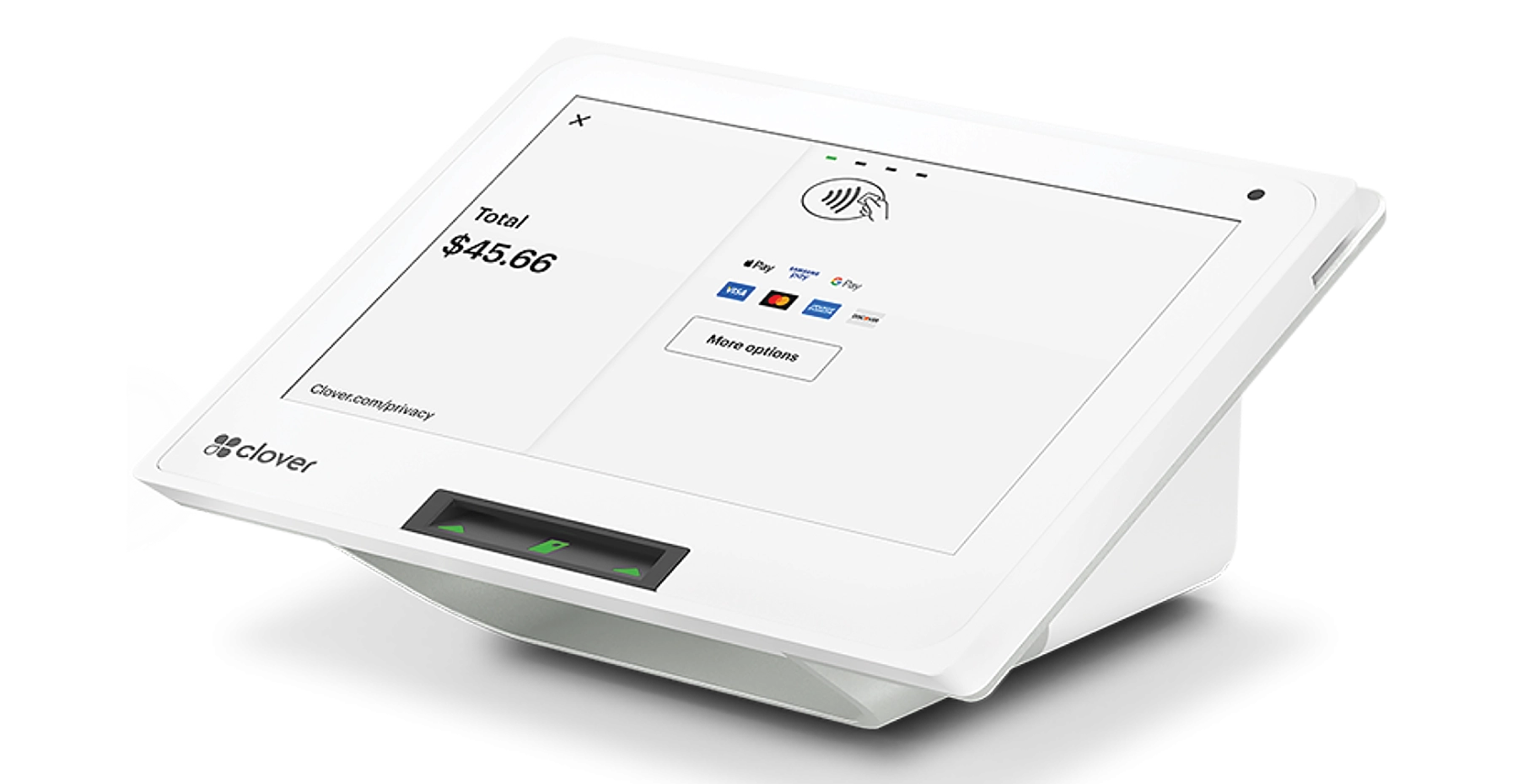
Predictable pay requires predictable deposits. That means a system that batches cleanly every night and reports in a way you can read — a Clover Mini on the counter or a Clover Flex in your hand will both show you daily collections, average ticket, and fees in one place. Browse the full range of POS devices for small businesses to match the hardware to your counter. Adding recurring or scheduled revenue smooths the curve further, whether that is a loyalty program that brings regulars back on a rhythm or online ordering that keeps sales coming when the door is quiet.
Automate the transfer
Schedule the owner transfer the way you schedule payroll — same date, automatic, no decision required. Decisions are where good intentions die. If you run payroll for staff through an employee management system, add yourself to it. The psychological shift from “I’ll see what’s left” to “this is a scheduled expense” is most of the work, and it is the single biggest change in how to pay yourself reliably.
Review it quarterly, not never
Four times a year, sit down with the last three months and check three things: did the owner-pay bucket cover the transfers, did the tax bucket cover the estimates, and did the reserve grow. If all three held, raise your pay. If one failed, find out whether it was pricing, cost, or timing before you cut yourself, because how to pay yourself less is almost never the right first answer. Raising prices carefully is usually the lever people reach for last and should reach for second.
One more reason to pay yourself on the books: lenders, landlords, and insurers all want to see it. A business that documents owner compensation looks like a real operation, which matters when you go to establish business credit or refinance. Getting how to pay yourself onto the books, consistently, is part of looking fundable. Paying yourself nothing does not read as thrift. It reads as risk.
What to Do in Your First Ninety Days
If you have never done this deliberately, do not try to solve how to pay yourself perfectly on day one. Solve it approximately, then improve it. Here is a sequence that works for most independent shops, restaurants, and service businesses.
Weeks one to two. Open a second business checking account and label it Taxes. Pull twelve months of deposits and twelve months of expenses. Calculate your effective processing rate. You now know more about your business than most owners know about theirs.
Weeks three to four. Pick your four bucket percentages and write them down. Decide the date you get paid and put it in the calendar as a recurring event. Deciding the date is the part where how to pay yourself stops being a theory.
Month two. Run it exactly as written, even if the number feels embarrassingly small. The goal this month is not the amount. It is proving the machinery works and that nothing breaks when the transfer goes out on time.
Month three. Review. If the operating bucket ran short every week, your pricing or your costs need attention before your pay does. If it held, raise the owner-pay percentage by a few points and run another quarter. Repeat forever. That iterative loop is genuinely all there is to how to pay yourself sustainably — a number, a date, and a quarterly honest look.
Two traps to sidestep along the way. First, do not treat the tax bucket as an emergency fund; sales tax in particular is money you are holding in trust and spending it is a problem that compounds. Second, do not let a strong season reset your expectations permanently. Owners who learn how to pay yourself well tend to raise their draw slowly and keep the reserve growing, because the reserve is what lets the draw survive a bad quarter.
Want more of every sale to reach your own paycheck?
VMS reviews your current statement line by line, shows you your true effective rate, and gets deposits landing next business day — usually in one short call.
Or call our team: 888-902-6227
Your Paycheck Is a Business Expense, So Treat It Like One
Every other bill you owe has a name, a date, and consequences for missing it. Yours should too. Once you stop treating your own compensation as the flexible line and start treating it as fixed, three things happen: you find out what the business really earns, you make better pricing decisions because you can finally see the true cost of operating, and you stop quietly funding the company out of your own life.
The mechanics are not complicated. Pick the structure that fits, take a draw or a reasonable salary accordingly, split every deposit into buckets, automate the transfer, and review it four times a year. The hard part was never the arithmetic of how to pay yourself. It was giving yourself permission to go first.
And if the honest answer is that there simply is not enough left over yet, that is worth knowing too — because it is usually fixable. Pricing, timing, and fees are the three levers, and fees are the one most owners have never actually examined. VMS has been helping independent businesses across the country keep more of what they earn since 1998, with straightforward processing, transparent statements, next-day deposits, and Clover POS systems that tell you where the money is going. Have a look at our merchant services FAQs, learn more about our team, or reach out through VMS support whenever you are ready. Read more on the VMS blog.
Start with one number and one date. The rest follows.
Have questions about paying yourself as a business owner?
Fill out the form below and a VMS payment specialist will contact you shortly.