

Picture the last few seconds of a sale. Your customer has their phone in hand, their coffee is getting cold, and there are three people in line behind them. Do they tap once and walk out smiling, or do they dig for a card, fumble the chip, and wait? That tiny moment is where a lot of small businesses quietly lose goodwill—and setting up Google Pay for business is one of the easiest ways to win it back.
Here’s the problem. Your customers have already gone contactless in the rest of their lives. They tap to ride the train, tap to buy groceries at the big chains, and tap to split a dinner bill. Then they walk into your shop, reach for their phone out of habit, and get met with a terminal that only takes a swipe. It’s a small friction, but small frictions add up to abandoned carts, slower lines, and the sense that your business is a half-step behind. The good news: closing that gap is faster and cheaper than you’d think, and your team can be up and running this week.
What Google Pay for Business Actually Means
Let’s clear up the jargon first, because the payments world loves to make simple things sound complicated. Google Pay for business simply means your store can accept payments from customers who keep their debit and credit cards inside Google Wallet on their Android phone or smartwatch. When they hold the phone near your reader, the payment goes through in about a second—no card, no PIN pad gymnastics, no “insert and wait for the beep.”
Under the hood, it uses the same NFC (near-field communication) technology behind every tap-to-pay card. If your terminal already accepts a contactless card tap, it very likely accepts Google Pay too, because to the reader they look nearly identical. That’s the part most owners miss: you’re usually not buying some separate “Google Pay machine.” You’re turning on a capability your modern terminal already has.
It’s worth knowing where Google Pay sits in the bigger picture. It’s the Android counterpart to Apple Pay, and together they make up the bulk of in-store mobile wallet payments. If you’ve already read our simple guide to Apple Pay for business, think of this as the other half of the same coin—the half that covers the roughly half of U.S. smartphone owners carrying Android devices. Skipping one is like accepting Visa but turning away Mastercard.

Why Your Customers Already Expect the Tap
This isn’t a “someday” trend you can safely ignore until next year. It’s already at your counter.
The numbers moved, and they moved fast
According to the Federal Reserve’s research on consumer payments, mobile and contactless payments have climbed sharply over the past few years while cash has slipped to a small slice of everyday transactions. Digital wallets are now on track to account for roughly half of global e-commerce value, and in the U.S. Google Wallet crossed an estimated 50 million users. Google Pay is already accepted at the large majority of American merchants—which means the customer tapping their phone at your register isn’t experimenting. They’re doing what they do everywhere else.
When something becomes the default behavior, not offering it stops feeling neutral and starts feeling like a downgrade. Nobody praises a shop for taking tap payments anymore, the same way nobody praises a restaurant for having Wi-Fi. But they absolutely notice when it’s missing.
It’s not just younger shoppers
There’s a myth that mobile wallets are a Gen Z thing. The data says otherwise—adoption is strongest among shoppers in their late 30s and 40s, the exact demographic with the disposable income you want walking through your door. These are busy parents and professionals who value speed and hate friction. Give them a one-second checkout and you’ve made their day a hair easier, which is exactly the kind of thing that turns a one-time visitor into a regular.
Friction is the silent sales killer
Every extra second at checkout is a chance for a customer to reconsider, get impatient, or abandon the purchase entirely—especially on impulse buys near the register. A tap removes that dead air. The transaction is done before the customer’s attention wanders, and your line keeps moving during the lunch rush instead of bottlenecking at the terminal. Think about your busiest fifteen minutes of the day: if each sale shaves even three or four seconds, that is a few more customers served before anyone gives up on the line—and at a coffee shop or lunch counter, a few extra sales per rush adds up to real money by Friday.
The Real Payoff of Accepting Google Pay
Speed is the headline, but the benefits of accepting Google Pay for business run deeper than a quick tap. Here’s what actually shows up in your day-to-day.
Security that protects you, not just them
This is the part owners underrate. When a customer pays with Google Pay, your business never sees their real card number. The wallet swaps it for a one-time token—a stand-in code that’s useless to a thief even if it were somehow intercepted. Every tap is also verified by the customer’s fingerprint, face, or PIN on their own device.
For you, that means fewer fraudulent transactions and a stronger position if a payment is ever disputed. Tokenized, device-verified payments are among the hardest for fraudsters to fake, which is one more reason to keep your whole operation buttoned up on PCI compliance. Safer payments are quietly cheaper payments, because chargebacks and fraud losses have a nasty way of showing up on the bottom line.
Fewer abandoned sales
An abandoned sale at a physical counter is money that walked out the door for no good reason. Maybe the customer left their wallet in the car but has their phone. Maybe their card is buried at the bottom of a bag. Maybe they just don’t feel like handling a card at all. Google Pay covers all of those cases. The phone is already in their hand—give them a way to use it and you capture sales you’d otherwise lose.
A checkout your customers actually enjoy
Speed and security are easy to measure. Harder to measure—but just as real—is how a smooth checkout makes people feel about your business. A confident one-second tap ends the visit on a high note instead of an awkward fumble. It signals that you run a tight, modern operation, the kind of small detail customers can’t quite name but definitely remember. In a market where your prices and products may look a lot like the shop down the street, a frictionless goodbye is a genuine differentiator. Little moments like that are how small shops out-charm the big chains—not by spending more, but by making the ordinary parts of a visit feel easy and unhurried.
It plays nicely with everything else
Because Google Pay rides on standard contactless rails, it works right alongside tap-to-pay cards, Apple Pay, chip, and swipe. You’re not forcing customers into one lane; you’re simply opening another. If you want the full picture on how tap payments work across every method, our guide to contactless point of sale breaks it down without the buzzwords.
Ready to turn every phone tap into a finished sale?
VMS gets Google Pay, Apple Pay, and tap-to-pay live on your Clover in days, not weeks.
Or call our team: 888-902-6227
How to Start Accepting Google Pay for Business
Here’s the reassuring part: getting set up is far simpler than most owners expect. You mainly need a payment reader that supports NFC contactless payments, and most modern terminals already do. Here’s how it comes together depending on how you sell.
At the counter
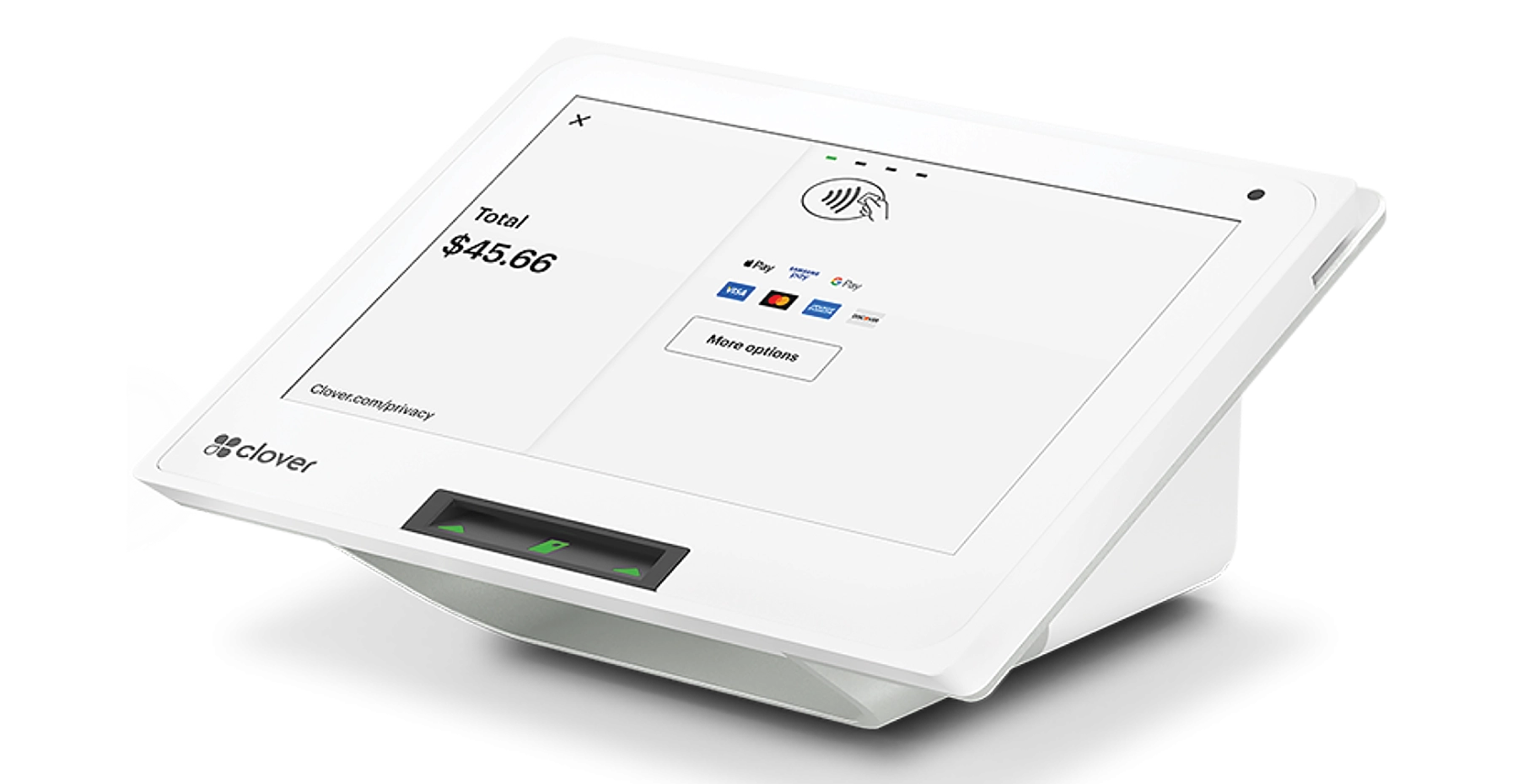
For a brick-and-mortar shop or restaurant, an NFC-enabled terminal is all it takes. A Clover Mini on the counter or a handheld Clover Flex for line-busting and tableside service both accept Google Pay right out of the box, no add-on hardware required. If you’re not sure what your current setup supports, our team can look at your POS devices and tell you in a two-minute conversation whether you’re already good to go or need a quick upgrade.
If you run a retail store, the win is even bigger during peak hours—faster taps mean shorter lines, and shorter lines mean fewer customers who put the item down and leave.

On your phone
No countertop terminal? If you sell at markets, pop-ups, or a customer’s home, you can accept contactless payments—including Google Pay—right on a compatible smartphone. Our rundown on Tap to Pay on Android shows how your phone becomes the reader, with no extra dongle to carry or lose.
Online and on invoices
Selling isn’t only a counter game anymore. If you take orders through a website, send digital invoices, or run a booking page, Google Pay can live there too. On a checkout page it appears as a one-tap button, so a customer shopping on their phone never has to peck out a 16-digit card number with their thumbs—one of the biggest reasons mobile shoppers abandon a cart before finishing. On an invoice, that same effortless tap can be the difference between getting paid tonight and chasing the money next week. Fewer keystrokes almost always means more completed payments, whether the sale happens in your store or on a screen.
Keep the fees from eating the upside
Here’s an honest caveat: accepting any card or wallet payment comes with processing fees, and if you’re not paying attention, those can quietly chip away at your margins. That’s where it pays to work with a processor that’s transparent about pricing. With a Zero Fee Processing program, you can offset most or all of your processing costs, so embracing tap-to-pay convenience doesn’t mean handing your profit to fees. It’s worth understanding your credit card processing fees before you sign anything—knowledge is leverage.
Common Questions About Google Pay
A few things owners ask us most often, answered straight.
“Do I need a special account with Google?” No. You don’t sign up with Google or manage anything on their end. Your payment processor handles it—Google Pay simply flows through your normal merchant account like any other card transaction.
“Is the money slower to arrive?” Not because it’s a wallet. Funds settle on your normal deposit schedule, the same as a tapped or swiped card. The payment method changes; your payout timing doesn’t.
“What does it cost me per sale?” Roughly the same as a regular contactless card payment—there’s no separate “Google Pay surcharge” from the wallet itself. Your effective rate depends on your processing plan, which is exactly the kind of thing a good merchant services partner should make crystal clear. If you want the fine print, our merchant services FAQs cover the common ground.
“What if a customer’s phone is dead?” No problem—Google Pay is an addition, not a replacement. They can still tap a physical card, insert a chip, or swipe. You’re widening the on-ramps to a sale, never narrowing them.
“Will it confuse my staff?” Almost never. From your cashier’s side, a Google Pay tap looks and rings up identically to a contactless card. There’s nothing new to learn and no separate button to hunt for.
The Bottom Line
Accepting Google Pay for business isn’t about chasing shiny technology. It’s about meeting your customers where their hands already are—on their phones—and removing the last bit of friction between “I’ll take it” and “thanks, come again.” Faster lines, tokenized security, fewer lost sales, and happier regulars, all from a capability your terminal probably already has.
The businesses that feel modern and effortless aren’t necessarily spending more. They’ve just cleared the small hurdles that make shopping a chore. A one-second tap is a surprisingly big part of that impression.
That’s exactly what VMS does for small businesses every day. We’ll make sure your Clover setup is ready for Google Pay, Apple Pay, and every tap in between, get your pricing working in your favor, and have you up and running without the runaround. Your customers are already reaching for their phones—let’s make sure your register is ready to say yes.
Have questions about accepting Google Pay?
Fill out the form below and a VMS payment specialist will contact you shortly.