

You had a great week. The door never stopped, the team hustled, the sales report looked like a genuine win — and then payroll cleared and the whole thing quietly evaporated. If that story sounds uncomfortably familiar, the number you are missing is your labor cost percentage: what you actually spend on people, expressed as a share of what you actually sold.
Most owners can recite their hourly wage rates to the penny. Far fewer can tell you their labor cost percentage for last month, and almost nobody watches it week to week. That gap gets expensive fast, because labor is usually the largest controllable cost in a small business — bigger than rent, bigger than inventory in most service businesses, and the only major expense that changes every single day based on decisions you make on a Sunday afternoon.
Here is the encouraging part: this is a fixable number, and fixing it almost never means letting good people go. Let’s walk through what it really measures, what healthy looks like in your industry, and how to bring it down without gutting the team that makes your business worth visiting in the first place.
What Labor Cost Percentage Actually Measures
The math is refreshingly simple. Take everything you spent on people in a period, divide it by total sales for that same period, and multiply by 100.
Labor cost ÷ total sales × 100 = labor cost percentage
Sell $40,000 in a month and spend $12,000 on labor, and your labor cost percentage is 30%. Nothing about the formula is hard. What trips owners up is the top half of that fraction — because the number most people plug in is far too small.
Wages Are Not Your Labor Cost
If you are only counting the hours on the timecard multiplied by the hourly rate, you are looking at maybe two-thirds of the real figure. According to the Bureau of Labor Statistics, employer costs for private industry workers averaged $32.60 per hour for wages and salaries and another $14.01 per hour for benefits as of March 2026 — $46.61 in total compensation. Benefits accounted for 30.1% of what employers actually paid.
Translate that to your shop and the rule of thumb is roughly $1.43 of true cost for every $1.00 of wage. That $18-an-hour cashier is closer to $25.74 once payroll taxes, workers’ compensation, unemployment insurance, and any benefits you offer are stacked on top. Run the numbers on wages alone and your labor cost percentage will look about a third healthier than it really is, which is exactly the kind of comfortable mistake that ends in a confusing month.
A complete labor cost figure includes hourly wages and salaries, overtime, employer payroll taxes, workers’ comp premiums, unemployment insurance, paid time off, any health or retirement contributions, and — the one owners forget most often — your own salary if you draw one. Leaving yourself out of the calculation makes the business look more profitable than it is and makes it much harder to ever hire your way out of a 60-hour week. If you are still building your team, our guide to hiring employees for a small business walks through the true all-in cost of a new hire before you post the job.
What a Healthy Labor Cost Percentage Looks Like
There is no universal target, and anyone who gives you one number for every business is guessing. A jewelry store selling four-figure tickets and a quick-service cafe selling $6 lattes have completely different labor math. What matters is knowing the range for your category and then beating your own previous quarter.
The clearest published benchmarks come from the National Restaurant Association, whose operator survey put salaries and wages, including benefits, at a median of 36.5% of sales for full-service restaurants and 31.7% for limited-service restaurants. Those figures sit well above the 25% to 35% range the industry treated as normal a decade ago, which tells you how much ground has shifted.
| Business type | Typical labor cost percentage | What moves it most |
|---|---|---|
| Full-service restaurant | ~36.5% (industry median) | Front-of-house coverage, overtime, prep hours |
| Quick-service / cafe | ~31.7% (industry median) | Peak-hour staffing, speed of service |
| Specialty retail | Commonly 10–20% | Foot traffic swings, average ticket |
| Salon, spa, barber | Commonly 35–50% | Commission structure, chair utilization |
| Professional and trade services | Commonly 25–40% | Billable vs. non-billable hours |
Use the table as a starting line, not a verdict. A high labor cost percentage is not automatically a problem — a salon running 45% with strong commission-driven revenue per chair can be far healthier than a retail shop running 18% with an empty floor. The number only becomes meaningful when you compare it to your own trend and to your gross margin.
Why Your Labor Cost Percentage Creeps Up Quietly

Almost nobody wakes up to a labor problem. It arrives one half-hour at a time, and there are three usual suspects.
Wages Rise Faster Than Your Prices
Compensation costs for private industry workers rose 3.3% over the twelve months ending in June 2026, with benefit costs climbing 3.8%. If your menu, your service list, or your shelf prices held steady across that same year, your labor cost percentage went up without a single scheduling decision changing. Most owners under-adjust here, which is why raising prices without losing customers is a skill worth practicing before the squeeze arrives.
The Schedule Reflects Habit, Not Demand
Most schedules are copied forward from last week, which was copied from the week before, which was originally built around who was available three summers ago. Meanwhile your actual traffic pattern has drifted. The Tuesday lunch rush moved to Thursday, the after-work wave got an hour later, and nobody rebuilt the schedule around it. Every hour of coverage that does not line up with a hour of sales lands directly in your labor cost percentage.
Overlap and Overtime Nobody Approved
Shift overlap is the most expensive fifteen minutes in retail. Two people clocked in for the same handoff, five days a week, across three shifts is roughly a full extra workday every week. Add unplanned overtime at time-and-a-half and a quiet 2% drift shows up on the P&L as a very loud number.
How to Lower Your Labor Cost Percentage Without Losing Great Staff

This is where most advice goes wrong. “Cut hours” is not a strategy — it is a way to make your best people leave and your service get worse, which lowers sales and pushes the ratio right back up. The durable moves either put the same hours in better places or grow the sales those hours produce.
Schedule Against Your Sales Curve, Not the Calendar
Your point of sale already knows exactly when you make money. Pull sales by hour and day for the last eight weeks and lay your schedule on top of it. Nearly every owner who does this finds at least one fully staffed dead zone and one under-covered rush where they are losing sales to a long line. Moving hours from the first to the second improves your labor cost percentage and your revenue at the same time, without a single person losing a paycheck. Pairing that data with employee management tools that handle scheduling, clock-in, and shift alerts turns a Sunday-night guessing game into a fifteen-minute task.
Remove Steps, Not People
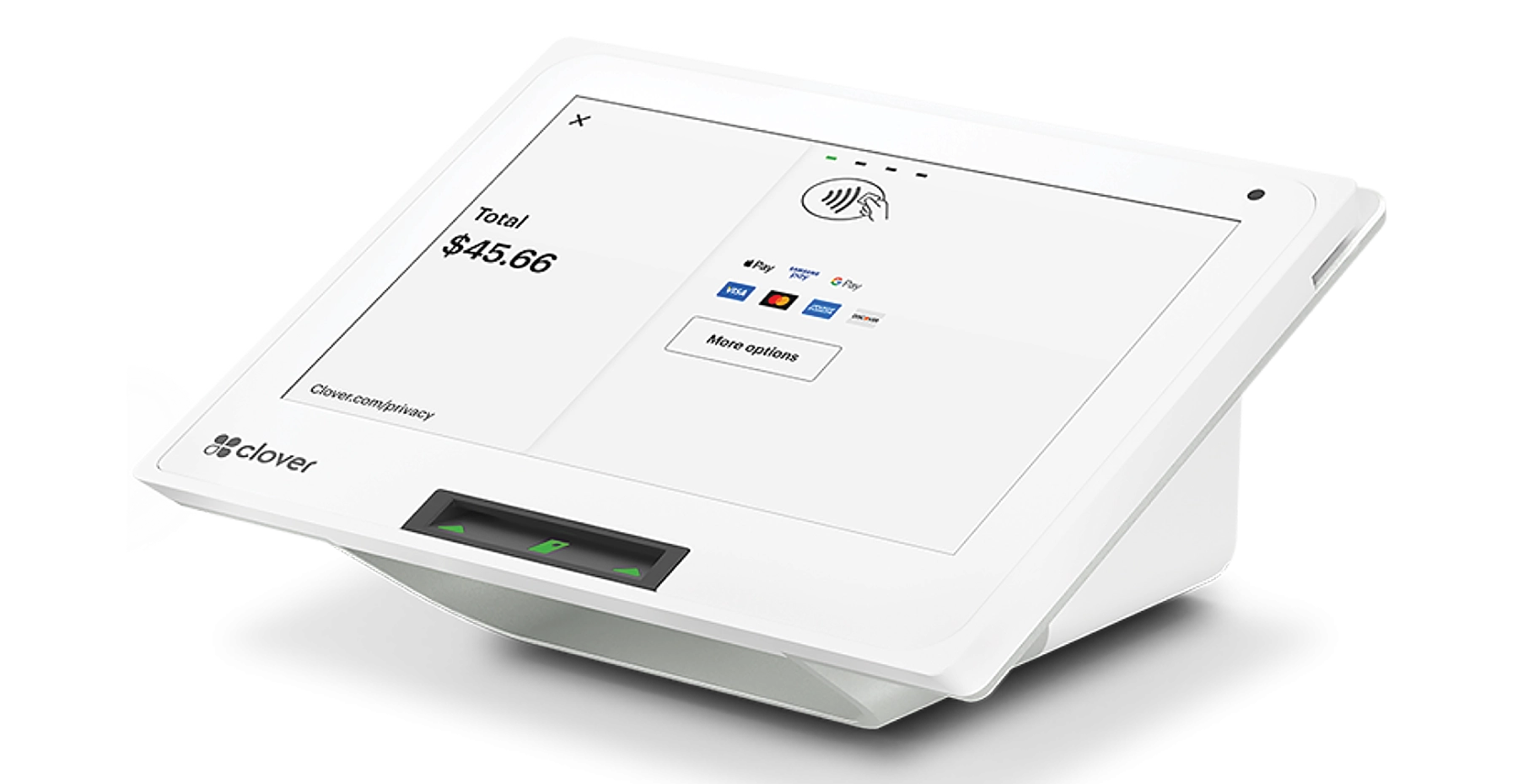
A faster transaction is a cheaper transaction. If checkout takes ninety seconds because the terminal is slow, the modifiers are buried three screens deep, and half the staff still calls you over for a refund, you are paying labor to wait. Modern hardware like the Clover Mini on the counter or a Clover Flex for line-busting and tableside payments takes real seconds off every order, and those seconds compound across a thousand transactions a week. Good POS system training does the same work for free — our full range of POS devices for small businesses is built around getting people through the counter faster.
Grow the Denominator
Remember the formula: labor cost percentage falls just as fast when sales go up as when labor comes down, and growing sales is far better for morale. Nudging average ticket size with prompted add-ons at checkout, running a loyalty program that brings regulars back a fourth time instead of a third, or adding online ordering so a slow Tuesday gets a second revenue stream all shrink the ratio without touching the schedule. Our post on customer retention for small business covers the cheapest version of this: selling more to the people already walking in.
Cross-Train So Coverage Bends
A team where three people can run the register, the floor, and the back is a team you can staff thinner without breaking. Cross-training is the single highest-return investment in labor flexibility, and it costs you a few slow afternoons rather than a payroll line item.
The Cost Sitting Right Next to Payroll
Here is a detail worth sitting with. Owners will spend a full weekend shaving 2% off labor and never once look at the fee line eating a comparable share of every sale that walks through the door. Card processing is not as large as payroll, but it is charged on gross revenue, it compounds every single day, and unlike labor it produces no service, no smile, and no repeat customer.
If you are tightening your labor cost percentage because margin is thin, the honest move is to tighten both sides of the same P&L. Read your statement properly — our breakdown of credit card processing fees shows where the padding usually hides — and then decide whether Zero Fee Processing makes sense for your counter. For plenty of VMS merchants, moving the processing cost off the P&L freed up more monthly cash than an entire round of schedule surgery would have.
And when a genuinely busy season needs more hands than this month’s cash flow can cover, that is a financing question rather than a scheduling one. Merchant working capital exists precisely so a strong quarter is not capped by payroll timing — something cash flow management done well should anticipate rather than react to. Restaurant owners in particular should read this alongside our look at restaurant profit margin, where labor and food cost have to be solved together.
Whether you run a full-service restaurant, a quick-service counter, or a retail floor, the pattern holds: the businesses that keep a healthy labor cost percentage are the ones measuring both sides of the ratio every week instead of once a year at tax time.
Labor is up. Your processing costs do not have to be.
VMS gives you POS reporting that shows exactly where your hours are going, plus a straight quote on processing — usually in one short call.
Or call our team: 888-902-6227
Make Labor Cost Percentage the Number You Steer By
The owners who never get blindsided by payroll are not smarter or luckier. They just check one number every week instead of once a quarter. Pull sales, pull fully loaded labor, divide, and write it down. Four weeks of that and you will spot the drift while it is still a rounding error rather than a crisis.
Your labor cost percentage is a steering wheel, not a scoreboard. It tells you where the hours are going, which shifts are carrying the business, and how much room you actually have to hire, to raise pay, or to open on Sundays. Treated that way, it stops being the number that ruins a good month and starts being the one that lets you grow on purpose.
VMS has been helping small businesses in retail, restaurants, and services make sense of these numbers since 1998 — with POS systems that surface the sales data your schedule should be built on, processing priced without the guesswork, and real humans on the phone when something breaks. Have a look at our merchant services FAQs, browse more small business guidance on the VMS blog, or reach out through VMS support whenever you need a hand. Fill out the form below and we will show you what your numbers look like without the padding.
Have questions about labor costs and processing fees?
Fill out the form below and a VMS payment specialist will contact you shortly.