

Somewhere between the fourth marketing email pitching you a CRM and the second free trial you forgot to cancel, it starts to feel like a real customer database is something you have to go out and buy. A subscription. A migration. Another login for a team that already has too many passwords.
Here is what almost nobody tells a small business owner: if you take cards at a counter, you are already building a customer database. Every tap, dip, and swipe leaves a record behind. The Federal Reserve’s 2026 Diary of Consumer Payment Choice found that credit and debit cards together account for two-thirds of all consumer payments — about 31 of the 47 payments an average person makes in a month. Two out of every three people who walk out of your shop hand you a durable identifier on the way through the door.
Most businesses throw it away. Not on purpose. The data just sits inside a system nobody was ever shown how to open. Let’s find the customer database you already own, decide what belongs in it, and turn it into repeat revenue without adding another monthly bill.
What Customer Database Software Actually Does
Strip away the pricing tiers and the onboarding calls, and every customer database on earth does exactly four jobs.
Identity. It knows that the woman who came in Tuesday is the same woman who came in three weeks ago. History. It remembers what she bought, what she spent, and when. Contactability. It holds a way to reach her that she agreed to. Segmentation. It lets you ask a question — who has not been in since June? — and get a list instead of a shrug.
That is it. Everything else a vendor charges for is packaging around those four jobs. And here is the uncomfortable part for the software industry: a modern point of sale system already does the first two automatically, and will do the third the moment you ask a customer one question at checkout.
Which means the real question is not “what customer database software should I buy?” It is “what is already in my register, and why am I not using it?” Owners who start there tend to discover they were about to pay a hundred dollars a month to duplicate a tool sitting on their own counter.

The Customer Database Your Register Builds While You Ring Up Sales
Every card sale creates a row of data whether you look at it or not. The trick is knowing which parts are useful and which parts you are legally better off never touching.
What one card transaction actually tells you
You do not get a name and address from a swipe, and you should not want one. What you get is better for your purposes and safer to hold: a token that stands in for the card, a timestamp, a dollar amount, and a line-item list of what was purchased. Modern processing replaces the actual card number with a meaningless stand-in — that is tokenization — so your customer database can recognize a returning card without ever storing the number itself.
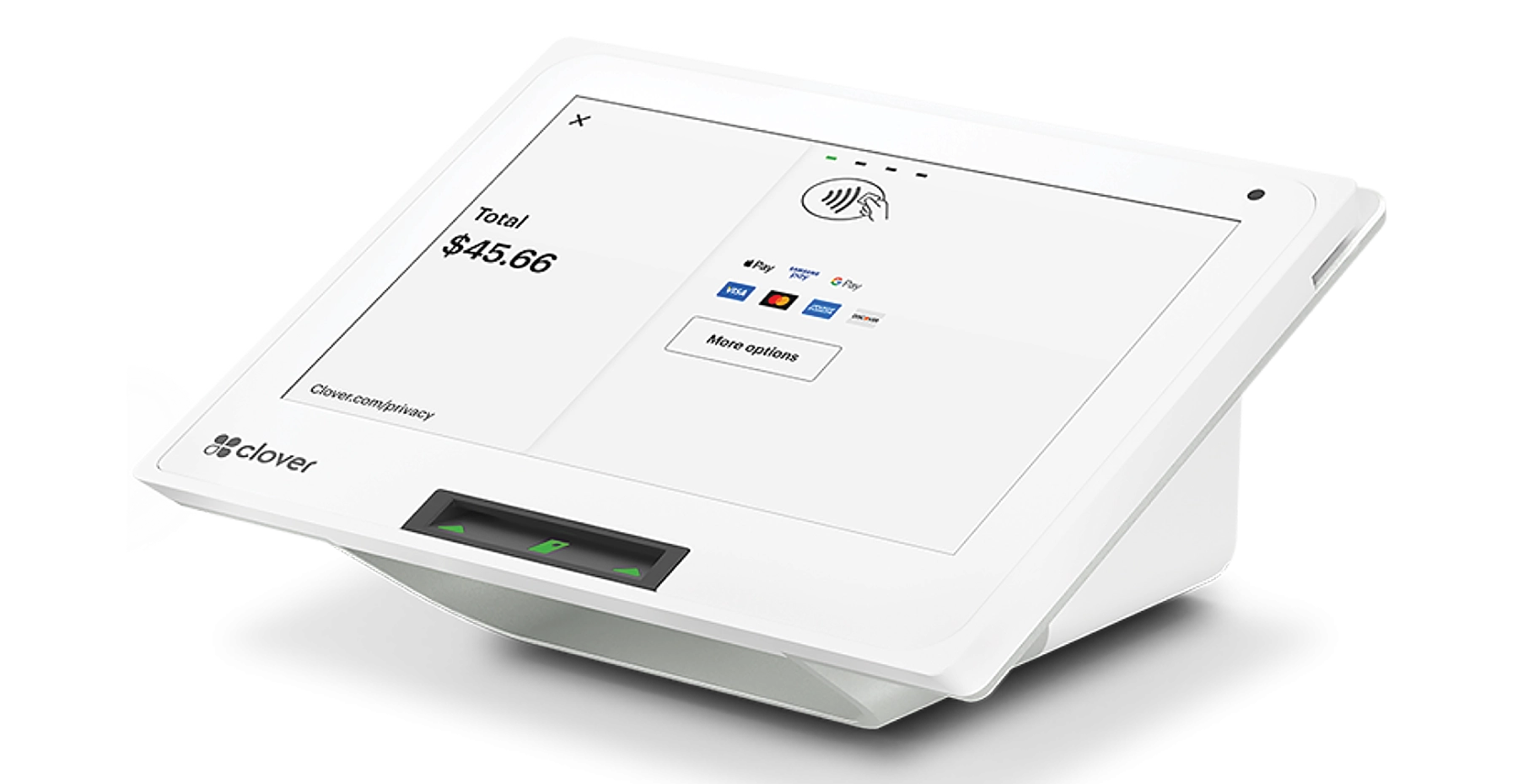
Stack a few months of those rows together and patterns appear on their own. You can see who your regulars are, what your genuine best-sellers are as opposed to the ones you assume are, and how your average ticket moves by day and hour. On a Clover Mini or a Clover Flex, that view is a couple of taps away in the reporting screen — no export, no analyst, no new vendor.
The three fields that do most of the work
You do not need thirty fields. A customer database that earns its keep in a small shop usually runs on three: a first name, one contact method the customer opted into, and purchase history. Name makes the message feel human. Contact method makes it deliverable. History makes it relevant.
The natural place to capture that contact method is the digital receipt prompt. A customer who has just paid and is waiting for a receipt is in the single most cooperative moment of the entire visit. Ask then — “email or text for your receipt?” — and you get an opt-in without an awkward pitch. It is the highest-converting list-building moment most businesses have, and it is free.
One warning worth taking seriously: a receipt opt-in is permission to send a receipt. If you intend to market to that address later, say so plainly at the point you ask, and give people a real way out. Sloppy consent is how a promising list turns into a compliance problem — the same lesson that governs SMS marketing and email marketing alike.
What to Keep on File, and What You Should Never Store
This is the section most guides skip, and it is the one that will save you the most money. Data you do not hold is data that cannot be stolen from you, subpoenaed from you, or turned into a breach notification letter with your name at the top.
The FTC’s rule, in plain English
The Federal Trade Commission’s guide Protecting Personal Information: A Guide for Business gives small businesses five steps, and the second one is the whole ballgame: scale down. Keep only what you need for your business. If you have no legitimate business reason to hold a piece of sensitive personal information, do not hold it.
Applied to a customer database, that translates cleanly. Keep: first name, opted-in email or mobile, purchase history, and a tokenized card reference if you run repeat billing. Do not keep: full card numbers, CVV codes, driver’s license or Social Security numbers, or a photocopy of anything. The FTC also asks you to write down a retention policy — what you keep, how long, and how you dispose of it. For most shops that is a half page, and it is the cheapest insurance you will ever buy.
The same discipline pays off elsewhere. Businesses that hold less card data have less to defend when card-not-present fraud comes calling, and a smaller footprint makes annual PCI paperwork noticeably shorter.
Where privacy law actually lands for a business your size
Twenty states now have comprehensive consumer privacy laws on the books, with new frameworks in Indiana, Kentucky, and Rhode Island taking effect on January 1, 2026. That sounds alarming until you read the thresholds. Indiana and Kentucky apply to businesses handling the personal data of at least 100,000 residents; Rhode Island’s is lower at 35,000, and still far above a single-location shop.
So the honest answer for most VMS customers is that these particular statutes probably do not reach you yet. What does reach you, at any size, is the FTC Act’s prohibition on deceptive practices and your state’s breach-notification law. Translation: you can be small and still be in trouble if you promise one thing and do another, or if you lose data you should not have been keeping. Build the customer database honestly now and the rules stay boring as you grow. This is not legal advice, and a quick call with your own attorney is worth it if you operate across state lines.
Turning a Customer Database Into Repeat Revenue
A list nobody acts on is a spreadsheet with feelings. Here are three segments that any decent customer database can produce, and what to do with each. None of them require a marketing team.

The lapsed regular
Pull everyone who visited at least three times but has not been in for ninety days. These are not strangers — they liked you enough to come back twice, and then life happened. One warm, specific message (“we have not seen you since the spring, here is what is new”) outperforms almost any campaign aimed at people who have never heard of you. Winning back a lapsed customer is the cheapest sale in retail, which is why customer retention beats acquisition on almost every measure.
The top twenty percent
Sort your customer database by twelve-month spend and look at the top fifth. In most small businesses that group is responsible for a startling share of revenue, and in most small businesses they have never once been thanked for it. Early access, a standing perk, a birthday note — the mechanics matter less than the recognition. This is also the group a loyalty program should be built around, rather than around discounts aimed at bargain hunters who leave the moment the discount does.
The single-product buyer
Find customers who have bought exactly one category from you, repeatedly. The salon client who books color and has never had a cut. The retail regular who buys coffee beans and does not know you sell the grinder. They already trust you; they just do not know the rest of the menu. A single message naming the specific thing they buy and the specific thing next to it converts better than any general newsletter, and it costs nothing but the five minutes it takes to write.
Run one of these each month and you are doing more with your customer database than most businesses ten times your size. The tools to deliver the message are ordinary: a gift card offer, a text, a printed line on the receipt itself.
When You Genuinely Do Need Dedicated Customer Database Software
None of this is an argument that standalone customer database software is useless. There are real cases where the register is not enough, and pretending otherwise costs you more than a subscription would.
Buy the dedicated tool when your sales cycle has stages — quotes, follow-ups, approvals — because a POS records a completed sale, not a pending one. Buy it when several people need to log notes about the same customer and hand off between them. Buy it when your customer database has to merge in-person, phone, and web activity into one profile. Service businesses that run on appointments often land here, which is why booking software and a customer database usually arrive together.
What you should not do is buy the second system while the first one sits unopened. Start at the counter, get honest about where the gap actually is, and then spend money on the gap.
| What you need | Where it usually lives | Where it belongs |
|---|---|---|
| Who bought from you | The cashier’s memory | A customer profile in the POS |
| What they bought | Paper receipts and Z-tapes | Transaction history on that profile |
| How to reach them | A sticky note by the register | Opted-in email or mobile on the profile |
| Who to contact this week | Nowhere at all | A saved segment you can pull in a minute |
Put It to Work This Week, Without a Project Plan
You do not need a project plan. You need about an hour, spread over five days.
Open the customer or reporting section of your POS and see what is already there — most owners are surprised. Turn on the digital receipt prompt and write one sentence for your team to say, so everyone asks the same way. Spend fifteen minutes with your staff on it, because a script nobody practiced is a script nobody uses; a short run-through during POS training is enough. Then pull one segment, send one message, and write down what happened.
If your current setup genuinely cannot do any of this, that is worth knowing too — and it is usually a sign the hardware predates the problem. A touch screen POS system that captures customer profiles is not a luxury purchase anymore; it is the difference between a business that knows its customers and one that starts over every morning. The Clover lineup covers a counter, a table, and a truck: a Clover Duo for busy front counters, a Clover Go for markets and mobile work.
And while you are looking at the counter, look at what it costs you to run. Our Zero Fee Processing program lets many businesses offset processing costs entirely, which tends to fund the upgrade that builds the customer database in the first place. If cash flow is the obstacle rather than the will, working capital can bridge it.
Want to see the customer database you already have?
A VMS specialist will walk your current setup with you, show you what your register is already capturing, and price a system that puts it to work. No jargon, no pressure.
Or call our team: 888-902-6227
Your Customer Database Is Already Earning. Go Collect It.
The best customer database software for most small businesses is not the one with the slickest demo. It is the one your team will actually use on a Tuesday afternoon with three people in line — and that is almost always the system already sitting on the counter, doing two-thirds of the job before anyone asks it to.
Every card sale you ran last year left a trace. The businesses that grow steadily are rarely the ones with the biggest ad budget; they are the ones who noticed the same faces coming back and did something deliberate about it. That is what a customer database is for, and you have been building one all along.
VMS has helped small businesses take payments since 1998, and we set up the hardware, the processing, and the customer-facing pieces as one system rather than four disconnected bills. Have a look at the merchant services FAQs, read more on the VMS blog, or meet the team behind it. When you are ready, our support team is a phone call away — and the form below is the fastest way to start.
Have questions about building a customer database?
Fill out the form below and a VMS payment specialist will contact you shortly.