

Ask a garden center owner when their year gets decided and almost nobody says January. They say the handful of Saturdays between the last frost and the Fourth of July, when the parking lot fills by nine and the wagons come back loaded. That compressed window is exactly where a garden center POS system either earns its keep or quietly bleeds money you will never see on a statement.
The scale of this business is bigger than most people outside it realize. The USDA’s 2024 Census of Horticultural Specialties counted 23,060 horticulture operations in the United States selling $18.3 billion in floriculture, nursery and specialty crops. Nursery stock and annual bedding plants topped the list. That is a lot of revenue moving through checkout counters that were, in many cases, designed for a hardware store in 1998.
Here is the part worth sitting with. Trade coverage of the sector describes a business built around a 10- to 12-week spring peak that drives the majority of annual revenue. You do not get a second try. If your checkout stalls on the second Saturday in May, that sale does not reschedule itself for August. It walks out to the parking lot with a full wagon and an empty receipt.
Why the Spring Rush Breaks a Garden Center POS System
Retail checkout was designed around a basket. Garden center checkout happens around a flat cart stacked three levels high with forty-eight cell packs, two shrubs, a bag of soil and a hose nozzle that came from a different department entirely. The person ringing it up has to identify plants by sight, find the right price for a three-gallon versus a seven-gallon of the same variety, and do it while eleven people watch.

Three things go wrong at once during peak weeks, and they compound.
- Lookup time balloons. A cashier hunting through a flat list of 4,000 SKUs to find “Hydrangea, Limelight, #3” adds fifteen or twenty seconds per line item. On a forty-item cart that is ten minutes.
- The line has nowhere to go. Most garden centers have one indoor register and an aisle too narrow for a queue, so the line spills into the retail space and physically blocks the plants people came to buy.
- Your best staff get stuck. The person who actually knows which arborvitae handles clay soil is now bagging fertilizer instead of selling a $600 privacy hedge.
None of that shows up as a loss. It shows up as a slightly smaller number than last year, and everybody blames the weather. Garden Center magazine’s most recent State of the Industry survey found that just 43% of garden centers reported higher spring sales than the year before, the second-lowest share in a decade, with 25% reporting an outright decline. Meanwhile 75% had raised plant prices between 1% and 10%. When you are raising prices and still not growing, the friction between a customer’s decision to buy and their ability to pay is worth auditing hard.
Take Checkout Out to Where the Plants Are
The single highest-leverage change most garden centers can make is refusing to accept that a garden center POS system has to live in one fixed spot. If a customer is standing next to a Japanese maple with a decision already made, the worst thing you can do is ask them to push it two hundred feet indoors and wait behind eleven people to hand you money.
A handheld device solves this cleanly. The Clover Flex is a full register that fits in an apron pocket: it scans, takes chip, swipe and tap, prints a receipt on the spot, and runs off Wi-Fi or cellular so the back forty of your yard is still selling floor. The Clover Go pairs with a phone or tablet for seasonal staff you do not want to hand a full terminal. Either way, checkout follows the customer instead of the other way around. That is the whole argument for a mobile-first garden center POS system.
Mobile checkout also unlocks the situations that used to end in “we will hold it for you.” Loading-zone payment for a truckload of mulch. Curbside for the customer who called ahead. A quick sale at a spring plant fair or a farmers market booth, which works much the same way as it does for the vendors running POS systems at farmers markets. If you have never priced out a portable setup, our overview of mobile payment processing for small business covers the practical differences.
Tap is the other half of the speed story. Contactless payments settle in a second or two and never involve a stuck chip read, which matters enormously when the person paying has soil on both hands. Both Tap to Pay on iPhone and standard contactless cards work on the same hardware, so there is nothing extra to buy.
Living Inventory Is the Hardest Thing Your POS Will Ever Track
Most retail inventory sits still and keeps its value. Yours drinks, grows, outgrows its container, gets root-bound, gets frosted and eventually gets marked down to nothing. A garden center POS system that treats a flat of petunias like a box of screws will lie to you all season.
A few structural things make the difference between inventory data you trust and a spreadsheet you ignore:
- Variants that share a parent. One “Limelight Hydrangea” item with #1, #3 and #7 sizes underneath it, not three unrelated SKUs your cashier has to guess between.
- Category-level reporting. You need to know that perennials were up 14% and shrubs were flat, not just that Saturday did $22,000.
- Fast markdown handling. When the mums go from $12.99 to two-for-$15 at 3 p.m., that has to be one action, not a manual override on every transaction.
- Shrink you can actually see. Plant loss is a real cost of goods, and a system that never records it is quietly overstating your margin all year.
The fundamentals here are the same ones we cover in our guide to small business inventory management and in the broader look at inventory management tools that connect to your register. The difference is the clock: a hardware store can fix its counts in February. You are reconciling stock that changes on its own every week.
The Fee Math Changes When Your Average Ticket Is a Shrub
Garden centers have a ticket-size profile most retailers would envy and most processors quietly love. A $14 hanging basket sits next to a $240 patio order sits next to a $700 install-ready hedge. That spread is exactly where pricing models separate, and where a garden center POS system running on the wrong rate structure quietly gets expensive.
U.S. merchants paid a record $198.25 billion in card processing fees in 2025 according to the Nilson Report, after $187.2 billion in 2024 — roughly $1.57 in fees for every $100 accepted. Those are averages across every merchant in the country. What matters for you is how your particular mix of tickets interacts with your particular rate structure.
Flat-rate pricing charges one percentage plus a fixed cent amount on everything. Interchange-plus passes through the card networks’ actual cost and adds a disclosed markup. On small tickets the fixed per-transaction fee dominates and the two look nearly identical. On large tickets the percentage dominates, and the gap gets loud:
| Typical sale | Flat rate (2.60% + $0.10) | Interchange-plus (approx. 1.90% + $0.18) | Difference |
|---|---|---|---|
| $18 flat of annuals | $0.57 | $0.52 | $0.05 |
| $65 mixed cart | $1.79 | $1.42 | $0.37 |
| $240 patio order | $6.34 | $4.74 | $1.60 |
| $700 hedge or tree order | $18.30 | $13.48 | $4.82 |
Run that across a season. Two hundred large orders a year at a $4.82 spread is roughly $964 — real money for a business whose whole margin is made in twelve weeks. If you have never audited this, start with our breakdown of credit card processing fees and the head-to-head on interchange-plus versus flat-rate pricing. Tracking your average ticket size is the fastest way to know which model actually favors you.
There is also the option of not absorbing the cost at all. Zero Fee Processing shifts the card cost to the transaction itself and lets customers paying cash keep the discount — a model that works particularly well in businesses with a wide ticket range, where a percentage-based fee on a $700 order is genuinely painful.
Seasonal Crews Need Guardrails, Not Trust Falls
In March you might have six people. By the second week of May you have twenty-two, and eleven of them are high school students who started Tuesday. That is not a knock on seasonal staff — it is just the reality of a business that quadruples its headcount for one quarter.
Your garden center POS system is the control layer for all of it. Role-based permissions mean a first-week cashier can ring sales but cannot void a completed transaction or edit a price. Individual logins mean every discount and every refund is attached to a name. Built-in employee management tools handle clock-in, shift reporting and the labor-versus-sales math that tells you whether Saturday was actually profitable or just busy.
The other half is onboarding speed. A system that takes three days to teach is a system you cannot deploy in April. If you want a framework for getting new hires productive fast, our post on POS system training lays out an approach that works when you do not have a spare week, and our notes on running short-staffed cover the rest of the season.
What a Garden Center POS System Should Be Doing in November

The quiet months are not dead time. They are the only stretch of the year when you can actually look at what happened, and a good garden center POS system turns that lull into next spring’s plan.
Pull the reports that matter: which categories carried the season, what your real hourly throughput was on the four biggest Saturdays, which vendors’ stock sold through before Memorial Day and which was still sitting there in July. That data is what turns a spring order from a guess into a decision, and a garden center POS system with real reporting makes pulling it a five-minute job instead of a lost weekend.
The off-season is also when you build revenue that does not depend on weather. Gift cards move well in November and December and bring people back in April with money already spent. A loyalty program gives you a reason to reach repeat gardeners in the shoulder seasons, and it works because your customers genuinely do come back three or four times a year. Adding online ordering for pickup extends the same idea to holiday greenery and winter goods.
And this is the right time to deal with cash flow honestly. Your expenses run twelve months; your revenue runs three. If the gap between paying for next spring’s stock and selling it is what keeps you up at night, merchant working capital is built for exactly that shape of business, with repayment tied to a percentage of daily card volume so it flexes with your season instead of fighting it.
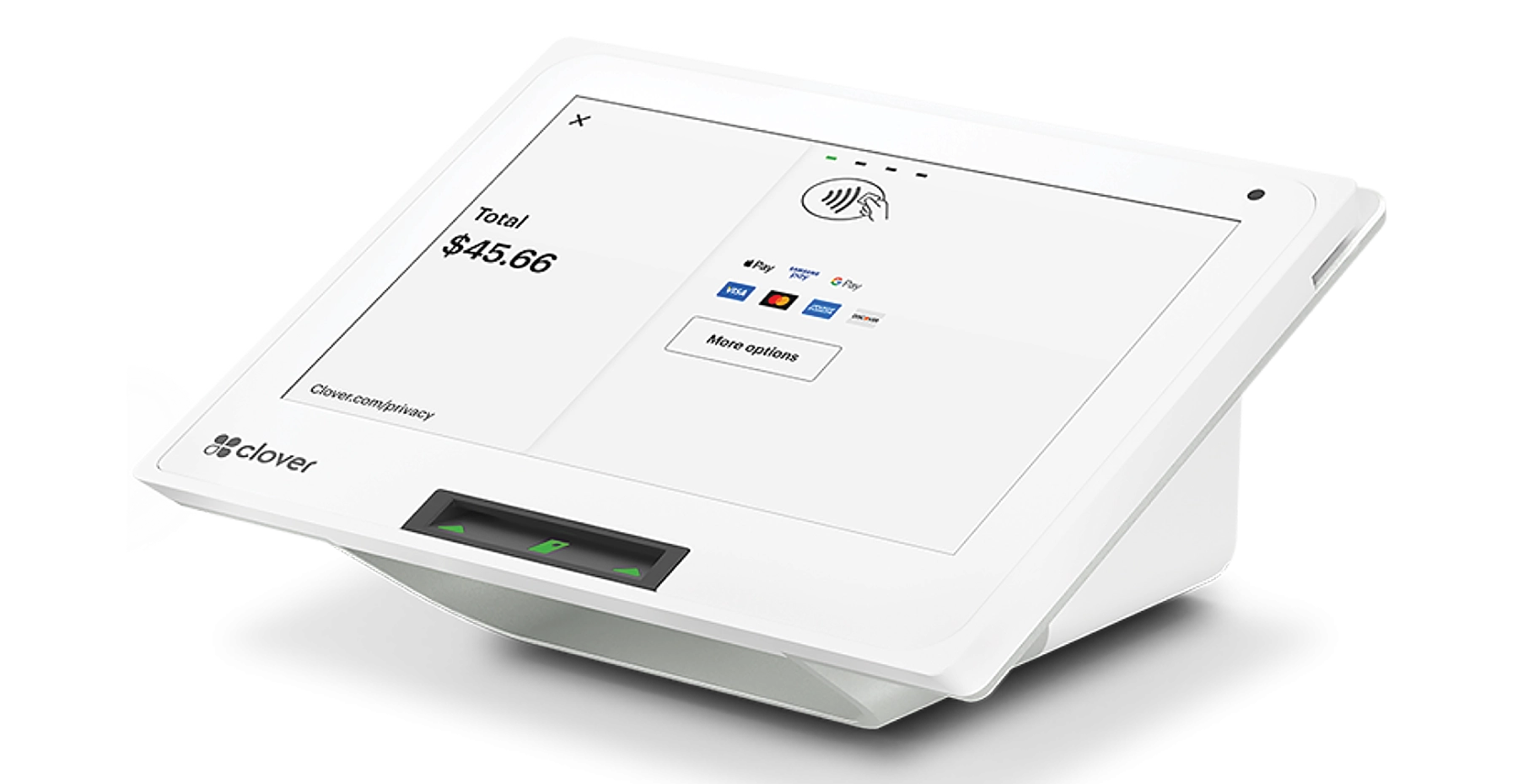
Buying a garden center POS system in the off-season is simply smarter than buying one in a panic in April. You get time to build your item catalog properly, import last year’s data, run a real test weekend and train your returning staff before the first truck of annuals arrives. Nobody has ever regretted having their register sorted out in February. Plenty of owners have regretted the opposite. If you are weighing devices, our rundown of POS devices for small businesses compares the countertop Clover Mini against handhelds, and the Clover Station makes sense for a main indoor counter that also needs a cash drawer and receipt printer. Retailers in adjacent trades — including florists and general retail payment processing — face many of the same seasonal swings.
Ready to fix checkout before next spring hits?
VMS sets up your item catalog, handheld terminals and rates so you are selling in the yard on day one — most garden centers are live in under a week.
Or call our team: 888-902-6227
Get Your Garden Center POS System Ready Before the Frost Lifts
Everything above comes down to one idea: your business gets one short run at the year, and the register is either helping you convert every person who walks the yard or it is standing in the way. A garden center POS system that moves with your staff, understands living inventory, prices your big tickets fairly and tells you the truth in November is not a luxury purchase. It is the difference between a good spring and a great one.
VMS has been helping independent retailers get paid since 1998, and we build your garden center POS system around how your business actually runs — not a generic template. We will look at your current statement, tell you plainly whether your rate structure fits your ticket mix, and get the hardware configured and staffed-up before your season starts. If you want to see how other owners approach it first, our merchant services FAQs answer the questions we hear most, and our support team is there once you are running.
The frost will lift sooner than you think. Let’s have you ready for it.
Have questions about a garden center POS system?
Fill out the form below and a VMS payment specialist will contact you shortly.