

Your best salesperson never takes a lunch break, never puts anyone on hold and never forgets a name. It is not a person. It is your calendar, assuming somebody wired it up properly. Good booking software for small business owners does not just show you who is coming in on Thursday. It catches the customer at the moment they decide to buy, takes their money while they are still enthusiastic, and protects the hours you have already promised away.
Most small service businesses still run it the other way around. The calendar lives on a phone line, in a paper book or in a text thread, and the owner finds out about lost work only when the day looks slower than it should. That gap is expensive and it is measurable. Below is what booking software for small business actually changes, what the no-show numbers look like when you run them honestly, and how a calendar wired into your POS system stops being an appointment list and starts being a revenue engine.
Your Phone Line Is Losing Bookings You Never Hear About
A missed call is invisible in a way a missed appointment is not. Nobody logs it. Nobody mentions it at the end of the shift. A 2024 study by 411 Locals, which placed calls to 85 businesses across 58 industries, found that only 37.8 percent were answered by a live person. Another 37.8 percent went to voicemail and 24.3 percent got no response at all. If that is anywhere near true for your shop, a large share of the people trying to hand you money are hitting a wall.
What happens after the wall is the part that stings. Someone who wants a haircut on Saturday or a brake inspection Tuesday does not leave a voicemail and wait. They tap the next result. Meanwhile you are mid-service with both hands busy, which is exactly when the phone rings hardest. The hours you are most booked are the hours you are least able to book anyone else.

There is a quieter version of the same problem: the hours you are closed. A large share of appointment requests arrive in the evening, on Sunday afternoons and during the commute, the moments when people finally deal with their own to-do list. A phone line answers none of that. Booking software for small business answers all of it and never asks for overtime.
What Booking Software for Small Business Actually Replaces
It helps to be concrete, because the phrase sounds like a scheduling widget and is really a chain of small jobs you do by hand today. When owners evaluate booking software for small business, they look at the calendar view and stop there. The calendar is the least interesting part.
- The phone tag. Three messages back and forth becomes one tap on an open slot.
- The double-booking. Real-time availability means two people cannot both claim 2:00 PM because one called and one texted.
- The reminder nobody sent. Automated text and email reminders go out on a schedule instead of whenever somebody remembers.
- The deposit you meant to ask for. Payment is collected at booking rather than negotiated awkwardly at the door.
- The customer record. Contact details, service history and notes accumulate automatically instead of in one employee’s head.
- The staff schedule. Availability follows who is actually working, which is why booking tools and employee management tools belong in the same conversation.
None of those alone justifies a subscription. Together they are most of a front-desk role. That is the honest case for booking software for small business: not a prettier calendar, but coverage you are not currently paying for. Salons that have gone down this road tend to find the calendar was never the real bottleneck. For a vertical view, our breakdown of the best salon scheduler app and our guide to a salon scheduler app for hair salons walk through the same trade-offs.
Booking Software for Small Business Should Collect Money, Not Just Time
Here is the line that separates a free scheduling link from a tool that pays for itself: does it take payment at the moment of booking? A calendar that only reserves time gives away your most perishable inventory for free. Once 10:00 AM Thursday passes unfilled it is gone. You cannot mark it down and sell it later like a product on a shelf.
Payment at booking usually takes one of three shapes, and the right one depends on your ticket size and your customers. Any booking software for small business worth paying for supports all three.
- A deposit. A fixed amount or a percentage, collected up front and applied to the final bill. Common for anything over an hour of labour.
- Payment in full. Standard for classes, sessions and anything with a fixed price and a hard capacity limit.
- Card on file with a stated cancellation policy. Nothing is charged at booking, but the card is stored and the terms are agreed in advance.
That third option is the one most owners get wrong. Storing a card is a regulated act. Visa’s stored credential transaction framework requires that you disclose the terms and obtain the cardholder’s consent before storing their credential, and that later merchant-initiated charges link back to that original agreed transaction. In plain English: a checkbox stating what you will charge, when and under what circumstances, captured at booking. Do that and a cancellation fee is a documented agreement. Skip it and you have invited a chargeback you will lose.

The mechanics matter less than the fact that money changes hands early. A customer who has put down $25 shows up. A customer who has put down nothing decides all over again on the morning of the appointment, against traffic, weather and whatever came up overnight. This is what most separates booking software for small business from a free calendar link. If you already take payments through payment links or online invoicing, a booking deposit is the same muscle applied earlier in the sale.
The No-Show Math Every Owner Should Run
Healthcare tracks no-shows more rigorously than any other service industry, which makes it a useful benchmark even if you cut hair or rebuild transmissions. MGMA put the median no-show rate for medical groups at 6.81 percent in 2023, close to the 7 percent recorded before the pandemic. A January 2025 MGMA Stat poll of 622 medical group leaders found 42 percent now charge a no-show fee, typically $25 to $50 in primary care, and that 25 percent of practices charging a fee reported attendance improving that year against 16 percent of those that do not.
Run those percentages against your own book rather than accepting them as gospel, because this is the calculation that decides whether booking software for small business pays for itself in month one or month six. The arithmetic is simple and slightly painful.
| Run your own numbers | Example service shop |
|---|---|
| Appointments booked per week | 60 |
| No-show rate | 7 percent, or about 4 slots |
| Average ticket | $150 |
| Revenue walking out the door weekly | $630 |
| Annualised | roughly $32,700 |
| Same math with a $25 deposit and no-shows halved | about $16,400 recovered a year, plus deposits already in hand |
Those last two rows are the whole argument. A deposit does not need to cover the value of the slot. It only needs to make skipping the appointment feel like a decision rather than a shrug. And unlike a fee you chase afterwards, a deposit is money you already hold. We go deeper on the behavioural side in our guide to reducing no-show appointments, which covers reminder timing and cancellation windows.
One caution: be reasonable. A punitive policy on a $40 service costs more in goodwill than it recovers in fees, and customer retention is worth more than any single recovered slot. Match the deposit to the ticket. If your average ticket size is $180, a $25 hold is proportionate. If it is $45, a reminder text is enough.
How Booking Software for Small Business Connects to Your POS
A booking tool living on its own island creates a second set of books. The deposit sits in one account, the final payment runs through your terminal, and at month end you reconcile two systems that disagree. The point of connecting booking software for small business to your point of sale is that a booking, a deposit and a final sale collapse into one record with one customer attached.
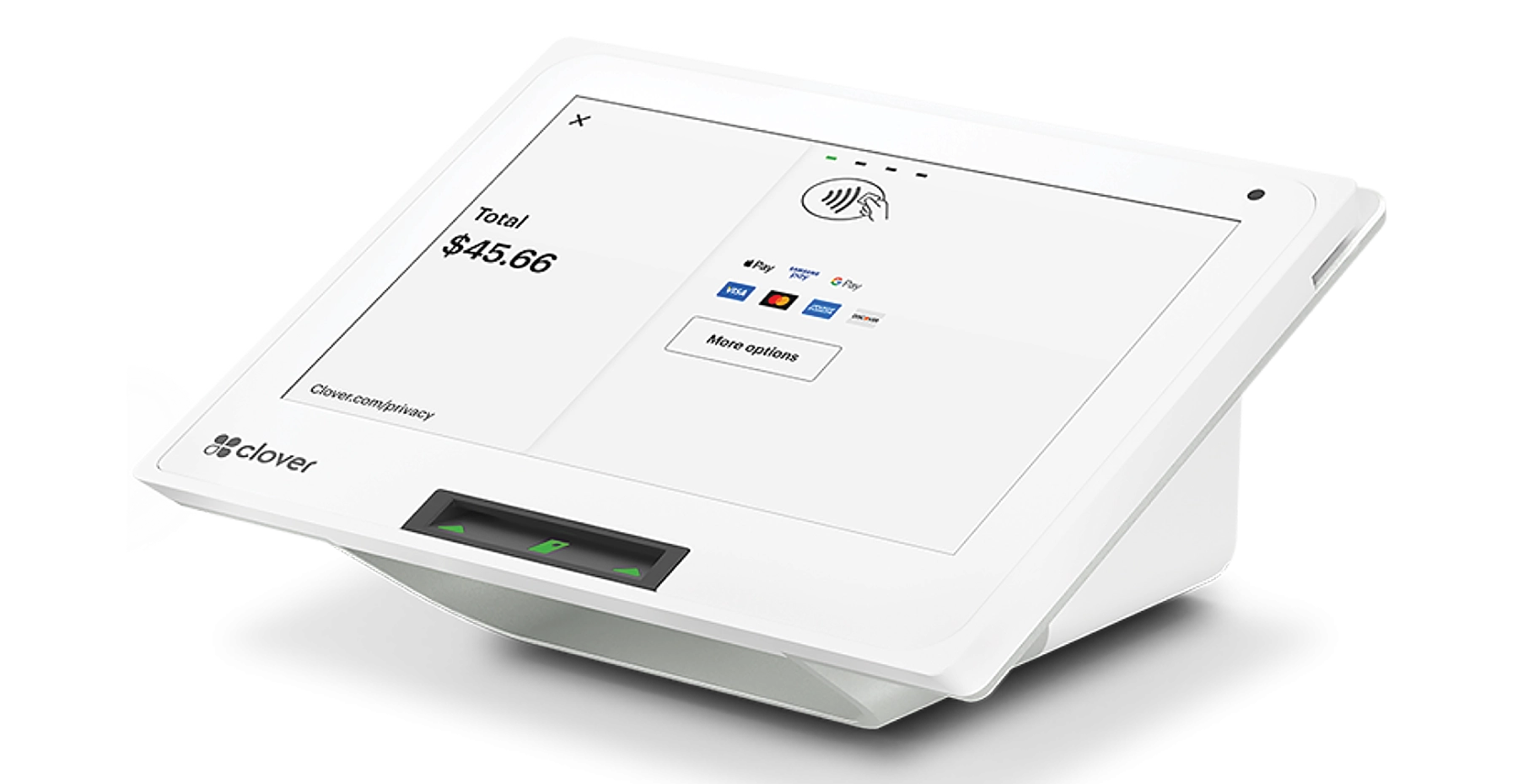
On a Clover setup it looks like this. The customer books online and pays a deposit. The appointment lands on the device your staff already use: a Clover Mini at a front desk, a handheld Clover Flex if you check people out where they stand, or a Clover Go reader if you work out of a van or a rented chair. When the service ends the deposit is already applied and the balance is one tap.
The knock-on benefits are the ones owners notice six months later. Service history attaches to a real customer profile, so loyalty programs and rebooking prompts have something to work with. Staff hours line up against booked demand instead of guesswork. And you learn which service, which day and which team member actually drives revenue, a reporting layer good booking software for small business unlocks almost by accident. If you are still choosing hardware, our notes on Clover POS pricing and total POS system cost are the place to start.
The same logic reaches past appointments. Restaurants apply it to online ordering and subscription businesses apply it to recurring billing. Our walkthrough on building a subscription program with Clover covers that variation. It is the same idea every time: capture the commitment and the payment in a single motion.
What to Check Before You Pick Booking Software for Small Business
Every booking software for small business demos beautifully. The differences surface in month three. When you compare options, push hard on these seven things specifically.
- Does it take deposits natively? Not “integrates with a payment provider” – can it hold a card, charge a deposit and apply it to the final ticket without a manual step?
- Whose processing rate applies? Some platforms force their own payment rail at their own flat rate, which can quietly cost more than your merchant account. Check it against your real credit card processing fees first.
- Does it sync to your POS? One customer record or two sets of books. This decides whether you still like the tool a year from now.
- Are reminders included or an add-on? Text reminders are the highest-return feature in the category, and some vendors price them per message.
- Can you set policy per service? A 15-minute consult and a four-hour job should not carry the same deposit or cancellation window.
- What happens to your data if you leave? Ask specifically whether customer lists and appointment history export in a usable format.
- Does staff availability genuinely work? Multi-provider businesses break cheap tools fast. Test your real roster, not the demo one.
A short honest note. The best booking software for small business is the one your staff will still be using on a bad Saturday. A simpler tool with total adoption beats a powerful one half the team routes around. Our guide to employee management software makes the same argument from the staffing side.
Fees, Refunds and the Boring Parts Worth Getting Right
Three practical details cause most of the friction after you switch booking software for small business on. First, refunds: decide in advance whether deposits are refundable inside your cancellation window, and write it where the customer will actually read it, on the booking page rather than behind a terms link. Second, processing cost: deposits mean more transactions, each carrying its own per-item fee, so a $25 deposit on a $150 job is billed twice rather than once. Usually worth it, but know the number. If card costs are already a sore point, Zero Fee Processing is worth a look.
Third, cash flow timing. Deposits arrive before you deliver, which helps when stocking up for a busy season, though it means part of next month’s revenue has already landed. Owners planning around a seasonal swing pair that with working capital so a booked calendar does not stall waiting on inventory. And if you sell gift cards, confirm they redeem cleanly against a booked appointment rather than forcing a workaround at checkout.
Whatever you choose, keep the flow short. Every extra field is another chance to close the tab, the same principle behind speeding up the checkout process. Name, contact, service, time, card. That is the entire form.
Ready to stop losing bookings after closing time?
VMS connects your booking calendar to Clover and your merchant account so deposits, card-on-file and payouts all agree with each other – usually live within a few business days.
Or call our team: 888-902-6227
Treat Your Calendar Like the Revenue Engine It Is
An empty slot on a Tuesday is not a scheduling inconvenience. It is unsold inventory with a shelf life of one day, and most small service businesses lose several a week without ever seeing an invoice for it. The right booking software for small business closes that gap three ways. It sells while you are closed. It collects money at the moment of commitment. And it turns skipping an appointment into a real decision rather than a free one.
VMS has been setting up payment systems for small businesses since 1998, and we can connect your booking flow to Clover, your merchant account and your deposits so all three agree. Whether you run a salon or spa, an automotive shop or a professional services practice, the setup is the same. Have a question first? Our merchant services FAQs and our support team are both good places to start.
Have questions about booking software and taking deposits?
Fill out the form below and a VMS payment specialist will contact you shortly.