

There is a database most small business owners have never heard of, and it can quietly decide whether you are allowed to accept card payments at all. It is called MATCH, and getting named on the MATCH list is the closest thing merchant services has to a locked door. No letter arrives. No phone call. You usually find out weeks later, when a new processor runs your application and comes back with a polite, unexplained no.
That is what makes this worth twenty minutes of your attention on a slow morning rather than a frantic afternoon. The rules are knowable, the triggers are mostly avoidable, and the handful of businesses that end up stuck are rarely the ones that set out to break anything. Most businesses that land on the MATCH list are ordinary shops that had one terrible quarter, one data breach, or one processor that decided the relationship was not worth the risk.
What the MATCH List Actually Is
MATCH stands for Member Alert to Control High-risk Merchants. It is a database operated by Mastercard, and it holds the names of businesses whose card processing relationships were ended by their acquiring bank for cause. Think of it less as a credit report and more as an industry-wide note in the margin: this merchant was terminated, and here is the numbered reason why.
Every acquiring bank in the Mastercard network is required to check the MATCH list before boarding a new merchant, and required to report qualifying terminations into it. That two-way obligation is what gives the MATCH list its teeth. One processor cannot quietly offload a problem account onto the next one down the street without the next one being able to see it.
A few things about it surprise people. It is not run by a credit bureau, so it will not appear on any business credit report you pull, and it is separate from the aggregator accounts that some small sellers start out on. It is not public, so you cannot search it yourself. And it is not a judgment about whether your business is good or profitable. Plenty of perfectly legitimate shops end up on the MATCH list, which is exactly why the rest of this matters.

Why You Probably Will Not Hear About It First
Nothing about the MATCH list is designed to reach you. Mastercard does not notify you. Your old processor is not required to tell you either, and in practice most do not volunteer it. The rules give the acquirer five calendar days to add a merchant after the earliest of three events: the decision to terminate, receipt of a termination notice, or the moment the bank becomes aware of a qualifying issue. Five days is fast. Your final statement has not even arrived yet.
So the discovery almost always happens in the same way. You shop for a new processor, sign an application, and a week later the answer comes back declined with no useful detail. Sometimes a candid sales rep will say the quiet part out loud. More often you get a form email, and the second and third applications go the same way, and it starts to feel personal.
It is not personal. It is a database lookup. And that distinction matters, because the moment you know what you are dealing with, the problem stops being mysterious and becomes a specific, addressable question: who put me on the MATCH list, under what code, and is it correct?
The Reasons That Catch Ordinary Small Businesses
Acquirers do not get to write a paragraph explaining themselves when they report a merchant to the MATCH list. They pick from a short list of numbered reason codes, and that code follows you. Several of them describe conduct no honest operator will ever go near, including merchant collusion, laundering, and fraud convictions. Those are not the ones to worry about.
The codes that actually catch ordinary shops are duller and much closer to home. Here are the ones worth knowing by name.
| Reason code | What it means | How an ordinary shop gets there |
|---|---|---|
| 04 — Excessive Chargebacks | Disputes climbed past the card network’s monitoring thresholds and stayed there | A viral product with a shaky supplier, a delivery failure, a subscription customers forgot about |
| 05 — Excessive Fraud | Too high a share of your sales were fraudulent card transactions | A card-not-present storefront that got targeted by testers or a reshipping ring |
| 01 — Account Data Compromise | Card data was exposed in a breach involving your systems | A compromised terminal, a hacked ecommerce plugin, an infected back-office PC |
| 12 — PCI DSS Noncompliance | You never completed or maintained PCI compliance | Skipping the annual self-assessment questionnaire year after year |
| 09 — Bankruptcy or Insolvency | The business became unable to cover its obligations | A Chapter filing, or an account left in a negative balance after closing |
| 10 — Violation of Standards | You breached the card network rules in your agreement | Selling something outside your stated business type, or surcharging incorrectly |
Read that table again and notice how few of those require bad intent. A breach is something done to you. A run of chargebacks can come from a single bad supplier. Skipping a PCI questionnaire is the kind of thing that falls off a busy owner’s desk for three years running. That is the uncomfortable truth about the MATCH list: the most common routes onto it are ordinary operational drift, not wrongdoing.
How Long a MATCH List Entry Lasts
Five years. That is the headline number, and it is measured from the date you were added, not from the date the underlying problem was resolved. Fix the chargebacks in month two and the listing still runs its full term. There is no good-behavior discount and no automatic early review.
Five years is long enough to matter enormously. It is longer than most small business leases, longer than the average small business loan, and considerably longer than most owners plan anything. In practical terms a MATCH list entry means you will struggle to open a standard merchant account for the better part of a business cycle.
What you are usually left with is the high-risk market. It exists, it is legitimate, and it will take you. It also costs more. Expect higher rates, a rolling reserve holding back a slice of every batch, longer funding times, and a contract with far less give in it than the one you had. Compare that against the processing fees you pay today and the gap is sobering. If you want the full picture of what that market looks like from the inside, our guide to what a high-risk merchant account involves covers it honestly.
There is a second cost that is easier to miss. Payment disruption is rarely just a payments problem. It is a cash flow problem, a payroll problem, and occasionally a landlord problem. A shop that cannot take cards for three weeks while it scrambles for a new processor loses far more than the processing fees it was arguing about.
Getting Off the MATCH List Is Harder Than Getting On
Here is the part that catches people. You cannot appeal to Mastercard. There is no merchant-facing hotline, no online dispute portal, no form to submit. Mastercard operates the database, but it does not adjudicate who belongs in it.
Only the acquiring bank that put you on the MATCH list can request a removal or a correction. That is the entire universe of options, which means the company you just parted ways with, possibly badly, is also the only company that can undo this. Deep breath.
The removal paths that actually exist
The clean one is error. If the acquirer added you in error, it can report that and the listing comes out. This is not as rare as it sounds. Mistaken identity, a wrong legal entity, a code applied to the wrong side of a dispute, a listing entered after a termination that was later reversed. If you genuinely believe the listing is wrong, say so in writing, in detail, with documents.
The other real path is reason code 12. If you were listed for PCI DSS noncompliance, the acquirer can remove the listing once it verifies you have achieved full compliance. That is a rare case where the door actually reopens on merit, and it is a strong argument for treating PCI compliance as a live task rather than paperwork. The FTC’s own guide to protecting personal information is a sensible plain-English place to start on the data-handling side.
How to approach the acquirer
Be boring and be organized. A MATCH list inquiry goes to the risk or compliance department rather than your old sales rep. State the legal entity name, the merchant identification number, and the approximate termination date. Ask two specific questions: was my business reported to MATCH, and under which reason code? Then make your case in writing with evidence attached.
Keep the tone flat. You are asking a risk department to revisit a decision, and risk departments respond to documentation, not frustration. If the amounts involved are significant, a lawyer who specializes in payments disputes is a reasonable investment, though be wary of anyone who guarantees removal. Nobody can guarantee that.

Staying Off the MATCH List Is the Only Reliable Strategy
Given all of the above, the honest advice is prevention. The good news is that the two most common routes onto the MATCH list are both measurable, which means you can watch them the same way you watch any other number in the business.
Watch your chargeback ratio like a gauge
Chargebacks are the number one route onto the MATCH list, and the card networks publish the thresholds. Under Mastercard’s Excessive Chargeback Program, a merchant enters the Excessive Chargeback Merchant tier at 100 to 299 chargebacks in a month combined with a chargeback-to-transaction ratio between 1.5 and 2.99 percent. The higher tier starts at 300 chargebacks and a ratio of 3 percent or more, and the penalties escalate from there. J.P. Morgan publishes a clear merchant guide to the program if you want the mechanics from an acquirer rather than a blog.
Two things follow from those numbers. First, the ratio and the count both have to trip, so a small shop with a handful of disputes on low volume is usually fine. Second, the thresholds are lower than most owners assume, and Visa runs its own monitoring program in parallel with its own numbers. One and a half percent is fifteen disputes in a thousand sales. If you are anywhere near that, treat it as an alarm, not a statistic.
Most disputes are preventable with unglamorous habits: a clear billing descriptor customers recognize, a refund policy you honor faster than the bank would, a hard look at return abuse, order confirmations that actually arrive, and answering the phone. The scale of the problem is not small either, as our look at chargeback fraud across the industry shows. Our breakdown of why customers file chargebacks and the longer playbook on how to prevent chargebacks both go deeper than there is room for here.
Close the fraud and data gaps
Excessive fraud is the other big door. If you sell online or take orders by phone, the exposure is structurally higher, which is the whole subject of our piece on card-not-present fraud. Address verification, card security codes, 3-D Secure on higher-value orders, and a hard look at any order that wants overnight shipping to an address that does not match the card will handle most of it.
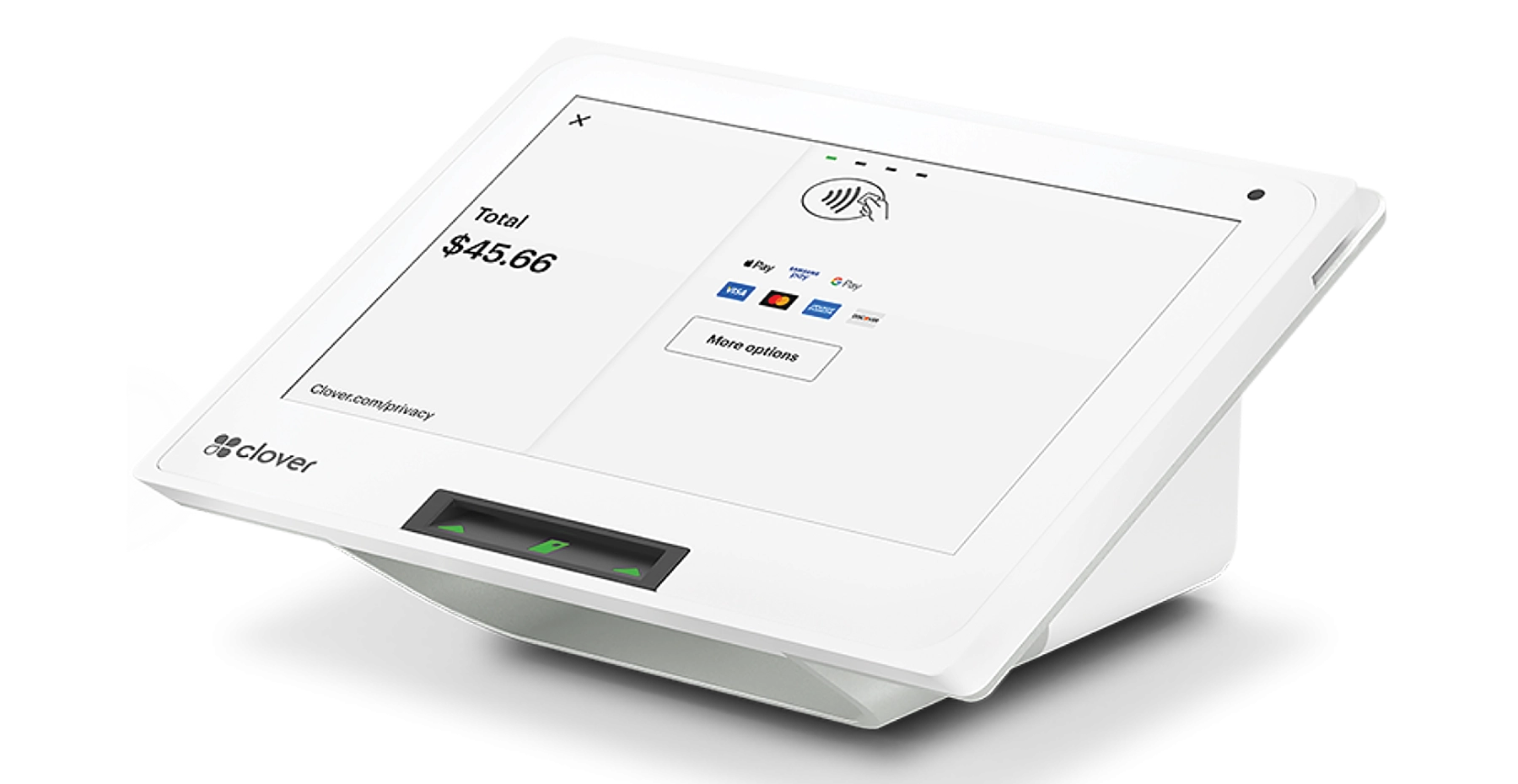
On the data side, the single most effective step is to stop storing card numbers anywhere. Modern terminals like the Clover Mini and the Clover Flex tokenize the card at the point of capture, so there is no usable card data sitting on your network to lose. You cannot leak what you never held.
Do not let the account go quiet on you
Two administrative habits prevent a surprising share of terminations. Keep your merchant application current: if you change what you sell, add an online ordering channel, or start shipping nationally, tell your processor first. This catches retail shops constantly. Selling outside your stated business type is a textbook standards violation. The same goes for the behaviors that trigger account holds and freezes and the rest of your onboarding paperwork, which our walkthrough of the merchant account application explains in plain terms.
And never leave a closed account in a negative balance. An unresolved debit after you walk away is one of the quietest routes onto the MATCH list there is, and one of the easiest to avoid. Settle the final statement, in writing, and keep the confirmation.
What to Do If You Think You Are Already Listed
Work through it in order. Panic is understandable and unhelpful.
- Ask directly. Contact your former acquirer’s risk department in writing and ask whether you were reported and under which reason code.
- Get the paperwork. Pull your termination letter, final statements, dispute records and any correspondence, and review what actually triggers holds and freezes. You will need dates.
- Fix the underlying issue anyway. Even if removal is not available, a documented fix is what makes the next conversation possible.
- Be honest with the next processor. Disclose it up front. An underwriter who finds a MATCH list entry you did not mention will decline on principle.
- Expect to pay more for a while, and plan the cash flow around it. A working capital facility can bridge the gap if a reserve is holding back part of your deposits.
- Keep records of everything from here forward. In five years you will want to show a clean file.
That fourth point deserves emphasis. Disclosure changes the conversation completely. An underwriter looking at a MATCH list entry you volunteered, with a written explanation and evidence the problem was fixed, is evaluating a business. An underwriter who discovers the same entry after you implied there was nothing to find is evaluating your honesty, and that decision is much easier for them to make.
Worried about your merchant account?
VMS watches your dispute ratio, sorts out PCI, and gets you set up with a processor that calls you before there is a problem.
Or call our team: 888-902-6227
Keep the Account Boring and Keep Processing
Nobody sets out to land on the MATCH list. The businesses that do are usually the ones that stopped watching a number, skipped a form, or stayed with a processor that would not pick up the phone when things got complicated. A MATCH list entry rarely requires bad luck so much as inattention, which is genuinely good news, because inattention is fixable.
The best defense is a processor that treats your dispute ratio as their problem too. At Velocity Merchant Services we have been setting up small businesses since 1998, and a real part of that job is the unglamorous side: watching the ratios, flagging a bad month early, sorting out PCI before it becomes a reason code, and making sure the hardware on your counter is doing the security work so you do not have to. If your current provider has never once called you about a chargeback trend, that is worth noticing.
If you are shopping for a new processor, already listed and trying to find a way forward, or simply want someone to look at your account before it becomes a problem, we are happy to take a look. Our merchant services FAQs answer the common questions, the VMS support team is there when something breaks, and a short conversation now is a great deal cheaper than five years of locked doors. Have a look at Zero Fee Processing or the rest of the VMS blog for more on keeping your processing clean and your costs down.
Have questions about the MATCH list or your merchant account?
Fill out the form below and a VMS payment specialist will contact you shortly.